
CANN: Efficiently Navigating Context and Connection in Social Networks
Context-Aware Nearest Neighbor Query on Social Networks
This paper introduces the Context-Aware Nearest Neighbor (CANN) query for social networks, which identifies the closest node to a query source matching a specific set of keywords. The authors propose a Hyper-Graph Index (HGI) structure to provide efficient, high-performance approximate results (ACANN) in large-scale social graphs.
TL;DR
Navigating modern social networks requires more than just finding a "person"; it requires finding the right person at the minimum social distance. This paper proposes the Context-Aware Nearest Neighbor (CANN) query and an efficient Hyper-Graph Index (HGI) to solve this. By partitioning the network around high-degree "hubs" and using signature-based keyword filtering, the authors achieve massive speedups in query time with minimal sacrifice in path accuracy.
Problem & Motivation: The Discovery Needle in the Social Haystack
In a social network like Facebook or LinkedIn, you might want to find the nearest "Data Mining Professor." Existing solutions fall into two failing camps:
- Shortest Path First (SPA): You search layer by layer by distance. You find the closest people, but none of them are professors in your field, wasting computational cycles on irrelevant nodes.
- Information Retrieval First (IR): You find all professors first. However, in a network of millions, there might be thousands of them. Calculating the shortest path to every single one to find the "nearest" is computationally prohibitive.
The authors' insight is grounded in the Power Law distribution of social networks: a few "influencers" or "hubs" connect the majority of the population. By treating these hubs as gateways, we can simplify global search into local lookups and hub-to-hub hops.
Methodology: The Hyper-Graph Architecture
The proposed Hyper-Graph Index (HGI) construction follows a three-step pipeline:
1. Hub Identification and Partitioning
The system identifies "center nodes" using Degree Centrality. These hubs are the most connected individuals. The rest of the graph is partitioned based on the nearest center node, effectively creating "local neighborhoods."
2. The Signature Map (Pruning Context)
To avoid checking every node in a partition, each hub stores a Signature Map. Keywords of local nodes are hashed into bit strings and superimposed (OR-ed).
- How it works: If a query's signature AND-ed with the hub's signature doesn't match, the entire partition is skipped. This is a classic false-positive-only filter that is extremely fast.
3. Hyper-Graph Formation
A higher-level graph is built where "nodes" are the centers and "edges" are shortest paths between adjacent centers.
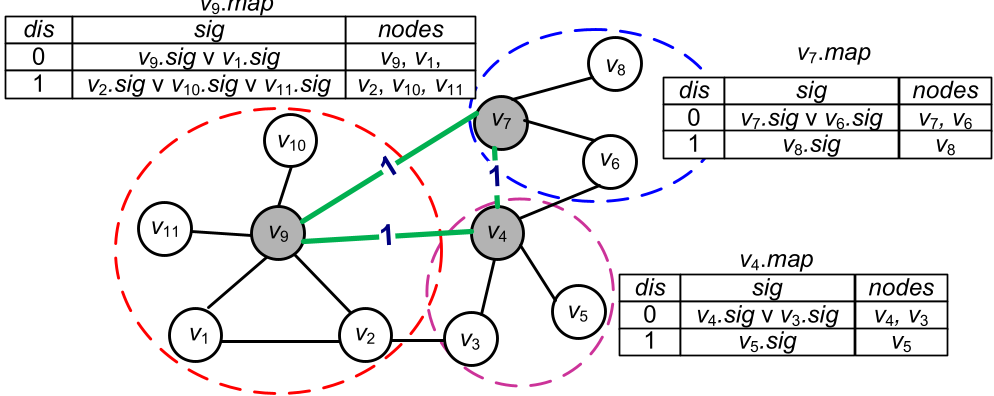 Figure: The Hyper-graph treats centers as a skeleton for the full network.
The ACANN Search Algorithm
The algorithm performs a two-stage search:
- Local Search: Check the query node's own partition.
- Extended Search: Use a priority queue to explore neighboring partitions via the Hyper-Graph. It uses the distance to the center plus the internal "signature map" distance bounds to prune any partition that couldn't possibly contain a closer node than the current best candidate.
Experiments & Results
The researchers tested HGI on the DBLP (co-authorship) and MyGamma (social service) datasets.
- Performance vs. Accuracy: The HGI method achieved an approximation ratio of ~1.3. This means if the true shortest path is 3 hops, HGI might find a 4-hop path—a negligible difference for most social applications.
- Storage Efficiency: HGI is incredibly "lean," requiring less than 5% additional storage over the base graph, whereas "All-Pairs Shortest Path" methods (AllPath) explode in size as the graph grows.
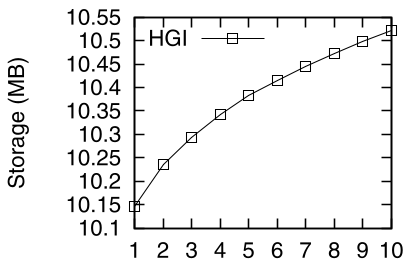 Figure: Performance metrics showing HGI scaling gracefully with dataset size compared to AllPath.
Critical Analysis & Conclusion
Takeaway
The CANN query fills a vital gap in social searching. By combining graph theory (the Hyper-Graph) with information retrieval (Signatures), the authors created a system that is practical for real-world deployment where sub-second response times are mandatory.
Limitations
- Dynamic Graphs: The paper focuses on static snapshots. In real social networks where edges appear/disappear constantly, re-partitioning and updating signature maps could be costly.
- Approximation Gap: While 1.3x is good, in very sparse graphs, the "center-must-be-on-the-path" assumption might lead to significant detours.
Future Work
The next logical step is extending this to dynamic graphs or integrating semantic similarity (e.g., finding "Data Science" when searching for "Machine Learning") rather than strict keyword matching.