
Context-Aware Crowdsourcing: Turning Social Networks into Complex Problem Solvers
4460_Context-Aware Reliable Crowdsourcing in Social Networks.
This paper proposes a "Context-Aware Reliable Crowdsourcing" approach that leverages social networks to handle complex tasks. It introduces a mechanism where principal workers autonomously recruit assistant workers from their social circles, optimizing for skills, reputation, and communication costs.
TL;DR
Current crowdsourcing (like Amazon Mechanical Turk) is great for labeling images but fails at complex engineering or rescue tasks. Why? Because requesters have to break tasks down themselves, and "strangers" in a crowd can't be trusted. This paper introduces a framework where workers use their own social networks to find partners and build trust, shifting the burden of task management from the requester to the crowd's natural social structure.
The Motivation: Why Crowdsourcing Simple Tasks Isn't Enough
Traditional crowdsourcing is stuck in the "Microtask" era. If you have a complex task—like delivering earthquake relief supplies requiring a driver, a guide, and porters—a requester shouldn't have to find each person individually.
The authors identify two massive bottlenecks:
- The Decomposition Burden: Requesters hate having to split big tasks into tiny subtasks.
- The Malicious Crowd: Reliability is usually achieved by "Redundancy" (asking 5 people and taking the majority vote). But if 60% of the crowd is malicious or lazy, the system breaks.
The Insight: Workers aren't isolated islands. They are connected via Facebook, Twitter, and LinkedIn. By utilizing these Contexts, a system can evaluate a worker not just on what they know, but on what their friends know and how much their friends trust them.
Methodology: The Power of Context
The core of the paper is the Contextual Crowdsourcing Value (Cv). Unlike standard rankings, Cv looks at:
- Self-Skills: What can you do?
- Contextual Skills: What can your reachable social network do?
- Relational Trust: How likely are your friends to help you (based on historical "credit")?
1. Task Allocation
In a Simplex Network, the system selects a "Principal Worker" with the highest Cv. This worker acts as the project manager. In a Multiplex Network (where people are connected via different layers like "Work," "Family," or "Interests"), the algorithm prioritizes layers where the density of expertise is highest.
2. Autonomous Execution
Once assigned, the principal worker doesn't work alone. They build a Coordination Tree using a Breadth-First Search (BFS) through their social links to recruit "Assistant Workers."
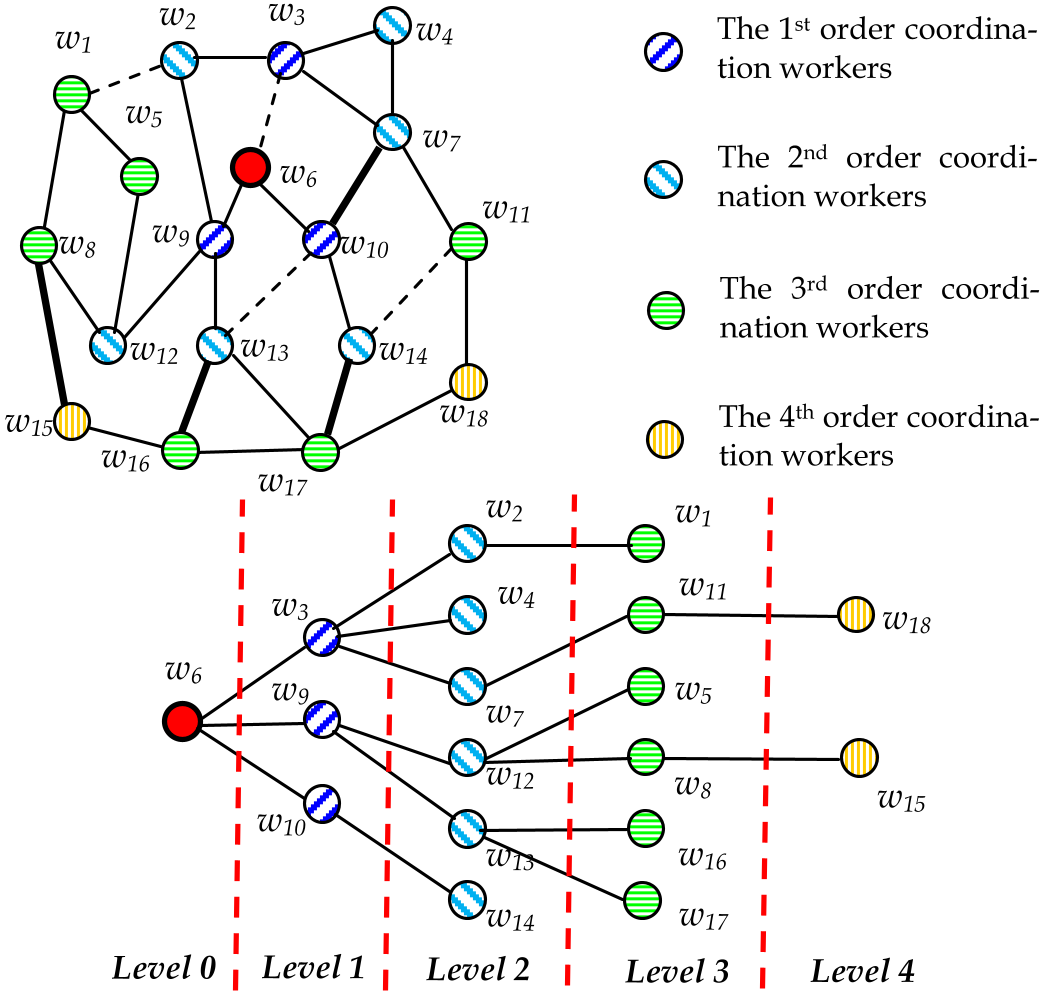 Figure 1: The Coordination Tree mechanism where an assigned worker (w6) recruits assistants through different types of social links.
Experiments: Proving the Value of "Friends"
The researchers validated their model using a real-world dataset from Freelancer combined with Facebook's social graph.
Key Finding 1: Higher Success in Complexity
As the number of required skills per task increases, traditional "straightforward" allocation fails (dropping to zero success) because it's impossible to find one person who knows everything. The Context-Aware approach remains stable because it leverages the "team" potential of the social network.
Key Finding 2: Reputation is Contagious
One of the most innovative parts of this study is how it handles reliability. Even if a worker is new (no history), they can "borrow" reputation from their social context.
 Figure 2: Accuracy differences. The reputation mechanism (z-axis) shows massive gains specifically when the proportion of unreliable workers (y-axis) is high and budgets (x-axis) are low.
Critical Insights & Future Outlook
The "Social Network" approach effectively solves the Inductive Bias problem in task allocation—it assumes that developers hang out with developers, and drivers know guides.
Limitations:
- Static Networks: The paper assumes social links don't change. In reality, people make new friends and block old ones constantly.
- Privacy: Relying on social network context requires access to private connection data, which remains a hurdle for public platforms.
Conclusion: This research marks a transition from "Crowdsourcing" (hiring a crowd of strangers) to "Groupsourcing" (hiring a social ecosystem). For future platforms, the "Context" will be just as important as the "Resume."
Senior Editor's Note: This work effectively proves that the 'social graph' is not just for ads; it is a computational resource that can solve NP-hard coordination problems.