
Towards Context-Aware Social Recommendation: Navigating Trust and Context
Towards Context-Aware Social Recommendation via Trust Networks
The paper introduces CASR (Context-Aware Social Recommendation), a novel framework that integrates trust networks and contextual information into recommendation systems. By constructing multi-dimensional trust vectors on top of social networks and utilizing Factorization Machines (FM), the model achieves SOTA performance, outperforming baselines like SoReg and TrustWalker by significant margins.
TL;DR
The paper presents CASR, an advanced recommendation framework that bridges the gap between social networks and contextual awareness. By modeling trust as a multi-dimensional vector rather than a single edge weight and using Factorization Machines to fuse non-social contexts, it significantly mitigates noise and data sparsity in social recommendation.
Contextual Position: This work moves beyond simple social regularization (SoReg) and basic trust propagation (TrustWalker) by introducing a hybrid "Filter-then-Predict" pipeline that utilizes both categorical and continuous contexts.
The Problem: The "Heterogeneity" Blind Spot
Most current social recommenders operate on a flawed assumption: if you follow someone, you share their tastes across all domains. In reality, friendships are diverse. You might trust a colleague for professional book recommendations but ignore their taste in horror movies. Prior works often:
- Ignored context: Failing to see how time, location, or item categories influence a recommendation's relevance.
- Lack of Refined Filtering: Using all available social ratings, which introduces "social noise" from non-expert friends.
- Data Sparsity: Failing to reach beyond immediate "first-hop" friends to find high-quality data.
Methodology: Trust Networks & Factorization Machines
The CASR approach is a sophisticated interplay of graph theory and latent factor modeling.
1. Context-Aware Trust Construction
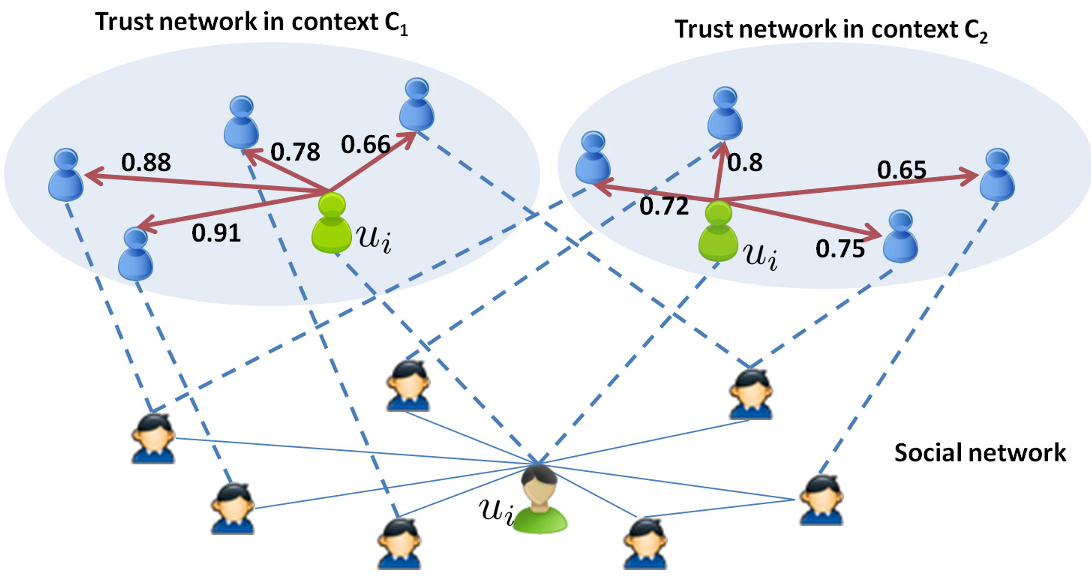
Instead of a binary "follow," the authors build a trust network where the weight is context-dependent. They use Pearson Correlation Coefficient (PCC) to measure taste similarity on items rated in specific categorical contexts (e.g., "Books").
2. Random Walk for Relevant Rating Collection
To combat sparsity, the model doesn't just look at a user's friends. It performs a Random Walk to find "trustworthy neighbors" up to a specific depth (optimal at ). The probability of moving to a neighbor is proportional to the trust score, ensuring that the "rating pool" collected is highly relevant to the target user's current situation.
3. Factorization Machines (FM) Integration
Once the relevant ratings are gathered, they are fed into a Factorization Machine. Unlike standard Matrix Factorization, FMs model the interactions between all features (User, Item, and Continuous Contexts like "Average Rating" or "Time").
The prediction formula for 2nd-order FM is:
This allows the model to handle sparse interaction data by factorizing the weights of feature overlaps.
Experiments and Results
The authors tested CASR on a real-world dataset from Douban, covering Books, Movies, and Music.
Key Findings:
- Optimal Hops: Performance peaks at 3 hops. Going further () introduces "distant noise" which degrades MAE and RMSE.
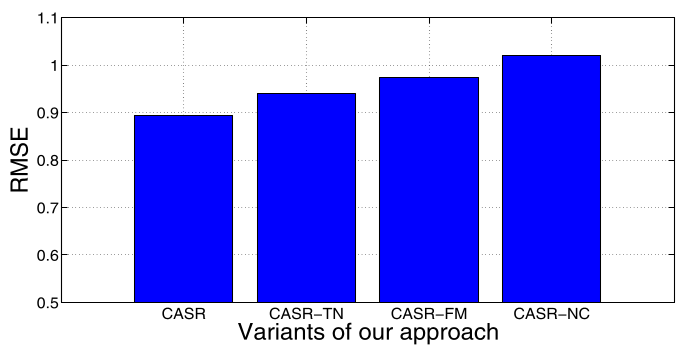
- Context Selection: Using statistical tests (, ANOVA) to select the top 5 relevant contexts performed significantly better than using all available contexts, proving that irrelevant context acts as noise.
- Performance Leap: CASR outperformed the standard Social Regularization (SoReg) and pure Factorization Machines (FM) across all training data ratios (40% to 80%).
Critical Analysis & Conclusion
Takeaway: CASR effectively proves that social information is only useful when filtered through a context-aware trust lens. The transition from "Social Network" to "Trust Network" is the core innovation here.
Limitations:
- Computational Overhead: Performing random walks for each user-context pair may be expensive in real-time systems.
- Cold Start: While it uses social ties, a user with zero friends and zero ratings still poses a challenge (the "Cold-Start" issue), which the authors acknowledge is not the primary focus of this work.
Future Outlook: The "decentralized" potential of this model is fascinating. Since data is collected along trust paths, it provides a blueprint for P2P recommendation systems where a central server doesn't need to hold the entire global rating matrix.