
Contask: Enhancing Mobile Crowdsourcing via Context-Aware Task Distribution
Context-Aware Task Distribution for Mobile Crowdsourcing
The paper presents a context-aware approach for task distribution in Mobile Crowdsourcing (MCS) to improve task completion rates. It introduces a conceptual task model based on five contextual categories (individuality, time, activity, relation, and location) and a prototype system called "Contask" which uses real-time sensor data and social APIs to match tasks with suitable workers.
TL;DR
Mobile Crowdsourcing (MCS) often fails when tasks are sent to the wrong people at the wrong time. This paper introduces a Context-Aware Task Distribution framework that uses smartphone sensors and social data to ensure tasks—like reporting parking availability or safety—are only delivered to users whose current "context" (location, activity, or social circle) makes them the perfect candidates.
The Problem: The "Mismatch" in the Crowd
Most Crowdsourcing Systems (CS) operate on a self-selection or random assignment basis. This leads to two critical failures:
- Information Overload: Workers are buried under irrelevant tasks.
- Low Quality/Incompleteness: A student in a library shouldn't be asked to rate parking lot occupancy 500 meters away.
The authors argue that "context" is the missing link. Without knowing the worker's current situation, the system cannot effectively match the task subject to the user's immediate capabilities.
Methodology: The Conceptual Task Model
The authors define context through five dimensions originally suggested by Zimmermann:
- Individuality: Device status (battery, sensors) or user profiles (student, staff).
- Time: Specific intervals (e.g., during exam week).
- Activity: What the user is doing (walking, attending a specific class).
- Relation: Social connections (e.g., tasks visible only to friends of the requester).
- Location: Physical proximity to the task.
System Architecture
The proposed architecture bridges the gap between raw sensor data and the application layer:
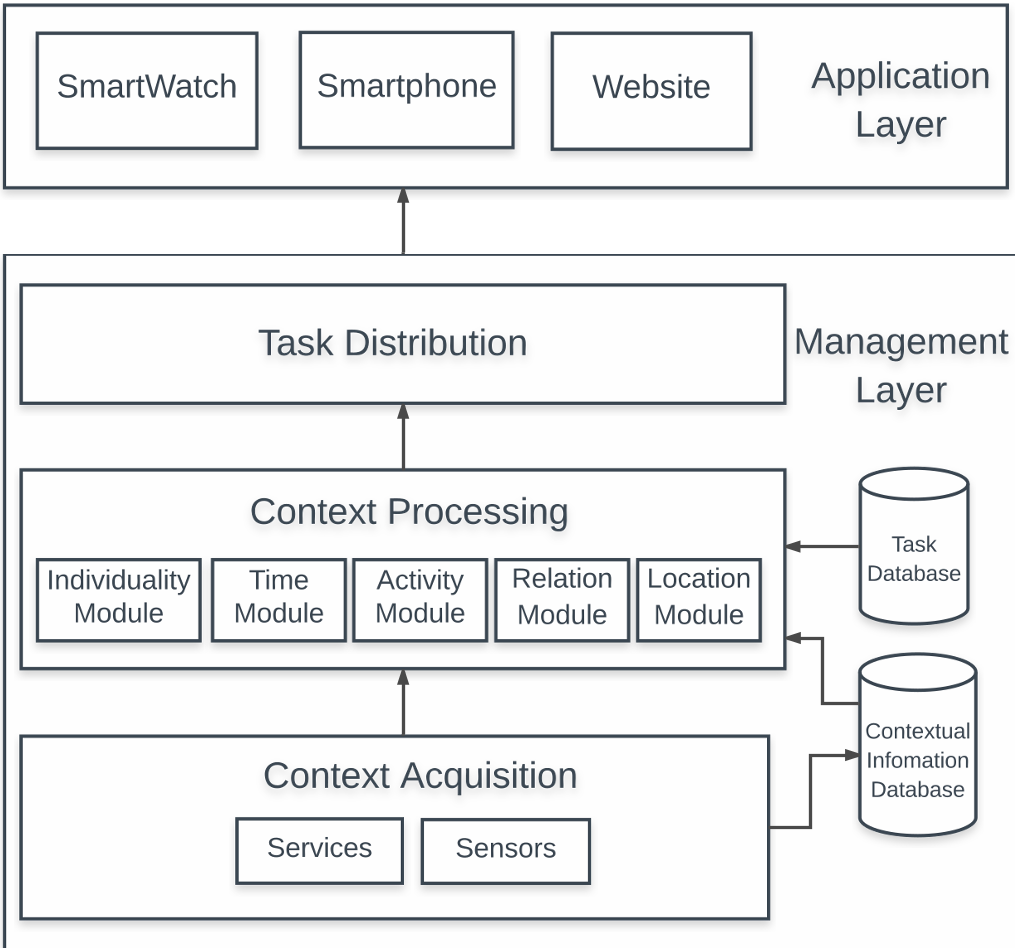
The Management Layer is the brain, where the Context Processing modules evaluate if a user's current status matches the task requirements stored in a JSON-based task definition.
Implementation: Contask App
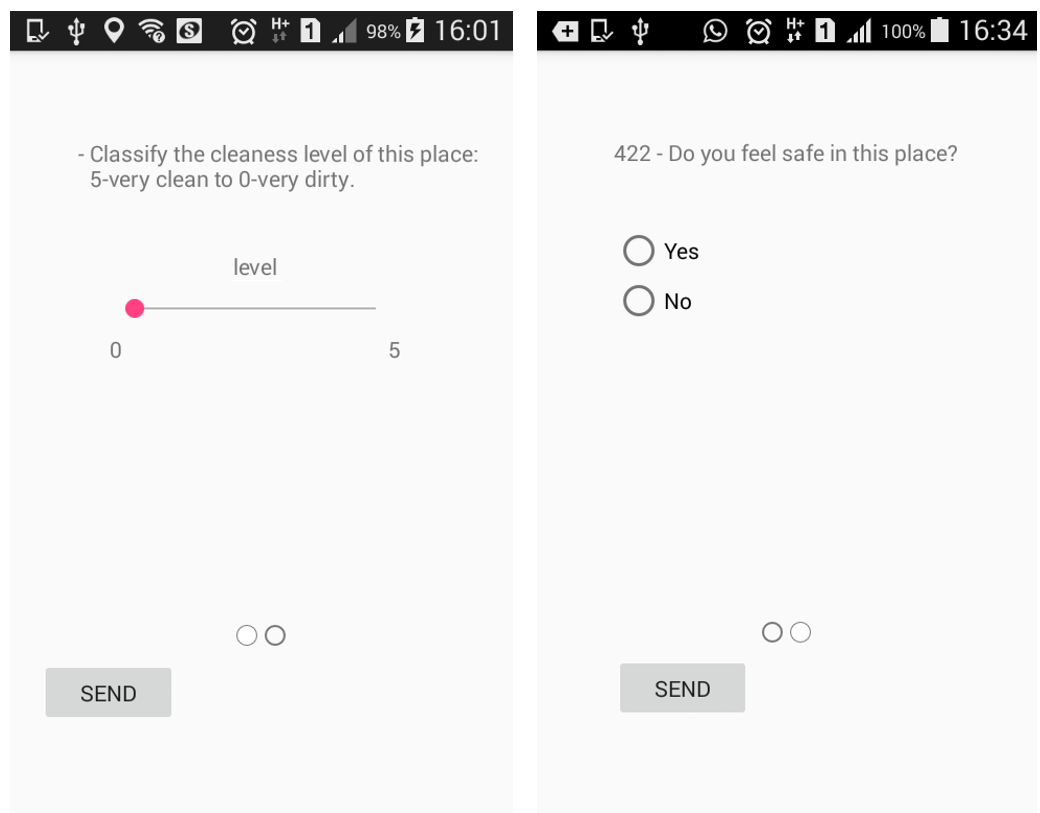
The prototype, Contask, was built for Android. It leverages the Facebook API for social relations/user profiling and the Google Awareness API for environmental contexts like weather.
Experiments and Insights
The system was tested in a "Micro-Urban" scenario: a university campus. Tasks ranged from identifying broken equipment to rating the safety of specific areas.
Key Results:
- Task Distribution Accuracy: Initially 50%, rising to 63% when false positives from adjacent locations were grouped (e.g., treating a library and the square in front of it as one "Library Area").
- Precision: Reached 73%, suggesting that when a user receives a task, there is a high probability it is relevant to their current context.
Usability Evaluation
A cohort of nine students evaluated the app using Nielsen’s usability attributes:
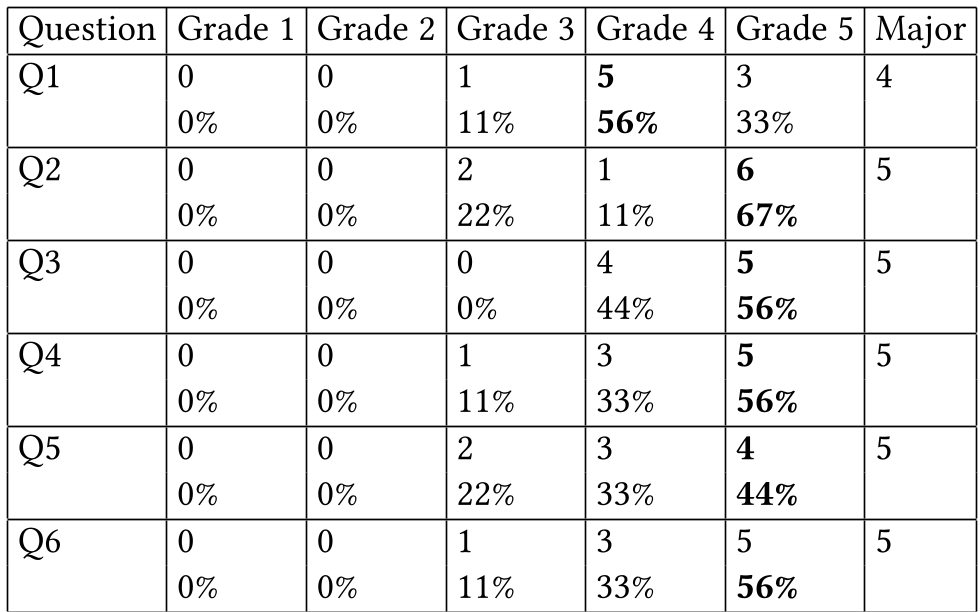
The results showed that while the system was easy to learn (67% gave it a top score), technical glitches—likely stemming from GPS drift in indoor environments—occasionally hampered user satisfaction.
Critical Analysis & Conclusion
The strength of this work lies in its holistic view of context. It doesn't just look at where you are (Location), but who you know (Relation) and what the weather is (Individuality).
Limitations:
- GPS Dependency: The "False Positive" rate highlights a classic challenge in mobile sensing: GPS is often too imprecise for micro-tasks (e.g., distinguishing between a hallway and a classroom).
- Privacy: The reliance on Facebook and constant GPS tracking raises significant privacy concerns that the paper mentions only briefly.
Future Outlook: Integrating "Activity" recognition (using accelerometers to know if a user is driving vs. walking) will be the next step in making these systems truly "invisible" and ubiquitous. As sensors become more accurate, context-aware distribution will likely become the standard for any data-centric "gig economy" platform.