
CBSCF: Bridging the Gap Between Social Influence and Behavioral Context in Recommendations
A Context-Aware and User Behavior-Based Recommender System with Regarding Social Network Analysis
The paper proposes CBSCF (Context-aware and behavior-based recommender system with Social network analysis), a collaborative filtering enhancement that integrates user behavior patterns and multi-layer social network metrics. By combining contextual behavioral similarity with social importance (Pagerank), the system aims to solve the data sparsity and accuracy issues in classic recommendation.
TL;DR
Modern e-commerce requires more than just rating correlations. This paper introduces a hybrid recommender system, CBSCF, which merges 2-layer social network analysis (capturing trust and physical similarity) with context-aware behavioral modeling (using sequential interaction patterns). Results demonstrate a significant leap in precision and recall over traditional collaborative filtering.
Problem & Motivation: Beyond the Rating Matrix
Traditional Collaborative Filtering (CF) relies heavily on the User-Item rating matrix. However, this matrix is notoriously sparse. The authors argue that a user's decision-making process is a byproduct of two overlooked factors:
- Behavioral Context: Your interests on a weekend might differ from a weekday; your interaction sequence matters more than a static score.
- Social Topology: We are influenced by those we trust and those who share our physical environment. Failing to model these multi-dimensional relationships leads to "one-size-fits-all" failures in classic SOTA methods.
Methodology: The Behavioral-Social Hybrid
The core of the paper lies in its dual-pronged approach to finding "true" neighbors.
1. Contextual Behavioral Similarity
The system categorizes interactions based on Time (Weekdays vs. Weekends) and Category. It represents user history as an ordered sequence:
UBP = <uid, iid, interaction, timestamp>
Instead of simple cosine similarity, the authors use a normalized Longest Common Sub-sequence (LCS) to measure how similar the "paths" of two users are. This captures the logic of how a user explores products.
2. The 2-Layer Social Graph
Social influence isn't flat. The methodology constructs a multi-layer graph:
- Layer 1 (Trust): Explicit "who trusts whom" directed edges.
- Layer 2 (Common Rate/Location): Implicit links between users in the same region with similar rating habits.
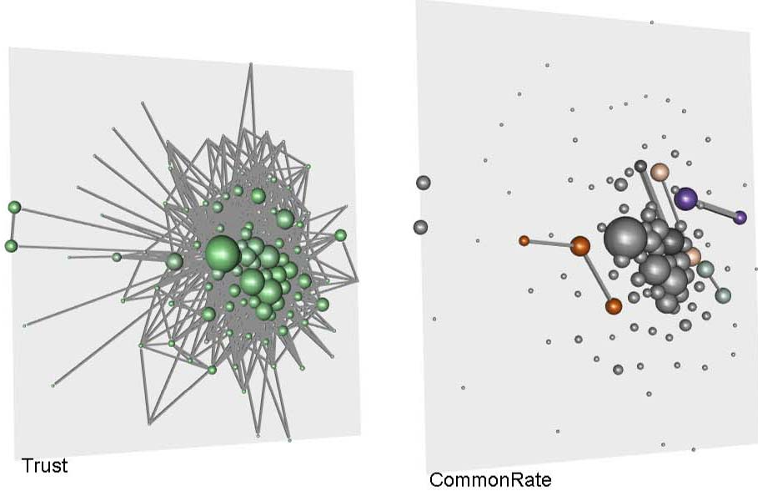
The Louvain Modularity algorithm detects communities within this complex structure, and Pagerank is applied to identify "influencers" (Social Importance) within each group.
3. The Fusion Formula
The final similarity is a weighted sum of behavioral similarity and social importance:
Experiments & Results
The authors tested CBSCF against three baselines using the Rich Epinions dataset (1.1 million reviews).
- Parameter Tuning: They found that a neighborhood size () of 70 and a social-behavioral balance () of 0.3 provided the lowest Mean Absolute Error (MAE).
- The "Hit" Rate: Using a leave-one-out evaluation strategy, CBSCF consistently placed "related items" higher in the top-K list than CF or SCF.
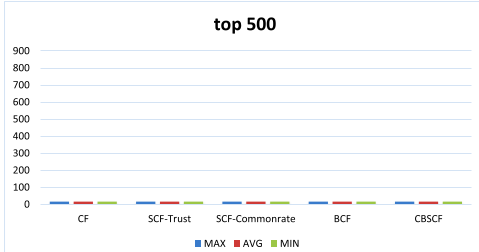 The charts clearly show that CBSCF (the proposed method) maintains higher precision even as K increases, which is critical for real-world apps where users only look at the first few results.
Critical Analysis & Conclusion
Takeaway
CBSCF proves that Social Network Analysis (SNA) and Behavioral Sequences are complementary. Social metrics provide a "prior" on who is worth listening to, while behavioral context fine-tunes the "now."
Limitations
- Computational Complexity: Calculating LCS for all user pairs in real-time is expensive compared to vector-based cosine similarity.
- Dependency on Rich Data: The model requires explicit trust graphs and timestamps, which may not be available in many datasets.
Future Outlook
The authors suggest that Deep Learning, specifically LSTMs (and by extension today's Transformers/GRUs), could automate the behavioral pattern extraction that they currently handle via manual sequence analysis. Integrating these multi-layer social priors into a GNN-based architecture would likely be the next logical evolution of this work.