
CFCEP: Why Your Background Says as Much About Your Emotions as Your Face
A new context-based feature for classification of emotions in photographs
This paper introduces Context-based Features for Classification of Emotions in Photographs (CFCEP), an image-based framework for classifying complex social media emotions. By leveraging the Hanman transform to analyze local variations in both foreground (facial) and background (contextual) components, the method achieves superior performance, including 91.7% accuracy on a custom 10-class dataset and 81.4% on FERPlus.
TL;DR
The paper introduces CFCEP (Context-based Features for Classification of Emotions in Photographs), a framework that moves beyond facial expressions to include background context (like clothing and environment) for emotion classification. By using the Hanman Transform to extract local variances and a CNN to fuse these insights, the authors achieve over 90% accuracy in identifying complex emotions like Bullying and Disdain—tasks where traditional "face-only" models typically fail.
Context Matters: The Death of the "Cropped Face"
In academic research, Emotion Recognition (FER) is often sanitized: high-resolution, cropped faces looking directly at the camera. But social media isn't sanitary. A photo of "Bullying" involves multiple actors, aggressive body language, and specific environmental cues that a cropped face simply cannot capture.
The authors argue that existing SOTA methods ignore the Relationship between Foreground (Expression) and Background (Action/Context). Their insight? The degree of variation between these two zones is the "fingerprint" of a specific emotion.
Methodology: The Hanman Transform and Contextual Fusion
The core innovation is a three-stage pipeline that treats the image as a dual-source information problem.
1. Component Separation
Using MTCNN, the system isolates faces. However, instead of discarding the rest, it uses Canny edge detection and bounding boxes to extract "background components"—hands, clothes, and surrounding objects.
2. The Hanman Transform (HT)
The Hanman Transform is used to measure the "uncertainty" or local variation of pixels.
- Uniform regions (like a clear face) result in high H values.
- Cluttered regions (like a complex background) result in low H values.
3. Smart Fusion
The researchers don't just stack these features. They use K-means clustering (K=2) to find the most "meritorious" features. They found that in aggressive classes, the background variance is a stronger signal than the face itself.
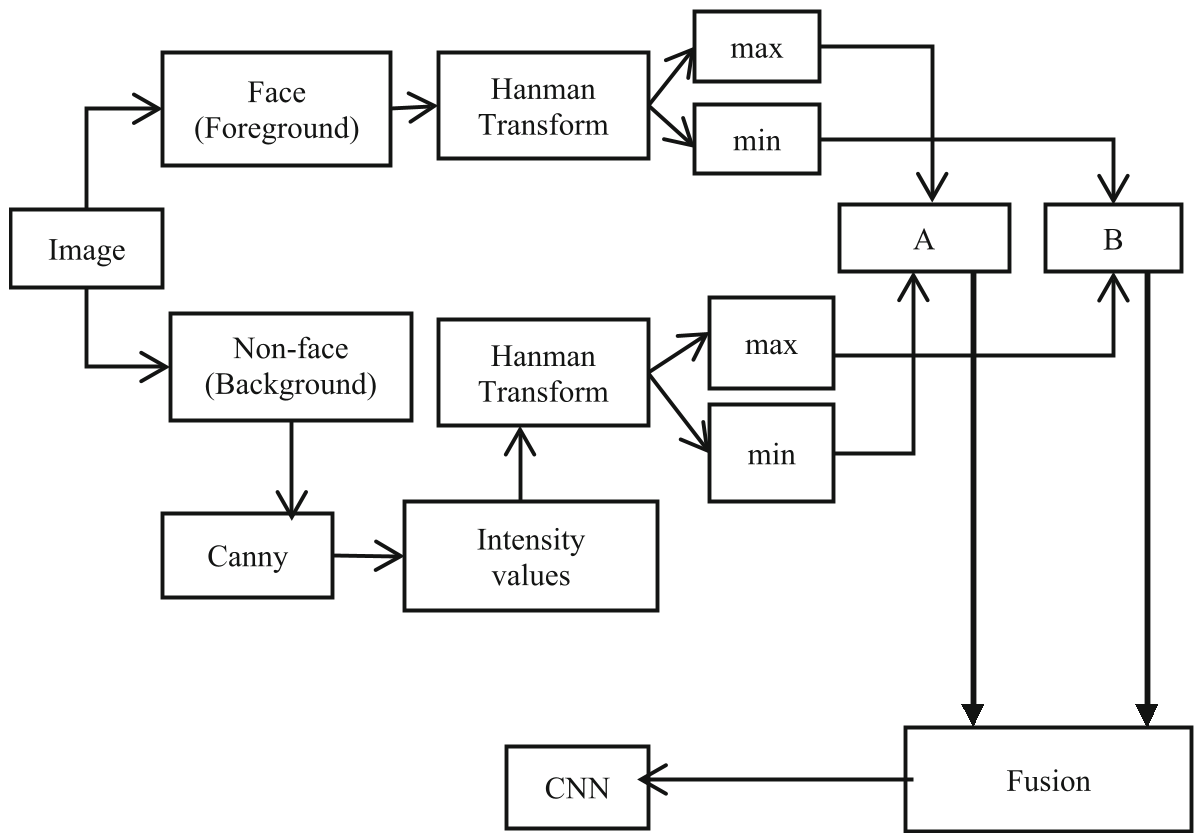 Figure: The CFCEP Architecture showing the separation of Face (Foreground) and Background components processed through the Hanman Transform.
Experimental Battleground
The model was tested on a massive scale: 71,718 images across four distinct datasets, including their own custom social media dataset covering 10 classes.
| Metric | CFCEP (Proposed) | Krishnani et al. | Liu et al. |
|---|---|---|---|
| 6-Class ACR | 92.0% | 88.9% | 25.1% |
| 10-Class ACR | 91.7% | 25.3% | 16.6% |
| Big Data (Liu) | 92.3% | 25.8% | 39.4% |
The "Ablation Study" provided a shocking reveal: Background Features (BC) contributed 84.2% to accuracy, while Foreground Features (FC) only contributed 75.2%. This proves that for complex emotions like "Unhappy" or "Aggressive," the environment tells a story that the face alone cannot.
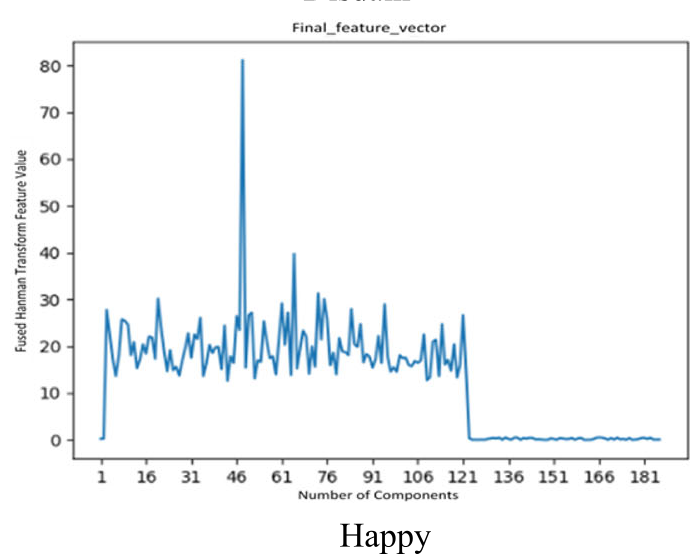 Figure: Histogram signatures showing unique "Contextual Footprints" for different emotion classes.
Critical Insight: The "Bullying" Challenge
Despite the high ACR, the authors admit that Bullying remains a "Boss Level" challenge. Why? Because bullying is a social interaction, not just a facial state. It often involves "fake" expressions—a bully might be smiling while the victim is unhappy. Future work will likely need Gait Recognition (how people walk/move) and Temporal Analysis (Video) to truly master these social nuances.
Conclusion
This work repositioned emotion recognition as a Global Scene Understanding problem rather than a local biometric one. By integrating handcrafted mathematical transforms (Hanman) with deep learning (CNN), the authors created a robust system capable of handling the messy, cluttered reality of the public internet.
Takeaway for Devs: If you are building sentiment analysis for social media, stop cropping your images. The background isn't noise; it's the signal.