
Unified Data Governance: Leveraging Contextual Intelligence and Graph ML
Contextual Intelligence for Unified Data Governance
This paper introduces a "Contextual Intelligence" framework for unified data governance, leveraging a graph-based metadata repository and machine learning. Developed by IBM Research, it transforms labor-intensive data stewardship into an automated process by capturing social, schematic, and usage context, achieving SOTA-level discovery and compliance across complex enterprise ecosystems.
Executive Summary
TL;DR: This paper argues that the "human-in-the-loop" approach to data governance is fundamentally broken at enterprise scale. IBM researchers propose a shift toward Contextual Intelligence, where a centralized Property Graph captures every interaction between users, queries, and datasets. By applying declarative machine learning over this "Usage Graph," the system can automatically discover hidden assets, enforce compliance, and provide Google-like query suggestions for data scientists.
Positioning: This work is a seminal bridge between traditional Data Management and modern AI/ML. It moves beyond "Data Profiling" (what is the data?) to "Data Context" (how is the data lived?), setting the stage for what we now recognize as the "Data Fabric" or "Data Mesh" architectures.
The "Tribal Knowledge" Trap
In large corporations, the most valuable information isn't in the database—it's in the heads of senior analysts (the "Tribal Knowledge"). When an expert leaves, their understanding of which table is "trusted" and which is "deprecated" disappears. Current governance tools fail because:
- Siloed Discovery: Catalog results are isolated to specific tools.
- Content vs. Context: They look at data formats but ignore that the most popular data sources are often the least governed.
- Labor Intensity: Data stewards cannot manually inspect thousands of new columns arriving daily.
Methodology: The Context Graph & Declarative ML
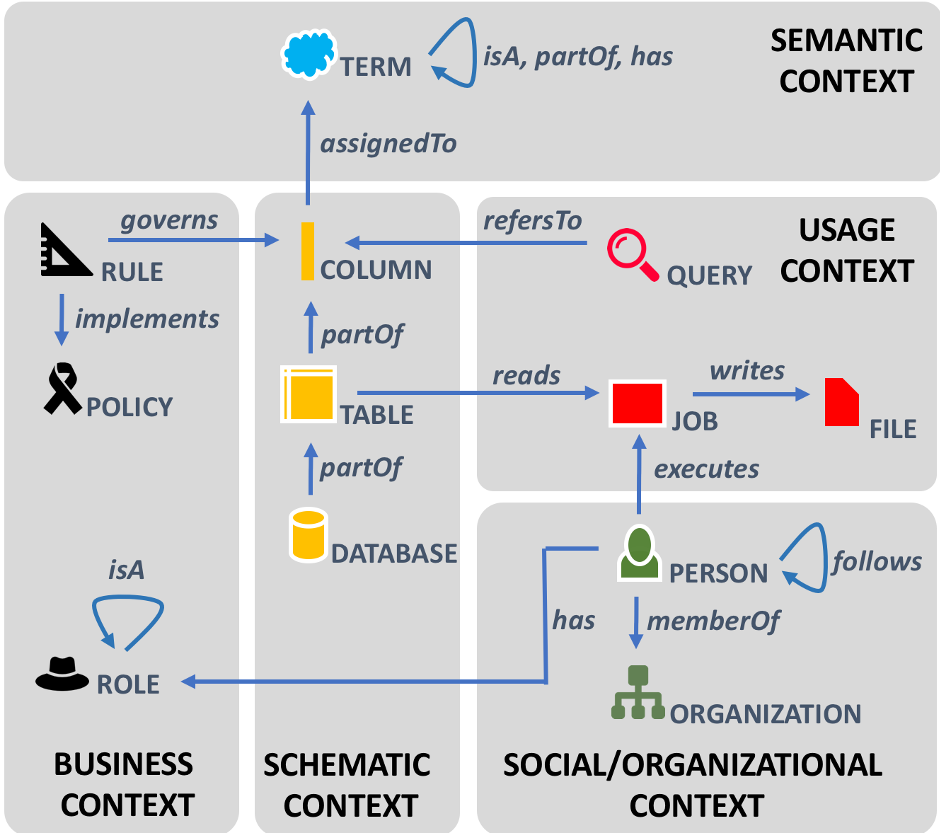
The core innovation is the Unified Governance Architecture. It doesn't just store table names; it captures Schematic, Usage, Semantic, Business, and Social context.
1. The Property Graph
The system models the enterprise as a directed, multi-relational graph. If a User (Person) issues a Query (Usage) that refers to a Column (Schematic) which is governed by a GDPR Policy (Business), all these nodes are linked.
2. Declarative ML Pipelines
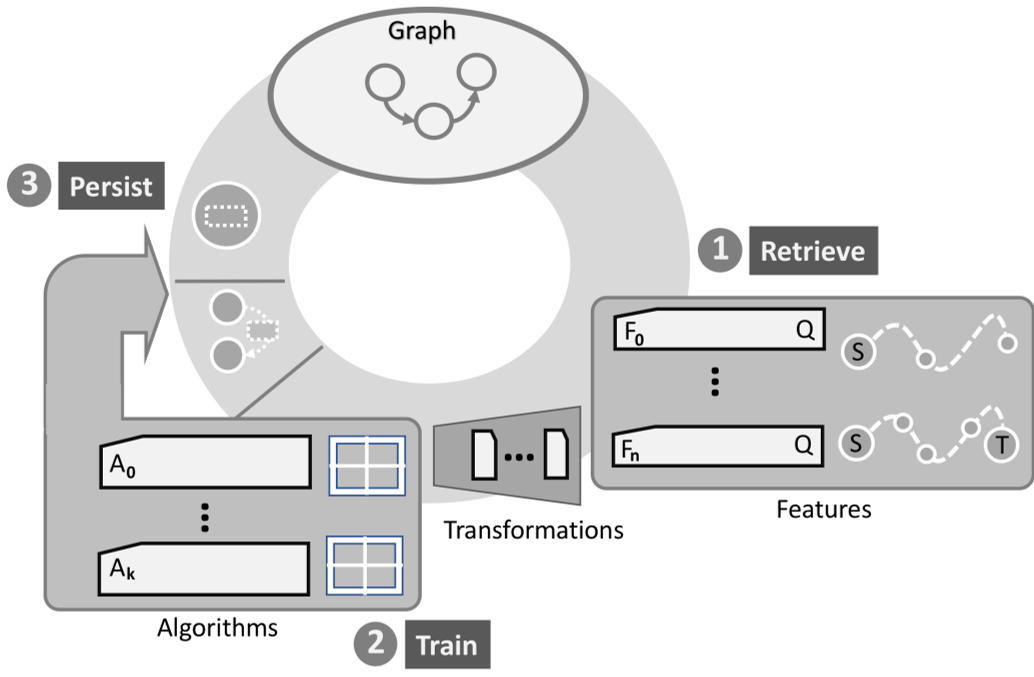
To avoid the "No-Compile" barrier, the authors introduced a HOCON-based declarative framework. Users can specify a Gremlin query to fetch data, a Spark ML algorithm (like K-Means or FP-Growth) to train it, and then persist the results back into the graph as new "discovered" edges.
Real-World Impact: From Discovery to Compliance
The authors validated their approach using two primary use cases:
Case A: Proactive Compliance
When a developer creates a new Table_B that isn't in the official catalog, the ML framework detects it is being used alongside Table_A (which is governed). It alerts the Data Steward: "Table_B is highly active but lacks a policy—apply GDPR tagging now."
Case B: Intelligent Query Assist
By analyzing patterns of how experts join tables (e.g., joining author and authored on fullname), the system provides a "Type-ahead" service for junior developers, effectively digitizing the "Tribal Knowledge."
 Typical output showing confidence scores (Conf) and reasons for table join recommendations.
Critical Insight & Future Outlook
Takeaway: This paper proves that metadata is the data. The "Usage Context" is the missing link in the ROI of data governance. By treating relationships as first-class citizens in a property graph, IBM Research successfully automated the role of a data steward.
Limitations: While powerful, the architecture relies on "Source-specific connectors." In a modern cloud-native environment, maintaining these connectors for every new SaaS tool (Snowflake, Databricks, Fivetran) is a significant engineering challenge. The future likely lies in "Active Metadata" standards like OpenLineage to feed this graph automatically.