
Facebook as a Learning Lab: Boosting Search Precision via Social Context
Contextual web searches in Facebook using learning materials and discussion messages
The paper introduces a contextual web search engine framework for collaborative learning environments, specifically implemented for Facebook groups. It utilizes Automatic Query Expansion (AQE) by extracting representative terms from shared learning materials and real-time student discussion messages to improve search precision.
TL;DR
Researchers have developed a prototype that bridges the gap between social networking and academic research. By automatically "listening" to classroom discussions and parsing lecture notes on Facebook, the system expands a student’s simple search query into a context-rich string, improving the relevance of web results by up to 73%.
Context: The Missing Link in Learning
Search engines are the backbone of modern education, yet they are remarkably "blind" to the user's environment. When a student searches for "Modeling," the engine doesn't know if they are studying fashion, 3D printing, or Information Systems Modeling.
Previous attempts to fix this relied on labor-intensive manual tagging or complex ontologies. The authors of this paper argue that the context already exists—it is buried in the PDFs teachers upload and the comment threads students generate on social media. The challenge is extracting that context dynamically and automatically.
Methodology: Turning Conversations into Context
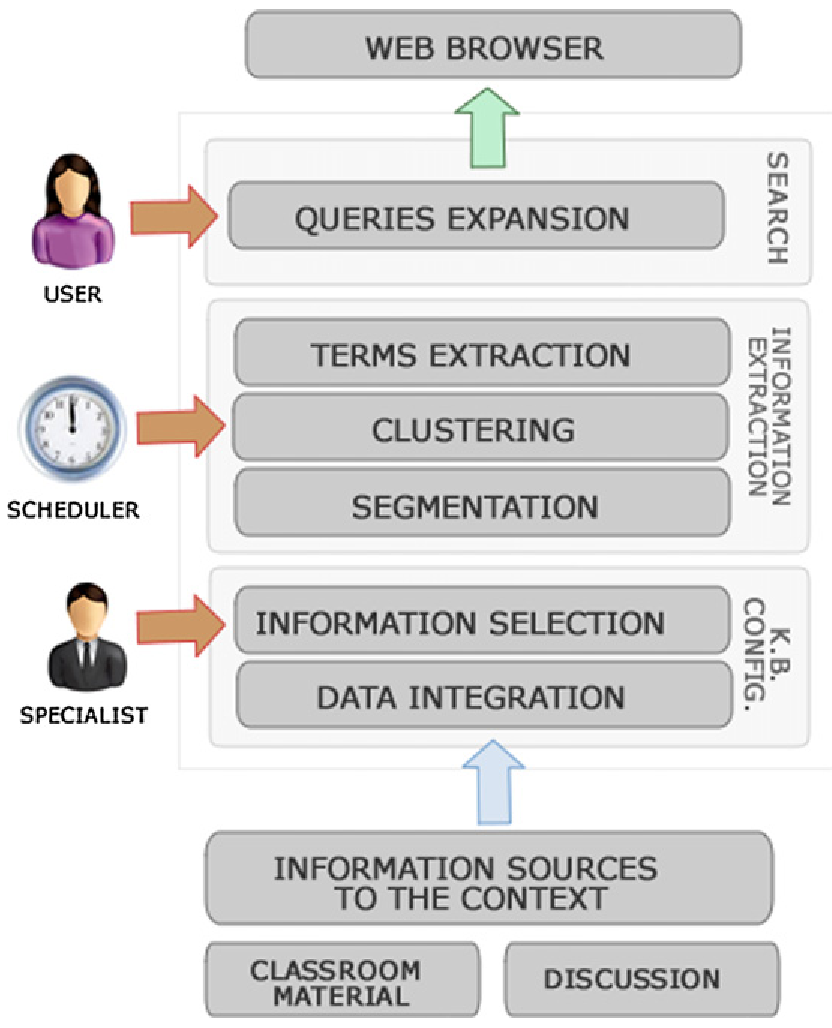
The proposed architecture is split into three phases: Knowledge Base Configuration, Information Extraction, and Search.
1. Topic Segmentation and Clustering
Instead of treating all course materials as one giant "blob" of text, the system uses TextTiling to break documents into sub-topics. It then applies k-Means clustering to group similar segments. This ensures that if a course covers "Database Design" and "UI Prototyping," the search engine understands these as distinct contexts.
2. The Power of AQE (Automatic Query Expansion)
The core innovation lies in how the search happens. When a student enters a keyword:
- The System searches its cache: It looks for the most weighted terms in that specific "class context."
- Query Multiplier: Instead of one search, it creates several. One for the "General Context" and others for specific "Subject Clusters."
- Result: The user sees multiple tabs of results, each refined by terms like "UML," "Class Diagram," or "Requirements," derived directly from their own course materials.
Experiments: Classroom Validation
The authors tested this with Information Systems students at a Brazilian university. They created a Facebook group—a familiar environment for students—to host the learning community.
Key Findings:
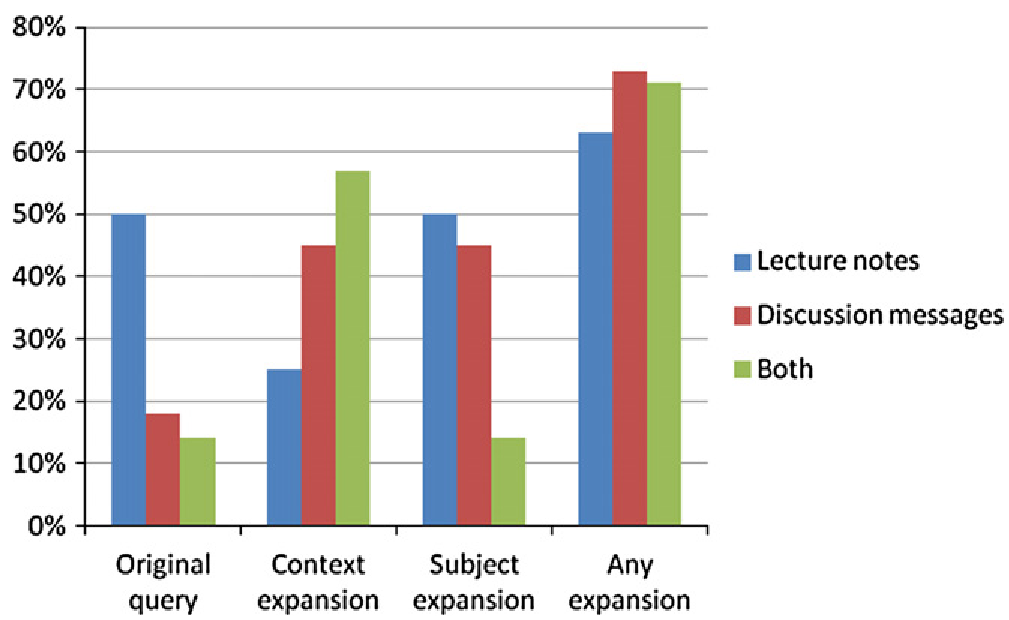
- Precision Gains: The expanded queries (AQE) outperformed the original keywords in almost 3 out of 4 cases.
- Discussions vs. Notes: Surprisingly, context extracted from student discussions was often more effective than context from the teacher's lecture notes. This suggests that the way students rephrase and discuss concepts is more aligned with how information is indexed on the broader web.
Critical Insight & Future Outlook
While this study was conducted in 2012 using tools like Apache Lucene and k-Means, its logic is even more relevant today in the era of Large Language Models (LLMs). The paper correctly identified that "Social Context" is a living, breathing dataset.
Limitations: The study notes that assessing these results can be "tiring" for users if too many expansion tabs are generated. This highlights a classic UX challenge in Information Retrieval: how much choice is too much?
Modern Takeaway: Today, this workflow could be seen as an early ancestor of RAG (Retrieval-Augmented Generation). Just as this prototype used Facebook messages to "prime" a Google search, modern AI uses local documents to prime LLM responses. The evolution of this field continues to prove one thing: context is king.
Conclusion
By integrating search tools directly into social learning platforms, we can reduce "search friction" for students. This paper provides a robust blueprint for making search engines smarter by making them social-aware.