
Contextual Wisdom: Why Social Trust Beats Brute-Force Classifiers in Image Annotation
10954_Contextual wisdom social relations and correlations for multimedia event annotation.
The paper introduces a novel event-centric framework for multimedia annotation that leverages social relationships, concept similarity, and annotator trust. It proposes a "coupling strategy" inspired by the HITS algorithm to recommend tags across facets like Who, Where, When, and What, significantly outperforming traditional SVM classifiers in data-scarce social network environments.
TL;DR
Researchers from Arizona State University and IBM have moved away from the "one classifier per tag" obsession. Instead, they’ve built a system that treats images as part of real-world events, using the social graph’s "Contextual Wisdom" to recommend tags. By combining ConceptNet (common sense), Co-occurrence (personal habits), and PageRank-based Trust, they outperformed traditional SVMs—especially in the "long tail" where data is scarce.
The Problem: The Long Tail and Semantic Chaos
The researchers identified a fundamental flaw in how we thought about image tagging in 2007 (and even today). In a social network like Flickr, tag distributions follow a Power Law.
- Learnability: Most tags have fewer than 10 photos—impossible to train a robust SVM.
- Scalability: Training a new classifier for every unique tag is computationally ruinous.
- Ambiguity: A tag like "Yamagata" could refer to a city, a singer, or a visual artist. Without context, a global classifier is blind.
Methodology: The Three Pillars of Wisdom
The authors propose an "Event-Centric" model where an event is a tuple of facets: Who, Where, When, What, and Image.
1. ConceptNet Similarity (Common Sense)
Instead of just looking at pixels, the system uses ConceptNet to understand that "Student" and "Library" are semantically related. They calculate a distance based on contextual neighborhoods, analogous concepts, and path lengths between nodes in the knowledge graph.
2. Personalized Co-occurrence
If you often tag "New York" along with "Business Trip," that’s a personalized association. The system maintains a matrix of these correlations for every user.
3. Trust Propagation (The Biased PageRank)
Not all annotators are created equal. If Mary's tags are consistently useful to John, her "Trust" score increases. Using a variant of the PageRank algorithm, trust is propagated through the social network graph, ensuring that recommendations are weighted toward people with similar activity patterns.
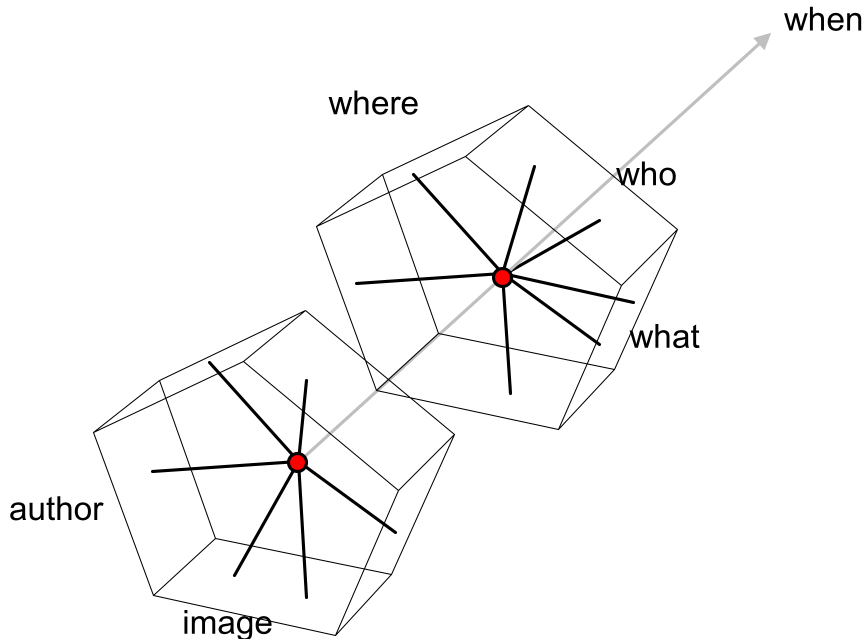 Figure: The multi-faceted event model where "Who, Where, When, What" serve as metadata context.
The "Coupling" Strategy
The core algorithm is a variant of Kleinberg’s HITS (Hyperlink-Induced Topic Search). It solves two coupled equations:
Here, is the global similarity (shared knowledge) and is the trust-weighted co-occurrence (personalized knowledge). This creates a feedback loop: shared knowledge helps discover personalized ties, and personalized ties refine the shared understanding of a query image.
Experimental Showdown: CM vs. SVM
The results were striking. In a study of 58 events and 250 images, the Coupling Matrix (CM) approach crushed traditional SVMs.
| Facet | SVM Hits | CM (Network) Hits |
|---|---|---|
| Who | 45 | 183 |
| Where | 62 | 179 |
| What | 72 | 204 |
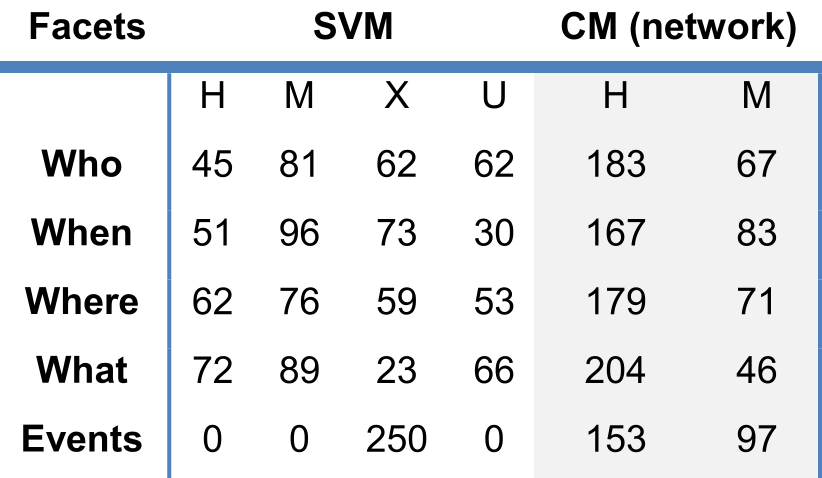 Table: Aggregated results showing the massive performance gap in the personal annotation scenario.
The SVMs failed primarily because they had "no classifier" (Column X) or were "undecidable" (Column U) for most specific tags. The CM approach, by leveraging the social context, could suggest relevant tags even for images it had never "seen" a training sample for, simply because it knew the event's context and the user's circle.
Critical Insight & Conclusion
This paper represents a shift from Computer Vision to Computational Social Science. It proves that the metadata surrounding an image is often more valuable than the pixels within it.
Takeaway: In modern AI design, we often try to solve every problem with a bigger model (more parameters). This work reminds us that Social Context is a powerful inductive bias. By knowing "who is with whom" and "where they usually go," we can reach accuracy levels that no visual-only classifier can match in data-sparse environments.
Note: While the visual features used (color/edge histograms) are dated, the underlying logic of social trust and multi-facet coupling remains a cornerstone of graph-based recommendation engines today.