
C L -B E N C H: Is Your AI Agent Actually Getting Smarter, or Just "Pre-Trained" Smart?
Continual Learning Bench: Evaluating Frontier AI Systems in Real-World Stateful Environments
The paper introduces C L -B E N C H, the first comprehensive benchmark specifically designed to evaluate the continual learning capabilities of Large Language Model (LLM) agents across six diverse, expert-validated real-world domains. It evaluates frontier models (e.g., GPT-4, Claude 3.5) using a novel gain metric to isolate true online learning from static pre-trained capabilities, revealing that most current systems fail to effectively leverage sequential experience.
TL;DR
Researchers from UC Berkeley and Snorkel AI have released C L -B E N C H, a reality check for the "Agentic AI" hype. While we hope our AI agents learn from their mistakes, this benchmark proves they mostly don't. By testing models on tasks with hidden patterns they couldn't have seen in training, the study reveals a shocking truth: The most advanced "memory" systems are currently outperformed by simply stuffing the entire history into a standard prompt.
The Problem: The "Static Intelligence" Illusion
Most AI benchmarks today are like one-off exams. If a model passes, we say it's "smart." But in the real world, we need workers (agents) who get better at their specific job over weeks of interaction.
The core difficulty in measuring this Continual Learning (CL) is "contaminated" data. If a model solves a coding bug on a famous repo, is it because it learned the codebase? Or because it saw that exact fix in its training data? C L -B E N C H solves this by creating environments with obfuscated latent structures—think of a database where column names are gibberish—that the agent must explore and learn online to succeed.
Methodology: How to Measure "Learning"
To isolate learning from raw power, the authors use a clever Gain Metric.
- Stateless Reward (): How the model performs on a task with zero memory (fresh start every time).
- Stateful Reward (): How the model performs after seeing previous related tasks.
- Gain: . This delta represents the actual "experience" the model gained.
6 Domains of Hardship
The benchmark covers everything from Software Engineering (fixing bugs in specific repos) to Blind Spectrum Monitoring (radio signal analysis).
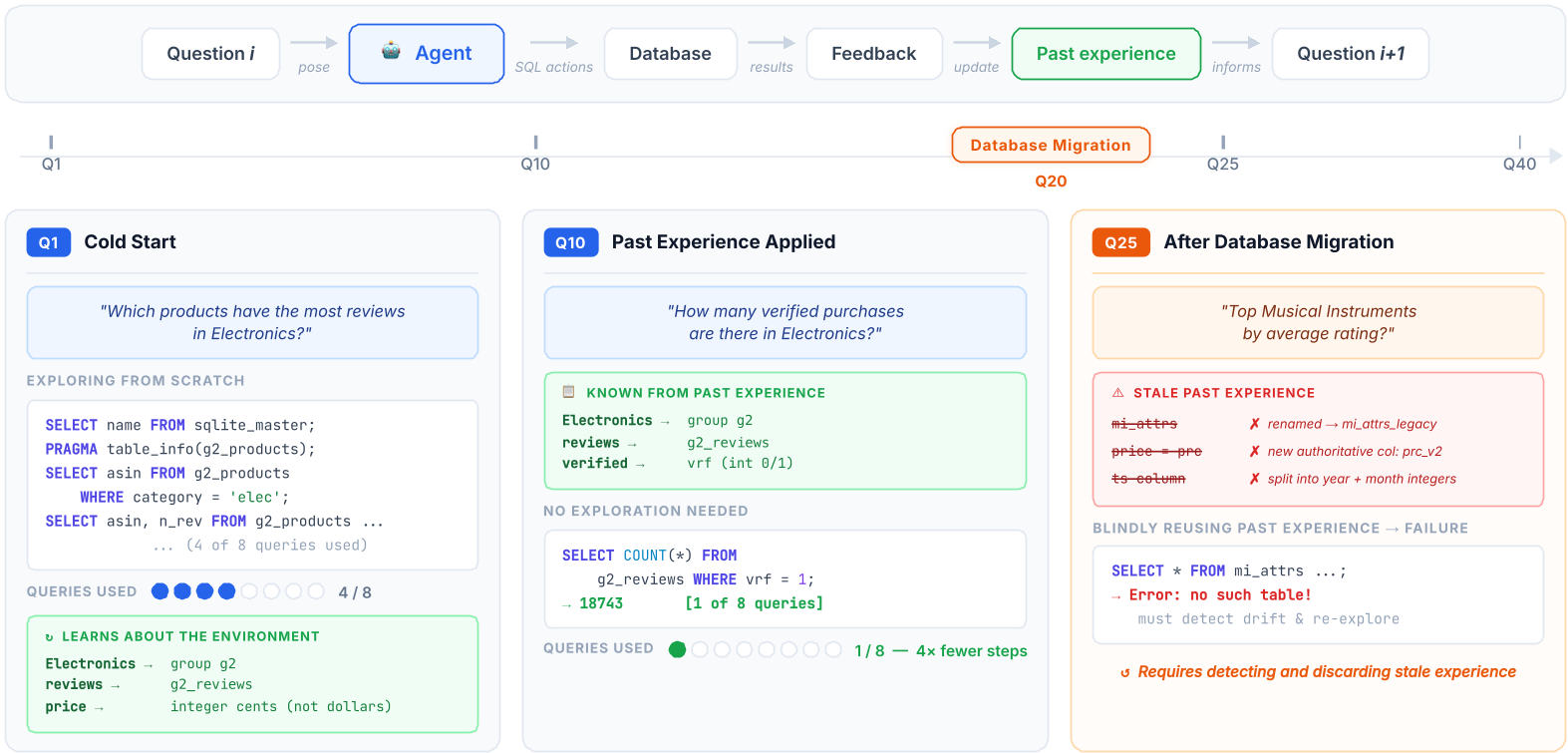 Figure 1: The evaluation framework. Note how the "Database Exploration" task uses obfuscated schemas to prevent the model from using pre-trained knowledge.
The "Memory" Paradox: Why Simpler is Better
The most counter-intuitive finding is that In-Context Learning (ICL)—the "naive" approach of appending every interaction to the prompt—crushes sophisticated agentic memory systems like ACE or Mem0.
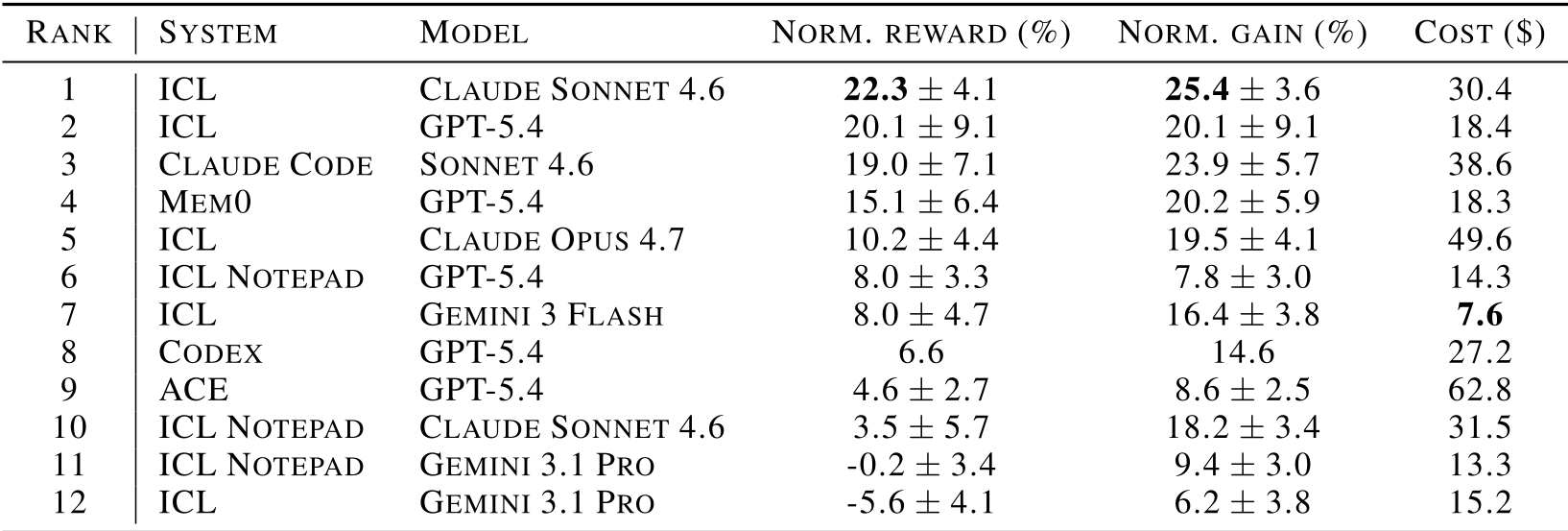 Table 1: Leaderboard results showing Claude Sonnet 4.6 (ICL) at the top, while dedicated memory systems like ACE lag significantly behind in gain.
Why do "Smart" Memory Systems Fail?
- Spurious Generalization: Systems like Mem0 tend to extract "memories" that are too generic or flat-out wrong, leading the model down the wrong path.
- Stability vs. Plasticity: Models struggle to decide when to keep old knowledge and when to overwrite it (Concept Drift). When a database schema changes, many agents remain "rigid" in their early, now-incorrect beliefs.
Hard Evidence: Heterogeneous Learning Curves
The learning dynamics differ wildly by task. In Sales Prediction, models show clear improvement as they figure out the underlying growth clusters. However, in Cohort Studies (Epidemiology), even frontier models are effectively "blind," failing to see the cross-study patterns validated by human experts.
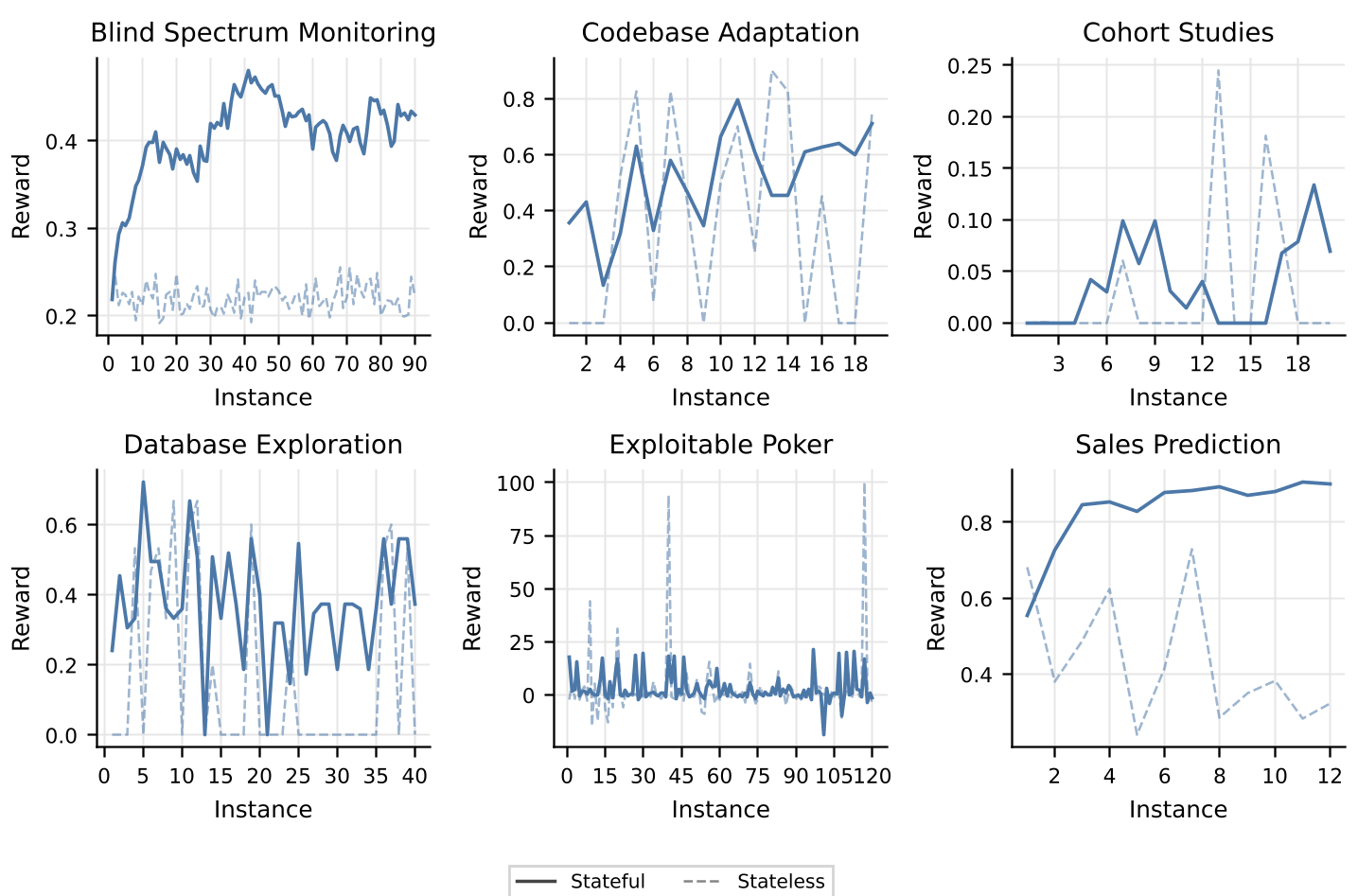 Figure 5: The gap between the solid (stateful) and dashed (stateless) lines represents the 'Gain'. Note the dramatic failures in Database Exploration where the stateless model collapses.
Conclusion: A Long Road Ahead
C L -B E N C H proves that we are still in the "pre-history" of autonomous agents. The fact that raw context beats structured memory suggests our current methods for "summarizing" or "retrieving" history are losing the critical nuances needed for complex reasoning.
Key Takeaways for Engineers:
- Don't over-engineer your agent's memory yet; Long-context windows are still your best bet.
- Focus on feedback loops: Agents need to "feel" the error to update their internal world model.
- Progress in AI will not just be about larger models, but about stateful architectures—systems that can change their "weights" or "logic" as they work.