
Beyond the First Click: Why We Stay on Social Networks
Exploring the continuance intention of social networking websites: an empirical research
This study proposes an integrated theoretical framework to explain user continuance intention on social networking websites. By synthesizing the Technology Acceptance Model (TAM), Theory of Planned Behavior (TPB), Expectation Disconfirmation Model (EDM), and Flow Theory, the research identifies how extrinsic and intrinsic motivations drive long-term Facebook usage.
TL;DR
While many platforms successfully attract users, the real challenge lies in continuance—preventing churn in a hyper-competitive landscape. This study identifies that staying on a platform like Facebook isn't just about it being "useful"; it's a complex cocktail of social pressure (Subjective Norm), cognitive validation (Expectation Disconfirmation), and the psychological state of "Flow." By integrating four major behavioral theories, the authors explain a staggering 72% of why users keep coming back.
Background: The Retention Crisis
As of 2012, Facebook had nearly a billion users, but the growth curve was flattening. The industry realized that the factors driving a person to join a site are fundamentally different from why they stay. Traditional models like the Technology Acceptance Model (TAM) were "too narrow," focusing mostly on the workplace and utilitarian tasks. To truly understand the "social" in social networking, researchers needed to look at intrinsic joy and social ecosystems.
The Anatomy of Intention: Integrating Four Pillars
The researchers posited that user behavior is driven by both Extrinsic Motivations (achieving a goal) and Intrinsic Motivations (the joy of the act itself). They built an integrated model based on:
- TAM: Focuses on Perceived Usefulness and Ease of Use.
- TPB: Adds the "Social" element (Subjective Norm) and the "Ability" element (Perceived Behavioral Control).
- EDM: Explains how our post-use satisfaction depends on whether the reality beat our expectations (Disconfirmation).
- Flow Theory: Captures that "lost in the zone" feeling where time disappears while browsing.
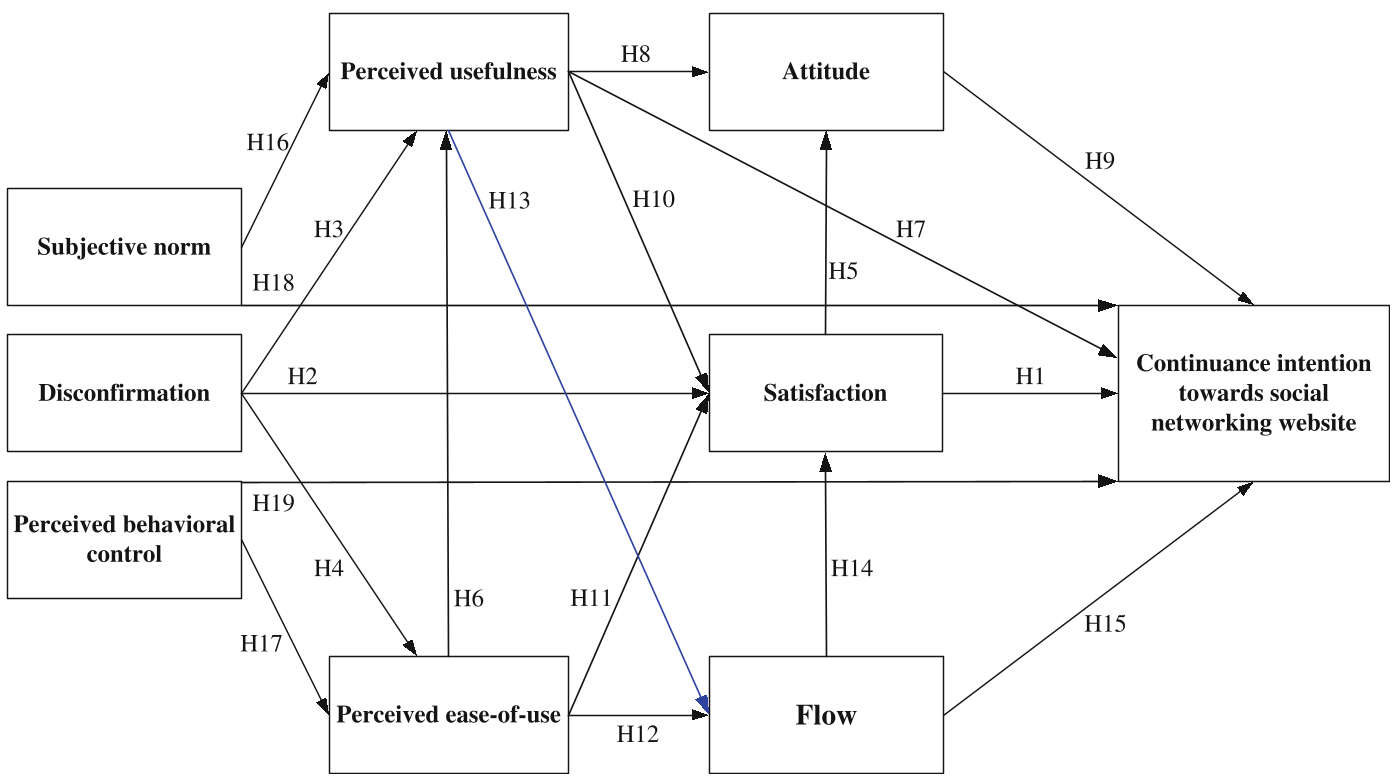
Deep Dive into the Results
Using a sample of 482 Facebook users and Structural Equation Modeling (SEM), the study confirmed that this holistic approach is far superior to looking at TAM alone.
The Power of the "Subjective Norm"
One of the most striking findings is the impact of social circles. Even if a user doesn't find the interface particularly efficient, they will perceive it as useful simply because everyone they know is on it. This "network externality" means that social networking providers must prioritize community building to create a "Subjective Norm" that makes leaving socially "expensive."
Finding Flow
The state of Flow—feeling captivated and losing track of time—directly affects a user's satisfaction and their desire to stay. The study found that "Ease of Use" is a prerequisite for Flow. If a site is frustrating to navigate, users can never enter that rewarding psychological state.
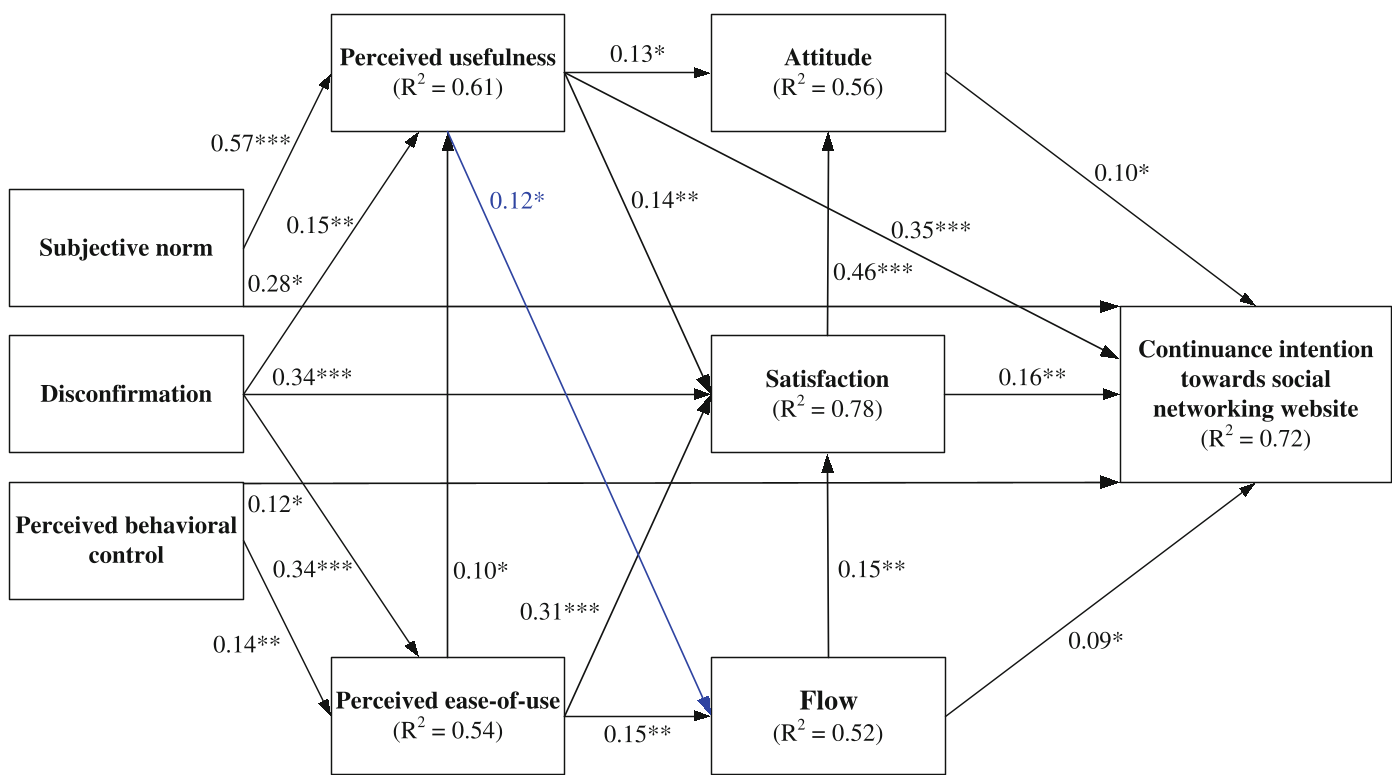
Key Takeaways for Product Strategy
- Manage the Gap: Satisfaction is driven by Disconfirmation. If your marketing overpromises and the UI underdelivers, satisfaction plummets regardless of how "good" the features are.
- The Peer Effect: Use opinion leaders. Since user intention is heavily influenced by "important others," positive word-of-mouth is more effective than traditional mass media.
- Control Matters: "Perceived Behavioral Control" (knowing how to use the site skillfully) significantly impacts the intention to stay. Help prompts and intuitive design aren't just for beginners; they are retention tools.
Critical Insight & Conclusion
This study marks a shift from seeing users as "rational tools-users" to "social-emotional beings." The leap from explaining 40% to 72% of behavior by adding Flow and Subjective Norms proves that the "killer app" of any social network isn't a single feature—it's the psychological and social environment the platform sustains.
Limitations: The study is a "snapshot" in time (cross-sectional) and focused primarily on the Taiwanese Facebook ecosystem in the early 2010s. Future research should explore if these same drivers hold true in the era of algorithmic "dark patterns" and decentralized social media.