
Social Voting: Bridging the Gap Between Tweets and Ballots
Allowing Continuous Evaluation of Citizen Opinions through Social Networks
The paper proposes a lightweight e-voting system designed for continuous citizen opinion evaluation using existing social network profiles. By integrating blind signatures and a distributed set of "Credential Providers" (CPs) on social platforms, the method achieves security properties like anonymity and uncloneability without requiring heavy dedicated infrastructures.
TL;DR
Researchers have developed a lightweight e-voting protocol that allows citizens to vote using their existing social network profiles (Facebook, Twitter, etc.). By leveraging blind signatures and a distributed network of Credential Providers, the system ensures voter anonymity and security without the heavy infrastructure of traditional electoral systems, making "continuous democracy" feasible.
Background & Positioning
In the transition toward Smart Cities, e-democracy is often hindered by a binary choice: use expensive, heavy-duty official electoral systems or use insecure, centralized web polls. This paper occupies a unique middle ground. It is a methodological innovation that repurposes pervasive social media for secure, low-stakes but high-frequency public opinion evaluation.
Problem & Motivation: The Complexity Trap
Existing e-voting protocols (like those based on complex mix-nets or homomorphic encryption) are "excessive" for day-to-day governance. They require:
- Dedicated infrastructures that are expensive to maintain.
- Complex user interactions that discourage frequent participation.
The authors identify a clear gap: we need a system that is as easy as "liking" a post but as secure as a secret ballot. The core challenge is the Security-Complexity Trade-off: How do you use a public social identity to cast a secret, unique, and unforgeable vote?
Methodology: The Core Mechanism
The protocol distributes trust across three main entities: the Voter, Credential Providers (CPs), and a Trusted Third Party (TTP).
1. Pseudo-Random CP Selection
Instead of relying on one central authority, the voter's software uses SHA-1(VoterID || i) to select a subset of Credential Providers. This ensures that even if some CPs are compromised, the entire system remains robust.
2. The Double-Blind Process
The secret sauce is the two-stage blinding process:
- Stage A (Credentialing): CPs sign a "blinded" token for the voter. They know who is voting but not what the vote is or even the specific voting session ID.
- Stage B (Balloting): The TTP receives the unblinded credential to verify the right to vote. The voter then submits a partially blind signature for the ballot. The TTP signs it without seeing the specific preference.
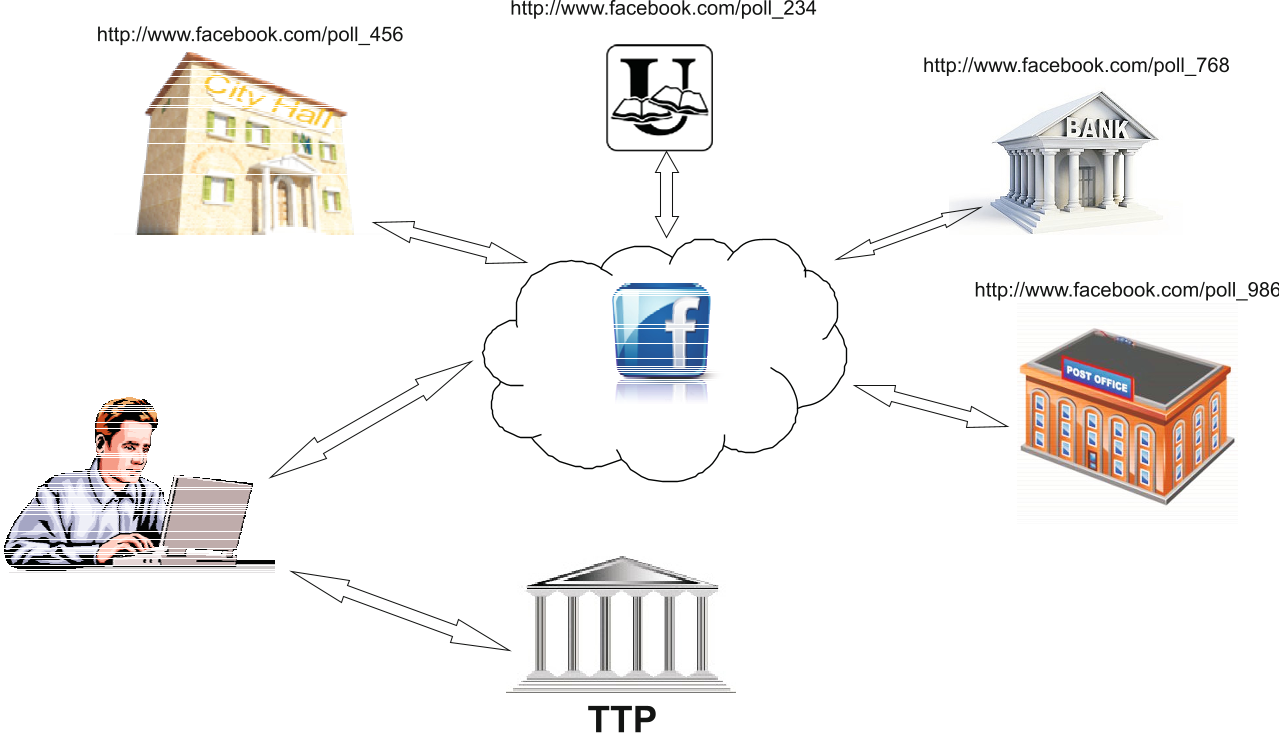 Figure 1: The interaction between the Voter (e.g., on Facebook), the distributed Credential Providers, and the TTP.
Experiments & Security Analysis
The authors perform a mathematical security analysis rather than a bench-test, focusing on the Birthday Attack probabilities.
- Uniqueness: By using a 128-bit random sequence () within the credential, the risk of two voters generating the same identifier—which would lead to an accidental "double-voting" rejection—is less than , even with 1 trillion users.
- Robustness: The protocol is threshold-resistant. As long as more than half of the contacted Credential Providers are honest (where ), faked credentials will be detected and discarded by the TTP.
- Performance: Unlike mix-nets where complexity grows with the number of participants, this protocol’s overhead is fixed per user, making it highly scalable for city-wide or nation-wide use.
Critical Insight & Future Outlook
The brilliance of this approach lies in its Infrastructure Independence. It treats social networks merely as identity carriers and communication channels. Because data is stored locally by CPs and the TTP, the system remains secure even if the social network provider (e.g., Meta or X) is curious or malicious.
Limitations: The system still relies on a "Trusted Third Party" (TTP), which remains a single point of failure for integrity. Future iterations could benefit from replacing the TTP with a Decentralized Autonomous Organization (DAO) or a blockchain-based counting logic to achieve absolute transparency.
Conclusion
This paper provides a pragmatic roadmap for Continuous e-Democracy. By lowering the barrier to entry while maintaining cryptographic rigor, it offers a way for communities to move beyond static 4-year election cycles toward a more responsive and interactive form of governance.