
CTIC: Redefining Information Diffusion with Continuous Time Dynamics
Learning Continuous-Time Information Diffusion Model for Social Behavioral Data Analysis
The paper introduces the Continuous-Time Independent Cascade (CTIC) model, a framework for estimating information diffusion parameters in social networks using continuous time delay. The authors propose a maximum likelihood estimation method based on an EM-like iterative algorithm, achieving significantly higher accuracy in ranking influential nodes compared to traditional PageRank and centrality heuristics.
TL;DR
Researchers have developed a Continuous-Time Independent Cascade (CTIC) model that moves beyond the limitations of discrete-time social simulations. By treating time as a continuous variable and parameters (delay and probability) as learnable through a rigorous maximum likelihood framework, this method identifies influential nodes and analyzes topic-specific propagation habits with far greater precision than classical heuristics like PageRank.
Context: Why Discrete Time is Not Enough
Most existing models for "viral marketing" or information spread rely on the Independent Cascade (IC) model. In this setup, if Node A becomes active, it has one shot at time to activate its neighbor.
The Problem: Real life doesn't happen in synchronized "ticks." A trackback on a blog or a retweet can happen 5 minutes or 5 days later. Previous attempts to fix this either used arbitrary discretization or lacked a solid mathematical foundation for learning the parameters from real-world data.
The Core Innovation: The CTIC Model
The authors propose the CTIC Model, where every link in a network is defined by two values:
- Diffusion Parameter (): The probability that the information will actually pass.
- Time-Delay Parameter (): A value governing an exponential distribution that determines when the activation will happen.
Breaking the "Hidden Source" Deadlock
The biggest challenge in learning from diffusion data is that we see when nodes turn "active," but we don't know which specific neighbor triggered them. The authors solved this by formulating a global Likelihood Function and using an iterative algorithm (similar to Expectation-Maximization) to find the parameters that best explain the observed sequence.

Performance: Crushing the Heuristics
The model was tested against two massive datasets: a Japanese blog network (12k nodes) and a Wikipedia network (9k nodes).
1. Accuracy and Convergence
The model's parameters and converge reliably to the true values as the number of training samples () increases. Even with small datasets, the error rate remains remarkably low.
2. Influential Node Ranking
The "Influence Maximization" problem asks: Who are the most important people to start a trend? Traditional metrics like Degree Centrality (who has the most followers) or PageRank are often used as shortcuts. However, CTIC proved that these heuristics are often wrong.
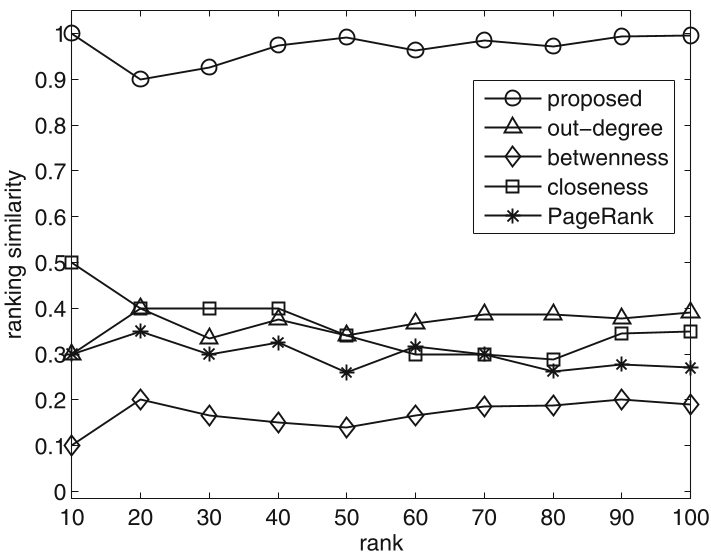 In the figure above, the circles (Proposed CTIC) consistently achieve near-perfect similarity with the true influential nodes, while PageRank (asterisks) and Degree (triangles) lag significantly behind.
Behavioral Insight: Topics Move Differently
One of the most fascinating applications in the paper is the Topic Analysis. By applying CTIC to different types of URLs:
- Musical Batons (Internet Games): Small delay, high diffusion (People love to play along).
- Emergency Alerts (Missing Children): Extremely high speed (low delay), moderate diffusion.
- Fortune Telling: Wildly inconsistent (depends on individual interest).
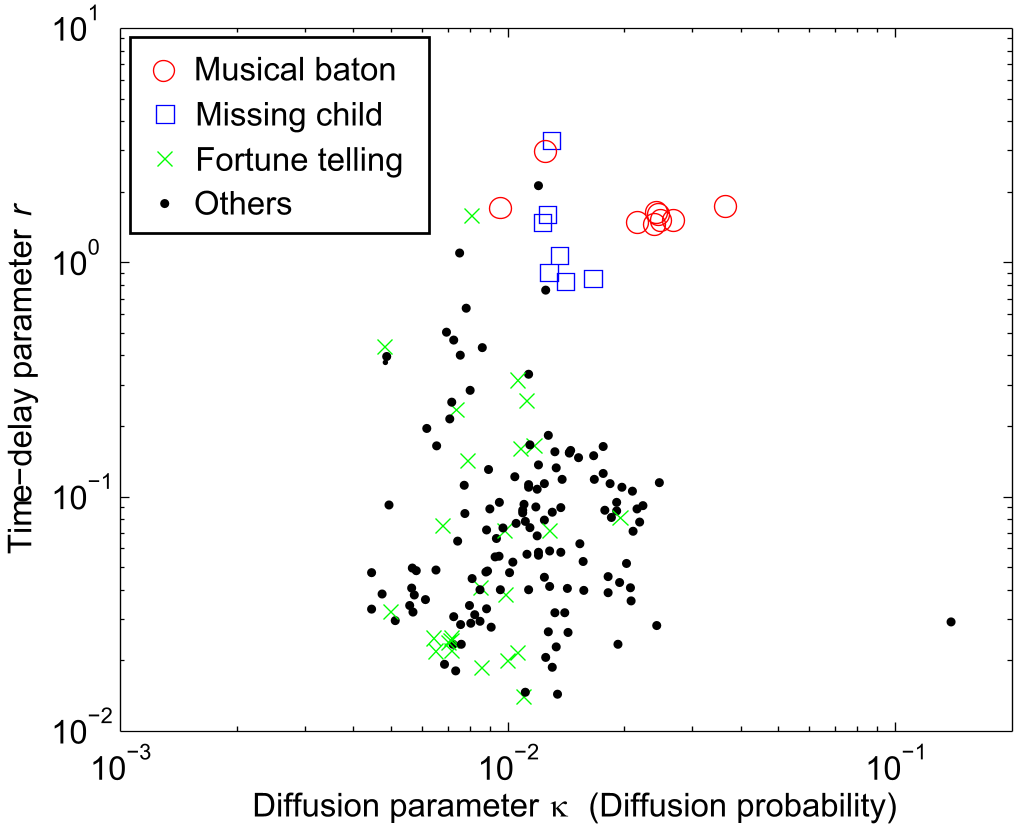 This scatter plot visualizes the DNA of a topic: the x-axis is diffusion probability, and the y-axis is speed (delay parameter).
Critical Insight: The Value of Asynchronicity
The authors' most profound observation is that information diffuses faster when a node has multiple active parents. This isn't just a psychological effect; it's a mathematical reality of competing exponential distributions. Simple average statistics fail to capture this "intrinsic speedup," making a model like CTIC vital for anyone trying to predict the reach of content in a complex network.
Conclusion & Future Work
The CTIC model provides a robust, principled framework for social network analysis. While the authors currently use an exponential distribution for simplicity, they acknowledge that real-world "lag times" might follow a power-law. The future of this research lies in incorporating these more "heavy-tailed" distributions to map the weird and wonderful ways information travels through the human web.