
Network Contribution Games: Balancing Social Budgets and Collaborative Incentives
Contribution Games in Social Networks
This paper introduces "Network Contribution Games," a framework where agents in a social network allocate finite effort budgets across multiple collaborative projects (edges). The study characterizes the existence, computational complexity, and efficiency of pairwise equilibria (states resilient to bilateral deviations) across various reward function types, establishing a standard Price of Anarchy (PoA) of 2 for most natural settings.
TL;DR
How much effort should you put into your different professional collaborations or friendships? This paper models this daily dilemma as a Network Contribution Game. By analyzing how agents distribute a finite budget across various projects in a social network, the authors prove that even if agents only cooperate in pairs, the resulting social welfare is at least 50% of the theoretical optimum (Price of Anarchy 2).
The "Why": Moving Beyond Unilateral Rationality
In classical Game Theory, we often look for Nash Equilibria, where no single person wants to change their strategy alone. However, in social networks, this is often "unreasonable." If you and a colleague both benefit from a project, you might both decide to work harder on it together, even if neither of you would benefit by working alone.
The authors argue that we must focus on Pairwise Equilibria. A state is stable only if no individual and no pair of individuals can change their contributions to improve their respective utilities.
Methodology: The Geometry of Reward
The paper categorizes the "success" of a project between agents and using a reward function . The core insight is that the behavior of the game changes drastically based on whether these rewards show "diminishing returns" (concave) or "increasing returns" (convex).
Key Reward Classes:
- Class C (Convex-like): Functions where marginal returns increase () and partners' efforts complement each other (). Examples include or .
- Minimum Effort: . Success is limited by the "weakest link."
- Concave: Functions where the first hour of work is more valuable than the tenth.
Critical Results: Efficiency and Complexity
1. The Power of Two (Price of Anarchy)
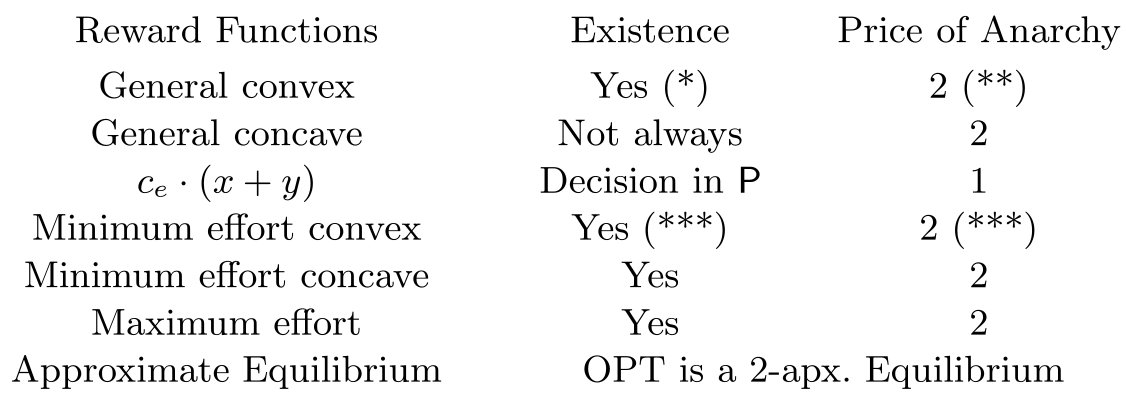
One of the most elegant results in the paper is that for a vast majority of these functions, the Price of Anarchy (PoA) is exactly 2. This means that in the worst-case stable outcome, the total social welfare is at least half of what a central "benevolent dictator" could achieve. This holds for both the Class C convex functions (Theorem 1) and concave functions (Theorem 5).
2. The Existence Paradox
While the PoA is low, finding an equilibrium is not always easy:
- The "Good" News: If all projects use a product-based reward (), an equilibrium always exists and can be found quickly.
- The "Hard" News: If a network mixes "additive" rewards () and "product" rewards (), deciding if a stable state even exists becomes NP-hard. The interplay between clustering effort (product) and spreading effort (additive) creates cycles that prevent stability.
3. Minimum Effort Games
In "weakest-link" scenarios, the authors find that with uniform budgets, a pairwise equilibrium always exists for convex rewards. This is vital for organizational design: it suggests that if everyone has similar resources, they can naturally find a stable way to coordinate on their most important shared tasks.
Deep Insight: Why is the PoA 2?
The physical intuition behind the PoA 2 bound lies in the bilateral nature of the deviation. Since any two partners can coordinate to maximize their mutual edge, they effectively "internalize" the local benefit of that edge. The factor of 2 arises because, while they coordinate for their own sake, they don't account for how their budget shift might negatively affect other partners they are connected to.
Conclusion and Limitations
This research provides a rigorous foundation for understanding how rational agents collaborate under constraints. However, it assumes agents have perfect information about their neighbors' reward functions. Furthermore, it focuses on pairs; in the real world, groups of three or more often collaborate.
Future Outlook: The next frontier is extending these bounds to "Hypergraph Contribution Games," where projects involve large teams. For now, this paper serves as a vital reminder that in social architectures, allowing even the simplest form of coordination (pairwise) dramatically improves the efficiency of the crowd.