
Systems Thinking: A New Frontier in Controlling Twitter Conspiracy Theories
How to Control Coronavirus Conspiracy Theories in Twitter? A Systems Thinking and Social Networks Modeling Approach
This paper proposes a systemic framework using Systems Thinking and Organizational Cybernetics to analyze and control the spread of COVID-19 conspiracy theories on Twitter. By modeling social media as a complex, dynamic feedback system, the authors demonstrate how noncooperative game theory and cybernetic loops can interpret the "tug of war" between misinformation spreaders and debunkers.
TL;DR
Social networks are not just graphs; they are living, breathing dynamic systems. This paper introduces a Systems Thinking approach to tackle the COVID-19 "infodemic," moving beyond simple fact-checking to a complex Organizational Cybernetics model. By treating the battle between misinformation and truth as a noncooperative game, the researchers provide a blueprint for controlling digital chaos.
Deep Dive into the Problem: Why Fact-Checking is Not Enough
Standard approaches to misinformation often treat it as a static classification task—identifying a tweet as "true" or "false." However, the authors argue that social networks are NP-hard problems characterized by extreme dynamicity.
Current tools often fail because:
- They don't account for Information Diffusion over time.
- They ignore the Adaptive Strategies of malicious actors who change their tactics the moment they face resistance.
- They overlook the Feedback Loops where a debunking attempt might unintentionally amplify a rumor (Backfire Effect).
Methodology: The Cybernetic Blueprint
The heart of this research lies in Organizational Cybernetics, the study of control and communication in complex systems. The authors propose that any influence operation on Twitter can be modeled as an "Organization" interacting with an environment.
1. The Feedback Loop
The model utilizes the concept of the Black Box. Instead of trying to find the "source" of every single node, managers should monitor the outputs (trending hashtags, sentiment shifts) and manipulate inputs (counter-messaging, policy changes) to achieve a "steady state."
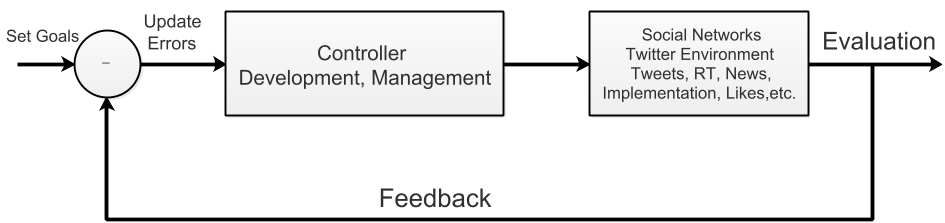 Fig 1: The negative feedback block diagram illustrates how Twitter networks respond to corrective inputs.
2. The Integrated Multi-Level Architecture
The authors suggest a 5-tier structure for managing social network influence:
- Operational Level: Real-time tweeting and engagement.
- Control/Management: Monitoring day-to-day changes in the narrative.
- Development: The "War Room" that processes internal/external data to change strategy.
- Policy: The highest level that defines the ultimate goal (e.g., public safety vs. protest mobilization).
Case Study: The Michigan Capitol Protests (May 2020)
The researchers applied this model to a real-world "tug of war" during the COVID-19 lockdowns. Using a dataset of ~5,000 tweets, they identified how two opposing factions—pro-gun/anti-lockdown and pro-peace/government—interacted.
- Day 1 (Anticipation): Fear-based reporting of armed rallies triggered negative feedback from opposition groups.
- Day 2 (Escalation): As pro-protest tweets gained "score" (a metric of retweets and engagement), the opposition shifted from reporting to policy advocacy (e.g., #StudentsDemandAction).
- Day 3 (Peak Conflict): Unpredictable, high-volume interaction where both sides optimized their "Policy Level" strategies to influence the physical environment (the State House).
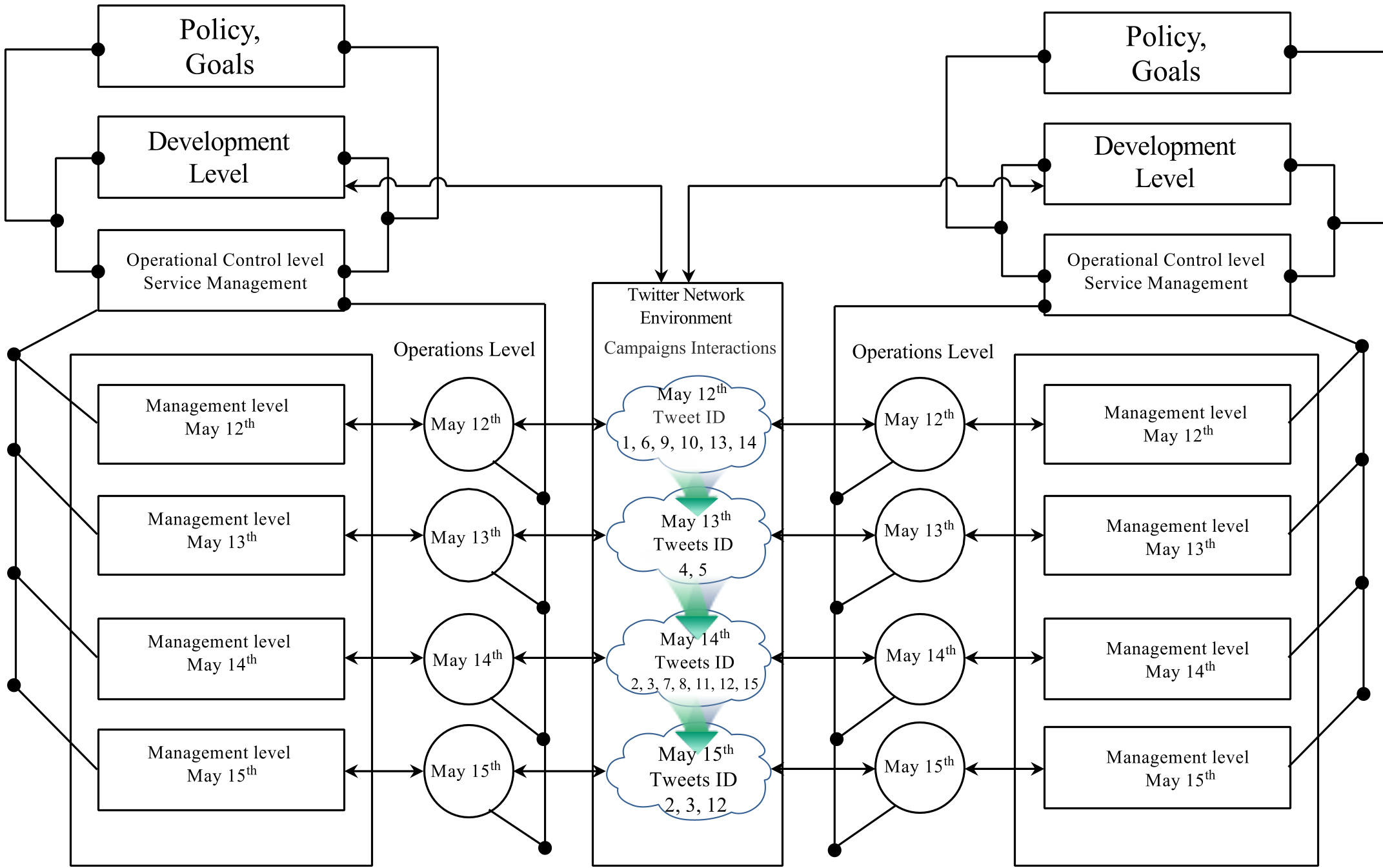 Fig 4: The non-cooperative interaction model shows how two competing "organizations" utilize cybernetic loops to dominate the Twitter landscape.
Critical Insight & SOTA Comparison
While traditional Social Network Analysis (SNA) focuses on Centrality Measures (who is the most important person?), this paper focuses on Dynamic Vitality (how is the system evolving?).
The core contribution is the shift from Qualitative Fact-Checking to Quantitative System Control. By scoring tweets and mapping them to cybernetic functions, the authors provide a way to "steer" a network's behavior, much like an engineer steers a mechanical system using feedback loops.
Conclusion & Future Outlook
This work serves as a foundational step toward "Digital Cybernetics." The authors conclude that:
- Complexity Theory is essential for predicting "small actions" (butterfly effect) that lead to large-scale radicalization.
- Game Theory must be integrated into social media algorithms to anticipate malicious pivots.
The future of social media management isn't just better AI filters; it's a Systems Thinking overhaul that understands the hidden interdependencies between users, algorithms, and the physical world.