
To Post or To Lurk: Driving Social Media Synergy via Generalized Metanorms
Effects of Controllable Facilitators on Social Media: Simulation Analysis Using Generalized Metanorms Games
This paper introduces the Generalized Metanorms Game to model social media participation as a public goods problem. It investigates how controllable facilitators (agents) influence the evolution of user cooperation—specifically posting and commenting—using agent-based simulations.
TL;DR
Social media is essentially a "Public Goods Game" where everyone wants to read, but few want to pay the cost of posting. This paper explores how "Facilitator Agents" can solve this. The big takeaway? If your bots only comment without posting original content, they might actually be killing your platform.
The "Lurker" Problem: Social Media as a Public Good
In the digital age, information is a public good: non-excludable and non-rivalrous. This creates a massive incentive for free-riding. We all enjoy the benefits of Twitter or Facebook, but posting an insightful article or a thoughtful comment takes time and effort (cost).
Traditional game theory, like Axelrod’s Norms Game, suggests punishment is the key to social order. But how do you punish a "lurker" on social media? You can't. This research pivots the focus towards rewards (Likes and Comments) and asks: What kind of behavior should platform managers simulate to make users contribute more?
Methodology: The Meta-Reward Game
The authors extend the concept of "Metanorms" into a reward-based framework. In this simulation, agents play a multi-stage game:
- Stage 1 (Post): An agent decides whether to post an article (Cooperate) at a cost .
- Stage 2 (Comment): Others choose to reward that post with a comment (Reward) at cost .
- Stage 3 (Meta-Comment): Others reward the rewarded (Meta-reward) at cost .
The key logic is the Evolutionary Strategy. Agents observe the "fitness" (total payoff) of others and use a Genetic Algorithm to imitate the strategies of high-scoring users.
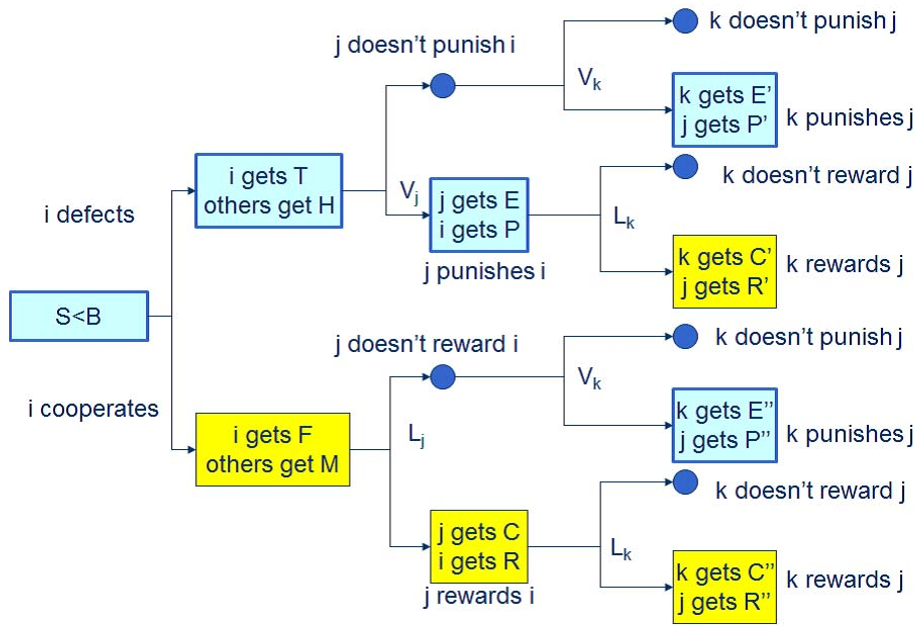 Note: Table 1 illustrates the payoff matrix where the benefits of reading articles must be balanced against the costs of posting.
The Hidden Danger of "Reactive" Bots
The most striking finding comes from the introduction of Controllable Facilitators. The researchers tested four personality types for these bots:
- C&R (The Model Citizen): Always posts articles and always comments.
- D&R (The Reactor): Never posts original articles but always comments on others.
While you might think any engagement is good, the D&R agents were toxic to the ecosystem. Because they comment without incurring the high cost of posting articles, their "net score" remains high. Other agents see these high scores and imitate the behavior of not posting.
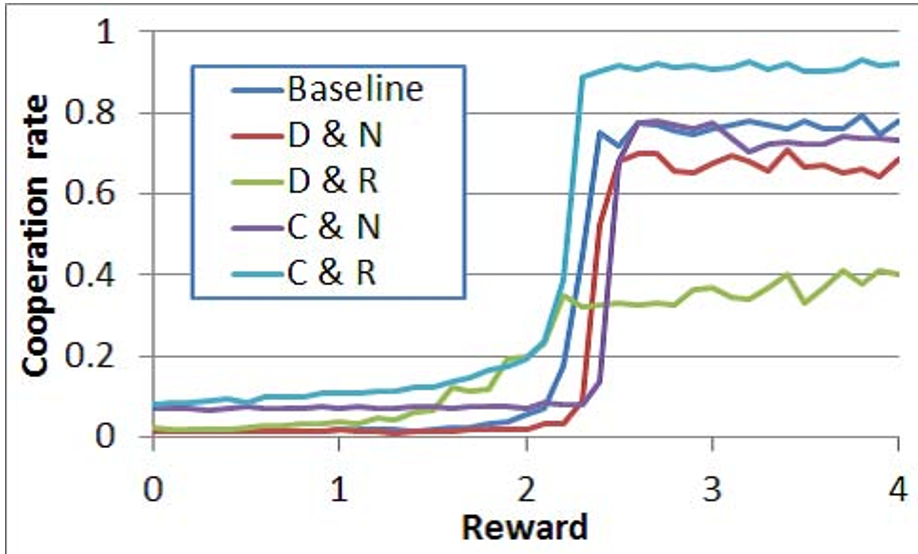 Fig 3. shows that C&R facilitators move the cooperation rate toward 1.0, while D&R facilitators cause it to crash.
Why It Works: Payoffs and Imitation
Why does the "Model Citizen" (C&R) work? In the simulation, agents who reward others (comments) gain high scores through meta-rewards. If the facilitator is a C&R type, it establishes a benchmark that "Posting + Commenting" results in high fitness. The community then converges on this high-contribution equilibrium.
Conversely, if the "top-ranked" user in a community is someone who only comments and never creates (D&R), the evolutionary pressure drives everyone to become a commenter only, and original content eventually disappears.
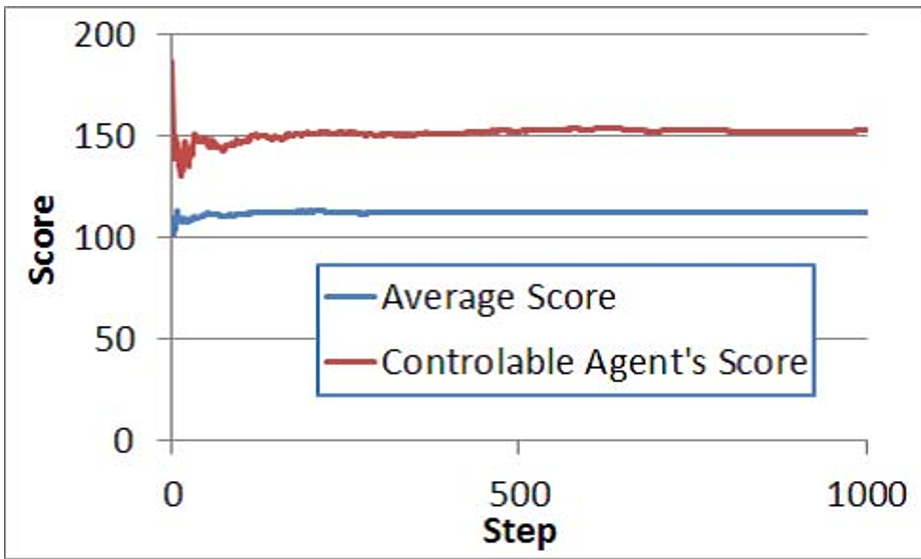 Fig 5. demonstrates how the specific strategy of the controllable agent dictates the "evolutionary path" of the entire population.
Strategic Insights for Platform Managers
- Don't Just "Like": If you are using automated accounts to boost a community, they MUST post original content. Being a "pure reactor" provides a bad template for human users to follow.
- Reward-to-Cost Ratio: Cooperation only stabilizes when (reward benefit) (reward cost). The "Like" button is powerful because it reduces the cost to almost zero.
- The "Social Vaccine": To protect a community from a "lurker" culture, one must inject active contributors who also engage intensely with others.
Conclusion
This study moves beyond the "stick" (punishment) and proves the power of the "carrot" (rewards) in digital spaces. However, it serves as a warning: the type of activity fueled by managers matters. To keep a community alive, your facilitators must be more than just fans—they must be creators.
Limitations: The model assumes a perfect graph (everyone sees everyone). Future research needs to test these dynamics in scale-free networks or "echo chambers" common in modern social media.