
Controlled Coalitional Games: The Tug-of-War Between Social Sharing and Operator Revenue
A Controlled Coalitional Game for Wireless Connection Sharing and Bandwidth Allocation in Mobile Social Networks
This paper introduces a "Controlled Coalitional Game" framework to optimize wireless connection sharing and bandwidth allocation in mobile social networks. The model integrates a coalitional game for content providers (CPs) to minimize delivery costs and a Markov Decision Process (MDP) for network operators (NOs) to maximize revenue, achieving a Strategic equilibrium between cooperative content distribution and resource management.
TL;DR
In the world of mobile social networks (MSNs), content providers (CPs) often face a dilemma: pay for expensive dedicated bandwidth or share connections with competitors to save costs. This paper presents a Controlled Coalitional Game—a mathematical framework that treats this social behavior not as a random occurrence, but as a system that network operators can "control" through bandwidth allocation to maximize their own revenue.
Background: The Social Distribution Shift
Mobile content distribution has moved beyond simple Client-Server models. Today, we rely on Opportunistic Networking: a few "seed" users download content from a base station, and then spread it to others via local Bluetooth or Wi-Fi encounters.
While this offloads traffic from the cellular network, it creates a complex economic battlefield. Content providers want to minimize their "Connection Price + Delivery Delay" cost. Network operators, however, want to maximize revenue by selling as many wireless connections as possible.
The Core Conflict: Rational Cooperation vs. Selfish Management
Existing research often assumes users or providers cooperate altruistically. This paper challenges that by introducing two layers of rationality:
- Content Providers (The Followers): They use "Split" and "Merge" strategies. If joining a coalition (sharing a line) reduces their cost, they merge. If a shared line becomes too congested (high delay), they split.
- Network Operator (The Leader): The operator isn't just a passive observer. By changing the bandwidth , the operator directly influences the "Delay" component of the CPs' cost, effectively forcing them to either huddle together or break apart.
Methodology: Mapping Social Dynamics to Math
The authors model the system using a hierarchical structure similar to a Stackelberg Game, but with a coalitional twist.
1. The Cost Function
For a content provider in a coalition , the cost is defined as: Where is the delay (Queueing time + Social transfer time) and the second term is the shared price.
2. The Operator's Strategy (MDP)
The operator views the "Coalition State" (who is grouped with whom) as a Markov State. They use an MDP to find an optimal policy —determining how much bandwidth to give to each connection to steer the providers toward states that yield the highest revenue.
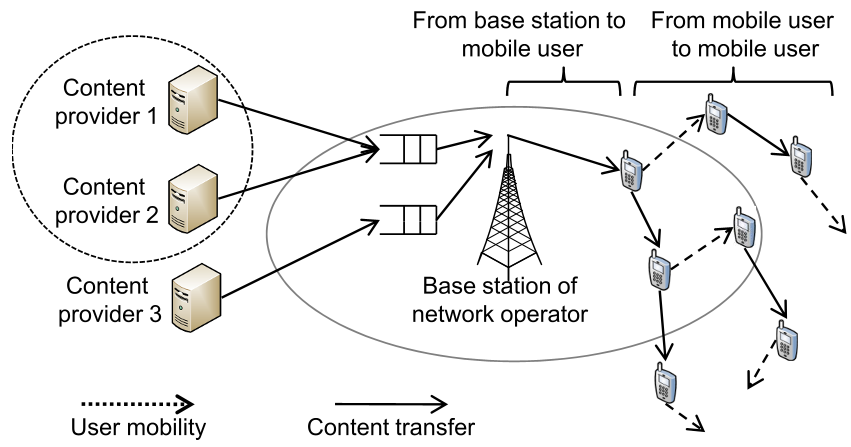 Fig 1: The interaction loop between Content Providers, the Base Station, and Mobile Users.
Key Insights from Experiments
The simulations revealed a fascinating "Coalition Breaking" strategy employed by the optimal operator.
- Strategic Throttling: When CPs formed a giant coalition (sharing one connection to save money), the operator would actually reduce the allocated bandwidth.
- The Result: The reduced bandwidth caused a massive spike in delay. To avoid this delay, CPs were forced to "split" and buy their own individual connections.
- Revenue Maximization: By breaking the coalition, the operator sells more connections, successfully maximizing long-term revenue.
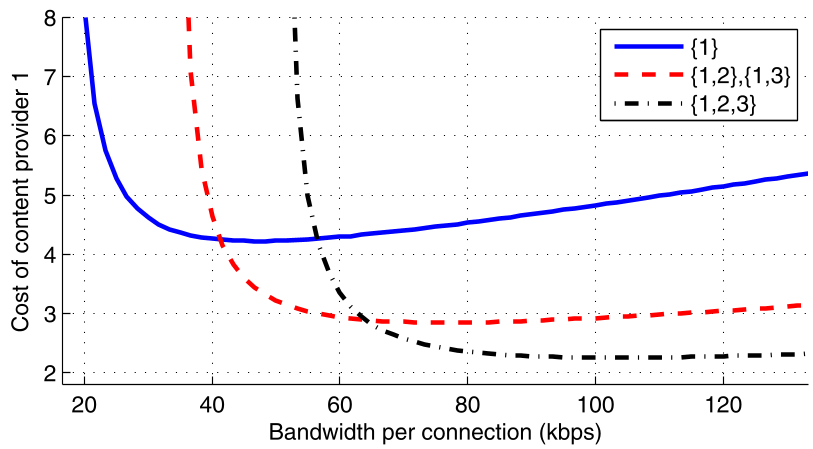 Fig 2: Analysis showing that the lowest cost for a provider shifts between different coalition sizes depending on the bandwidth 'b' provided by the operator.
Critical Analysis & Takeaways
The brilliance of this paper lies in the Transition Probability Matrix. By modeling how likely a provider is to make an "irrational" move ( ) versus a "best-reply" move ( ), the authors create a robust model for real-world unpredictability.
Takeaways for the Industry:
- Operators: Don't just set a flat price. Dynamic bandwidth allocation can be used to manipulate user cooperation patterns for higher profitability.
- Social Networks: The efficiency of peer-to-peer "SocialCast" is highly sensitive to the initial "seed" bandwidth. As seen in Fig 4, increasing the density of social contacts () acts as a natural buffer against high operator costs.
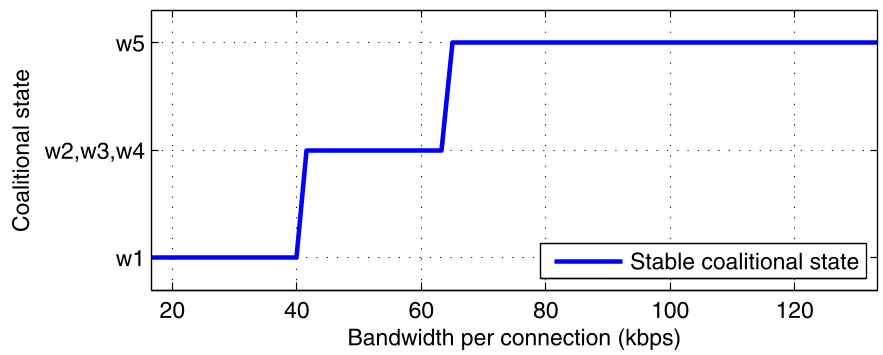 Fig 3: Increasing subscriber density reduces the overall cost, validating the power of the "Social" aspect in Mobile Social Networks.
Conclusion
This paper effectively bridges the gap between game theory and network engineering. While "Coalition Breaking" might sound predatory, it highlights the essential equilibrium required to keep infrastructure providers profitable while allowing content providers to benefit from social mobility.