
Distributed Influence: Decoding Message Passing in Social Networks
On the Convergence of Message Passing Computation of Harmonic Influence in Social Networks
The paper investigates the convergence of a distributed Message Passing Algorithm (MPA) for calculating "harmonic influence" in social networks. It proves that the algorithm converges asymptotically on any connected graph with a symmetric interaction Laplacian, providing a scalable alternative to solving multiple global Dirichlet problems.
TL;DR
How do you find the most influential person in a massive social network without seeing the whole "map"? This paper proves that a distributed Message Passing Algorithm (MPA)—where nodes only talk to their neighbors—can successfully estimate "Harmonic Influence" on virtually any connected network. While cycles in the graph introduce some noise, the algorithm remains stable and accurately ranks the most powerful nodes.
Background: The Price of Influence
In network science, Harmonic Influence measures a leader's ability to shift the average opinion of a network against a stubborn adversary (a "field" node). Mathematically, this is a discrete Dirichlet problem.
The traditional way to solve this is "grounding" the Laplacian matrix for every single node. If you have 1 million users, you solve 1 million linear systems. This is a computational噩梦 (nightmare) and requires a central server to know every single edge in the network. The quest for a distributed and scalable solution led to the MPA.
The Core Mechanism: How Messages Flow
The MPA operates on a simple premise: each node sends two values to its neighbor :
- : A weight reflecting the relative influence.
- : A partial sum of influence values.
The beauty of the MPA is that nodes update these values synchronously using only local information from their immediate neighbors.
The "Message Digraph" Visualized
To prove this works, the authors create a "Message Digraph." They transform the physical social network into a graph of dependencies between messages.
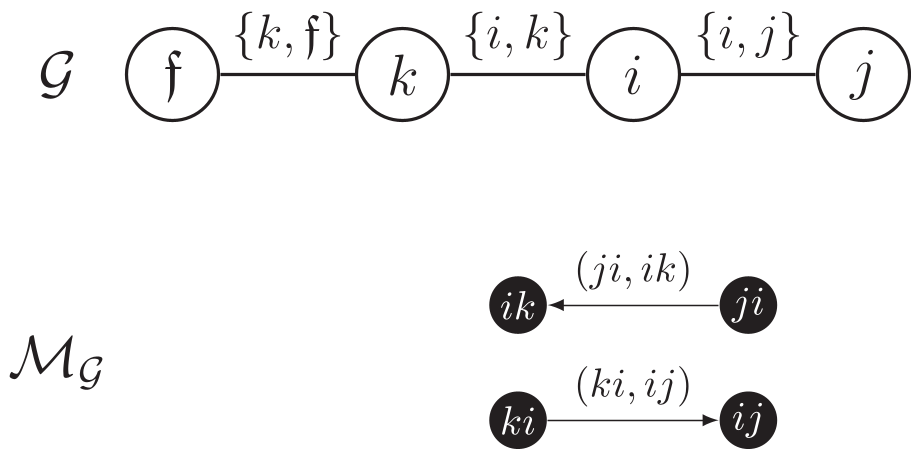 Figure 1: Mapping physical edges to directed message arcs. This abstraction allows the authors to use spectral radius analysis to prove stability.
Methodology: The Convergence Proof
The primary contribution is moving beyond "trees." On a tree (a graph with no cycles), the MPA is exact and fast. On a general graph, cycles create feedback loops.
The authors prove that if the interaction matrix is symmetric (meaning if I influence you 50%, you influence me 50%), the algorithm is guaranteed to settle into a steady state (converge). They use the Schur stability condition of the message matrix to show that the spectral radius , preventing the values from exploding.
Experimental Battleground: Performance vs. Cycles
The authors tested the MPA on random graphs (Erdős-Rényi) to see how it handles the "messiness" of real networks.
1. Speed and Accuracy
In a typical 50-node setup, the core messages () converge extremely fast ( steps). However, the final influence estimate () takes longer to stabilize as the information trickles through the loops.
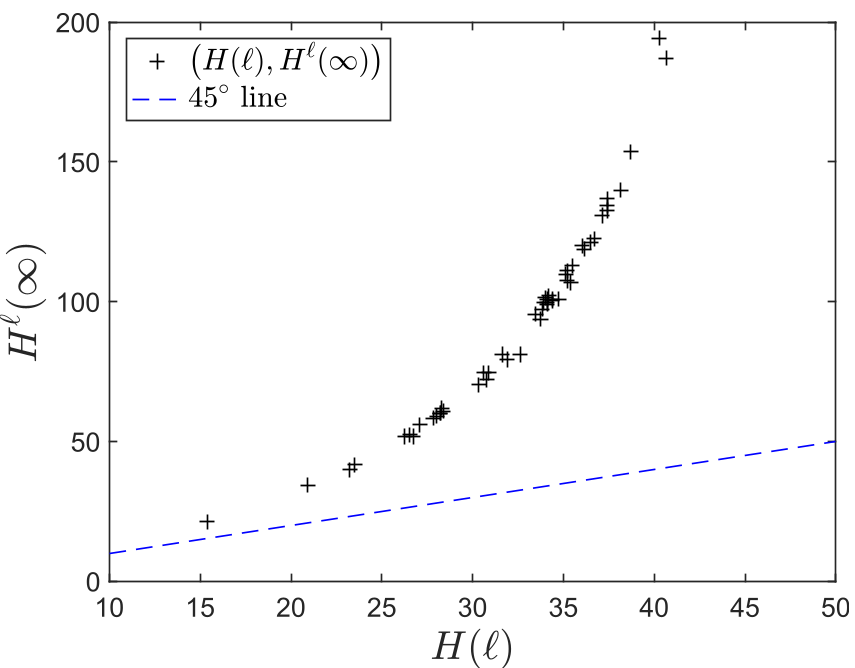 Figure 2: The distance to convergence. Notice how the messages (dashed) settle much faster than the final influence sum (solid).
2. The Scaling Factor
Does the algorithm choke as the network grows? No. Simulations show that the convergence time scales gracefully with . This makes it viable for extremely large datasets where traditional matrix inversion is impossible.
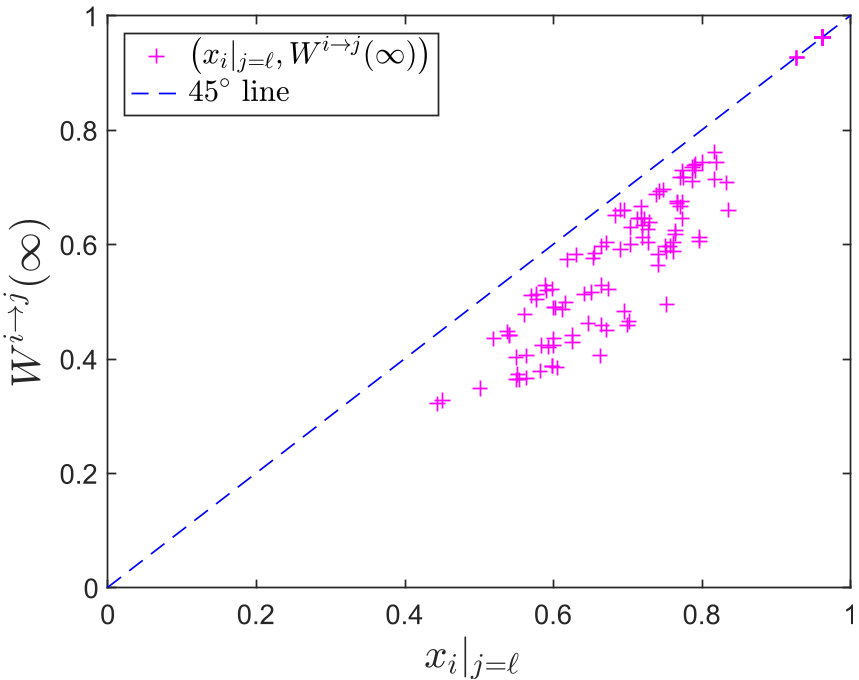 Figure 3: Convergence time vs. Network Size. Even as increases from 10 to 2000, the iterations required remain manageable.
Critical Insights
- The Overestimation Trap: On loopy graphs, the MPA tends to overestimate the absolute value of influence. However, it preserves the ranking. If the algorithm says Node A is more influential than Node B, it is almost certainly correct (Spearman correlation 0.99).
- Symmetry is Optional?: While the proof requires a symmetric Laplacian, simulations suggest the algorithm converges even on non-symmetric networks. This hints at a deeper, more robust property of message passing yet to be mathematically "captured."
Conclusion
Rossi and Frasca have successfully bridged the gap between theoretical "tree-only" algorithms and practical network applications. By proving asymptotic convergence on general symmetric graphs, they provide a green light for using distributed message passing in real-time social analytics, leader selection, and consensus-driven AI systems.
Future Outlook: The next frontier is proving convergence for non-reciprocal (directed) social interactions—the "Twitter/X" model—where I follow you, but you don't follow me.