
Convex Edges: Decoding Social Intimacy via Hidden Geometry and Ricci Curvature
Convex Edges in Social Networks
This paper introduces the concept of "Convex Edges" in social networks, quantitatively defined using discrete Ricci curvature in hidden geometry spaces. By applying Wasserstein distance (Optimal Transport) to evaluate edge intensity, the authors demonstrate that convex edges effectively identify highly stable, high-intensity social relationships and predict "frenemies" in complex networks.
TL;DR
Is a social link just a line between two dots? This paper argues it isn't. By treating networks as manifolds with "hidden geometry," the authors introduce Convex Edges. Using Ricci Curvature, they prove that the most stable social ties exist on "convex" surfaces where the geometric distance is effectively shorter than it appears. This framework successfully identifies close friends, predicts high-frequency interactions, and provides a geometric proof for Dunbar's number.
Background: The Geometry of Human Attention
In the "attention economy," our cognitive resources are finite. We cannot treat every "friend" or "follower" with equal intensity. While traditional graph theory focuses on the topology (who is connected to whom), it often ignores the geometry—the underlying tension and curvature that define the "strength" of a tie.
The authors pivot from "Popularity is Attractive" to a more nuanced view: how does the surrounding network structure "bend" the space between two people?
Methodology: Curvature as Tie Strength
The core innovation lies in the quantitative definition of a Convex Edge.
1. The Ricci Curvature Metric
The authors use the Wasserstein distance (also known as Earth Mover's Distance) to measure how much effort it takes to transport the "influence" of node 's neighborhood to node 's neighborhood.
- Convex Edge (): The neighborhoods are "closer" than the nodes themselves. This suggests high aggregation and stability.
- Concave Edge (): The neighborhoods are "further" apart, indicating instability or "frenemy" behavior.
2. Physical Intuition
Imagine two balls in space. If the neighbors are attracted to each other, the space "curves" inward (Convex), making the bond between the centers stronger. If the neighbors repel or are indifferent, the space is flat or concave.
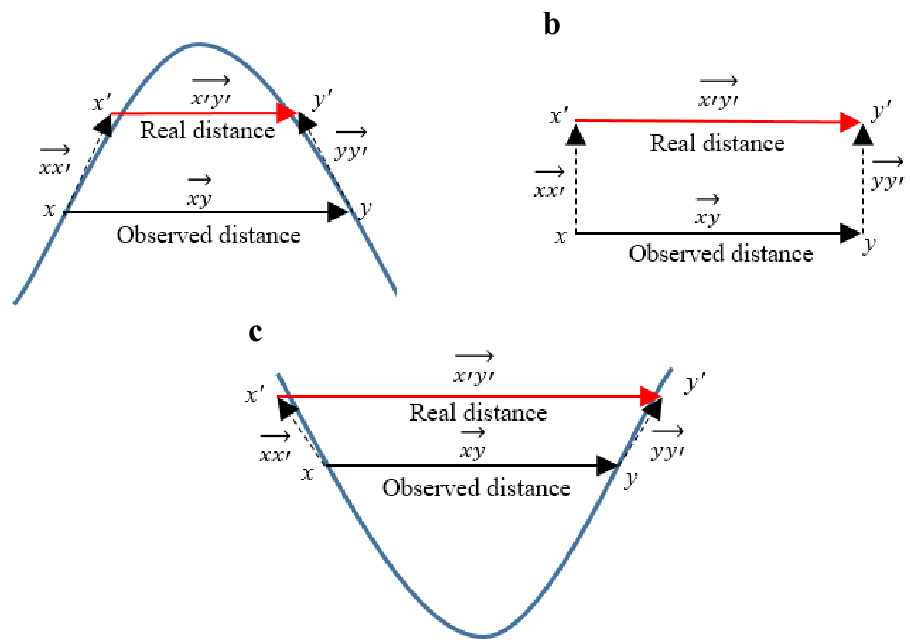 Fig 1. Geometric representation of (a) Convex, (b) Flat, and (c) Concave edges.
Key Insights from Real-World Data
1. Predicting High-Intensity Interaction
Using an e-mail-Eu-core temporal network, the authors found that edges with high Ricci curvature were almost certainly those with the highest frequency of e-mail exchanges. At a curvature threshold of 0.73, the precision for identifying "true" high-interaction edges reached 92.8%.
2. The "Similar Popularity" Rule
In the famous Zachary’s Karate Club study, the authors observed that convex edges predominantly occur between nodes of similar popularity (degree). Interestingly, they identified "frenemies"—nodes that are in the same popularity tier but belong to opposing factions—by looking for concave edges between high-degree nodes.
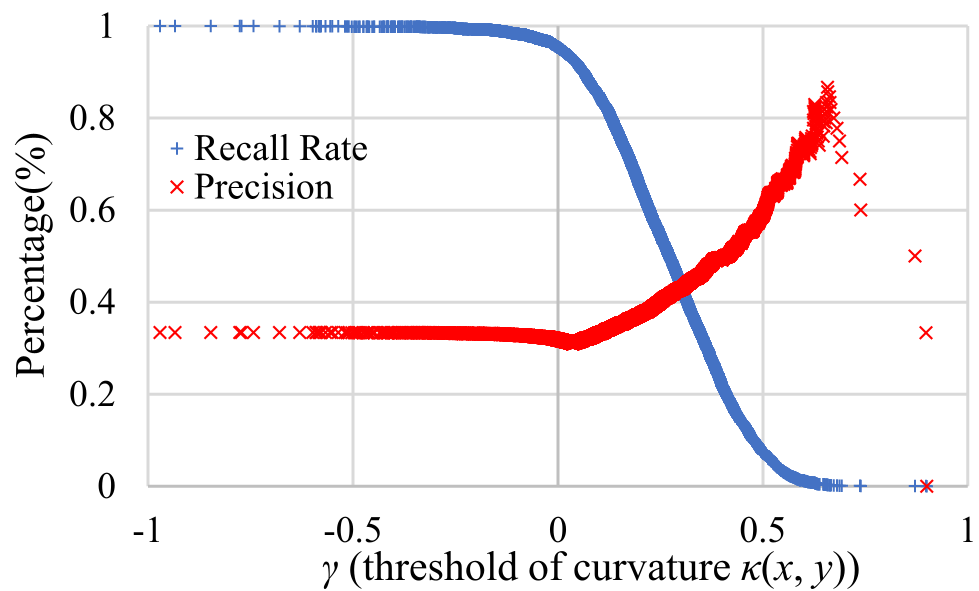 Fig 2. Precision and Recall for predicting high-interaction edges using curvature.
3. Dunbar’s Number & Attention Limits
Analysis of the Enron e-mail dataset showed a power-law distribution for convex edges. Most nodes maintain fewer than 200 stable (convex) relationships, providing biological and sociological validation for the theory of limited cognitive capacity.
Synthetic Network Evolution
The authors also tested their theory on ER, WS, and BA models. They found a fascinating trend: as networks become denser (more edges), the average Ricci curvature increases linearly with the log of the degree.
- Scatter to Aggregation: A sparsely connected network is mostly concave (scattered). As it evolves and clusters form, it transitions to a convex (aggregated) state.
Critical Analysis & Conclusion
This work bridges the gap between differential geometry and social science. By introducing "Convexity," we no longer look at social ties as binary (exists/not exists) or just weighted; we see them as products of the geometric "pressure" exerted by the community.
Limitations:
- Computational Complexity: Calculating Wasserstein distance is , which is intensive for massive graphs, though approximation methods like Sinkhorn distances help.
- Static vs. Dynamic: While temporal data was used for validation, the curvature definition itself is primarily structural.
Future Outlook: This methodology could revolutionize Recommendation Systems. Instead of just suggesting "friends of friends," algorithms could prioritize "convex potential"—identifying pairs whose neighborhood geometry suggests a naturally stable and high-intensity bond.