
Convince a Dozen More: The Non-Linear Power of Multi-layered Social Networks
Convince a Dozen More and Succeed -- The Influence in Multi-layered Social Networks
The paper investigates the spread of influence in multi-layered (multiplex) social networks by extending the Linear Threshold (LT) model. It focuses on how different network topologies—such as Barabási–Albert (BA) and Watts–Strogatz (WS)—interact across layers to determine the success of global influence cascades.
TL;DR
Influence isn't a simple linear game. By studying Multi-layered Social Networks (MSNs), this research demonstrates that "viral" success is heavily dependent on how layers (like email, social media, and physical meetings) interact. Using the Linear Threshold (LT) model, the authors show that reaching a "critical mass" of seeds can lead to a sudden, explosive spread of influence, where convincing just a few more people can mean the difference between total failure and absolute success.
Problem & Motivation: The Fallacy of the Flat Network
In network science, we often simplify reality by treating all connections as one type. However, you aren't just a node in a "friendship" graph; you are simultaneously a node in an email network, a professional network on LinkedIn, and a physical community.
Prior work often ignored these layers, treating them as independent or merging them into a single "flat" graph. This is problematic because:
- Dynamic Profiles: Information flows at different speeds on different channels.
- Bridge Effects: A person influenced in one layer (e.g., seeing an ad on Facebook) becomes a carrier who can spread that influence in another layer (e.g., a face-to-face dinner conversation).
The authors argue that the topology of these individual layers and the overlap of nodes across them are the hidden drivers of social influence.
Methodology: Crossing the Threshold in 3D
The core of this research is grounded in the Linear Threshold (LT) Model. In this model, each person has a "resistance" (threshold ). They only adopt an innovation if a certain percentage of their neighbors have already done so.
The Multiplex Shift
In a multi-layered environment, the activation condition is calculated across the total neighborhood across all layers.
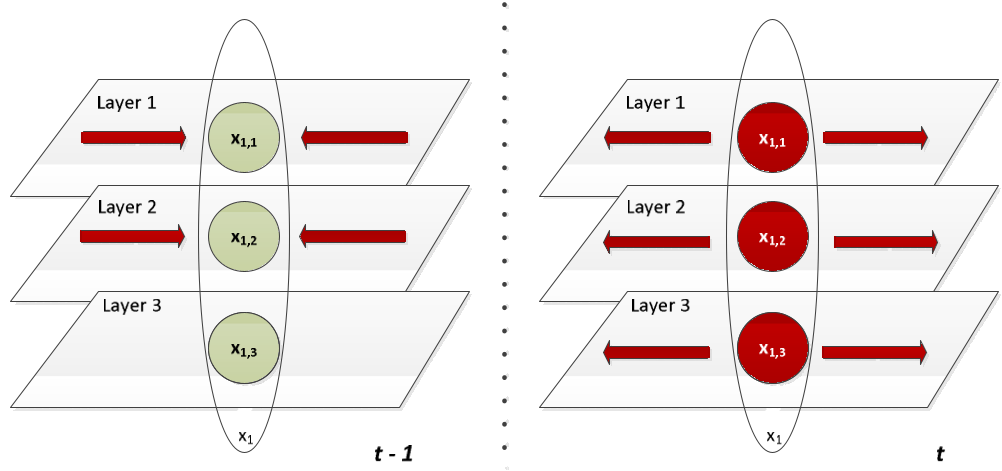
As seen in the figure above, a node might be below the threshold in Layer 1, but when its neighbors in Layer 2 also become influenced, the "collective pressure" pushes over the edge. Once is influenced, it immediately becomes a source of influence in all layers it belongs to, potentially sparking sub-cascades in layers that were previously dormant.
Experiments: How Topology Changes the Game
The authors simulated influence on four network types:
- Watts–Strogatz (WS): Small-world properties.
- Barabási–Albert (BA): Scale-free, "rich-get-richer" dynamics.
- Erdős–Rényi (ER): Random graphs.
- Square Lattice (LA): Rigid, grid-like structures.
Key Finding 1: The BA Advantage
The Barabási-Albert model (BA-BA layers) was the easiest to "infect." Because BA networks have high-degree hubs, influence reaches these hubs quickly, who then broadcast it to the masses. In these networks, a mere 3-5% seeding was enough to influence the entire population.
Key Finding 2: The ER Obstacle
Conversely, Erdős–Rényi (ER) layers acted as "influence sinks." Even when paired with more efficient networks, the random nature of ER connections made it difficult for cascades to build momentum, often requiring 30% or more initial seeds to reach a tipping point.
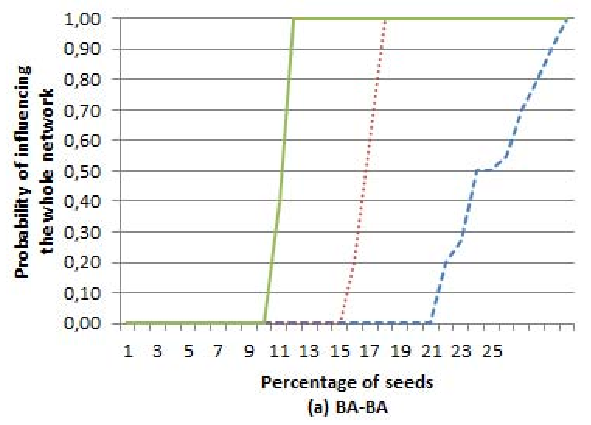 Figure: The steep S-curves show that increasing seeds from 5% to 10% can jump the success probability from nearly zero to 100%.
Critical Analysis & Conclusion
The most striking insight is that the probability of existence (P)—or how many people are present on multiple layers—doesn't change the nature of the influence curve; it just shifts it. This suggests the topology type (e.g., Scale-free vs. Random) is a much more dominant factor than the sheer "connectivity" between layers.
Takeaway for Marketers and Sociologists
If you are planning a viral campaign:
- Identify the Network Model: If your target audience resides in a scale-free environment (like Twitter/X), you need very few seeds.
- The "Dozen More" Rule: Because the process is non-linear, if your campaign is stalling, don't give up. A very slight increase in the seed budget might trigger a phase transition that captures the whole network.
Limitations
The study assumes a constant threshold () for all nodes and treats all layers as equally important. In reality, a recommendation from a close friend (face-to-face layer) usually carries more weight than a LinkedIn post (professional layer). Future research incorporating layer weighting and directed links will be essential to perfecting these predictive models.
Final Verdict: This paper provides a crucial mathematical foundation for understanding why some ideas "die" in one context but "explode" when they leap across layers.