
CNN-Based Emotion Detection: Why Random Initialization Might Be All You Need
A Convolutional Neural Network Model for Emotion Detection from Tweets
This paper proposes a deep learning framework for binary emotion detection (positive/negative) from informal Twitter text using a multi-channel Convolutional Neural Network (CNN). The model achieves 80.6% accuracy on the Stanford Twitter Sentiment dataset by employing trainable, randomly initialized word vectors that adapt to the specific nuances of social media language.
TL;DR
Researchers from Ain Shams University have developed a robust CNN framework designed specifically for the messy, informal world of Twitter. By using a triple-filter convolutional approach and—surprisingly—randomly initialized word vectors that evolve during training, the model achieves a high-performing 80.6% accuracy in distinguishing positive from negative sentiments.
Context: The Struggle with Informal Language
Sentiment analysis on social media is notoriously difficult. Unlike formal prose, tweets are riddled with slang, abbreviations, and unique syntactical structures. Traditional lexicon-based methods (which use pre-defined dictionaries of "good" and "bad" words) often fail because they cannot capture the implicit relationships between words in a specific context.
While deep learning has shifted the field toward word embeddings (dense vectors), the common wisdom is to use pre-trained vectors like Word2Vec. This paper challenges that necessity, proving that the Inductive Bias of a CNN is powerful enough to organize a random latent space into a meaningful semantic map.
Methodology: The Parallel CNN Architecture
The core of the methodology lies in how the model "sees" a sentence. It treats a tweet not as a sequence, but as a matrix where each row is a word vector.
1. The Embedding Layer
Instead of loading a heavy pre-trained model, the team starts with a [50,485 * 300] matrix of random numbers. Because this layer is trainable, the backpropagation algorithm moves these random points in the 300-dimensional space until words with similar "emotional weight" cluster together.
2. Triple-Window Convolution
To capture different lengths of expressions (e.g., "good," "very good," or "not very good"), the model uses three parallel CNN paths:
- Small Window (3): Captures short phrases.
- Medium Window (5): Captures mid-length context.
- Large Window (7): Captures broader sentential structure.
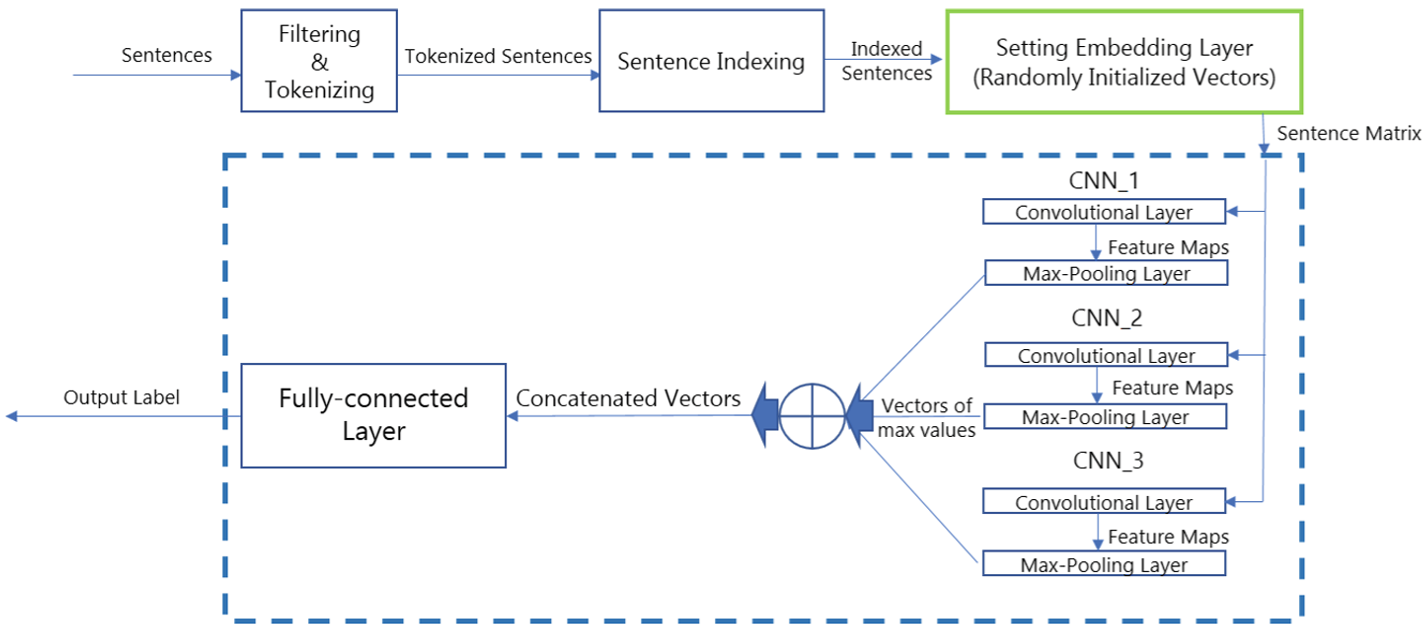
The outputs are processed via Max-Pooling—retaining only the most "salient" feature from each map—concatenated, and fed into a Sigmoid-activated fully connected layer for final classification.
Experimental Validation
Using the Stanford Twitter Sentiment dataset (1.6 million tweets), the authors trained on 80k samples.
Key Performance Insights:
- Accuracy: Reached 80.6%, which is competitive with more complex architectures that use character-level or pre-trained features.
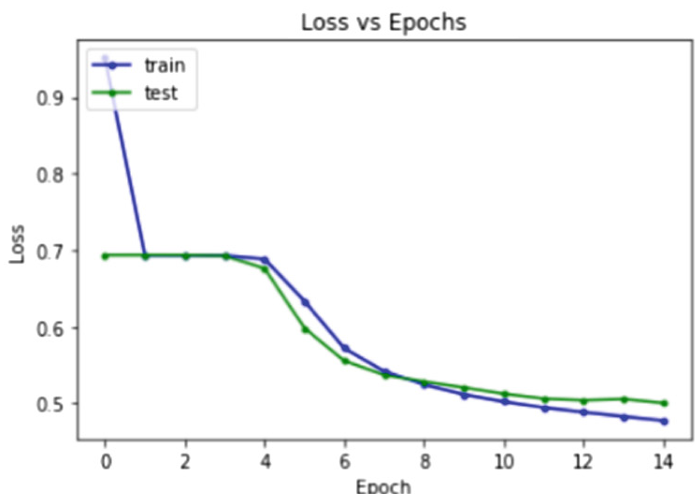
- Stability: As shown in the training logs, the model reaches equilibrium around the 15th epoch. The gap between training and testing loss remains narrow, suggesting the use of Dropout effectively prevented over-fitting.
Critical Analysis: The Power of Task-Specific Learning
The most striking takeaway is the success of Random Initialization. In many NLP tasks, practitioners spend significant time fine-tuning pre-trained GloVe or BERT embeddings. This study suggests that for binary sentiment tasks in niche domains (like Twitter), the signal-to-noise ratio is high enough that the model can define its own "emotional vocabulary" from scratch safely.
Limitations:
- Context Length: The model was tested with a maximum sentence length of 8 words. While typical for tweets, this might struggle with longer, more nuanced threads.
- Granularity: Binary classification (Pos/Neg) ignores the "neutral" class, which is a significant portion of social media traffic.
Future Outlook
The authors plan to explore Character-level embeddings to handle typos and "out-of-vocabulary" words (like loooooove), which are prevalent on Twitter. This work serves as a solid baseline for developers looking for efficient, lightweight emotion detection without the overhead of massive pre-trained transformers.
Keywords: CNN, Sentiment Analysis, Word Embeddings, Twitter Mining, Deep Learning.