
The Anatomy of Collective Creativity: Characterizing Mass Cooperation on Nico Nico Douga
Characterizing the nature of interactions for cooperative creation in online social networks
This paper investigates the nature of large-scale artistic cooperation within the Japanese online social network Nico Nico Douga (NND). The authors propose two novel frameworks: a set of metrics (SSI, RI, CI) to characterize interaction types and a formal typology of "Indirect Roles" (e.g., Global Inspirers, Building Blocks) to categorize creative contributions based on their topological position in reference networks.
TL;DR
In this seminal study, researchers bridge the gap between social network structure and creative output. By analyzing millions of interactions on the Japanese video platform Nico Nico Douga (NND), they demonstrate that artistic cooperation behaves less like a conversation and more like a diffusion process. The study maps out how "Original Music" serves as a global catalyst for thousands of derivative works, categorized through a new typology of creative "Roles."
Problem & Motivation: Beyond "Following" and "Friending"
While we understand how information spreads on Twitter or how people connect on Facebook, we know surprisingly little about how people create together at scale. In platforms like NND, cooperation is decentralized: an amateur musician uploads a song, a singer covers it, an animator creates a 3D video for it, and a "Mashup" artist merges all of them.
Existing methods struggle to classify these interactions. Are they "Social" (like emails), "Informational" (like retweets), or "Academic" (like citations)? The authors realized that to understand mass cooperation, they needed to move from who is talking to how the creation itself is being used.
Methodology: Deciphering the Network Signature
The authors proposed a two-pronged approach.
1. The Interaction Profile (SSI, RI, CI)
To compare NND with other networks (like Enron emails or Twitter), they developed three metrics compared against "null models" (randomized versions of the graphs):
- Social Structure Impact (SSI): Does the network structure actually influence interactions?
- Reciprocity Impact (RI): Do people interact back-and-forth (Interpersonal) or is it one-way (Diffusion)?
- Concentration Impact (CI): Does a tiny minority receive all the attention?
2. The Typology of Creative Roles
The most innovative part of the paper is the definition of Indirect Roles for the videos themselves:
- Local Inspirers (LI): Videos that attract many "simple variants" (e.g., a karaoke version of a song).
- Global Inspirers (GI): Seminal works that spark complex, multi-layered derivative chains.
- Building Blocks (BB): Content like 3D models or textures used as components in unrelated projects.
- Aggregators (AGG): The "collectors" who combine multiple independent sources into one.
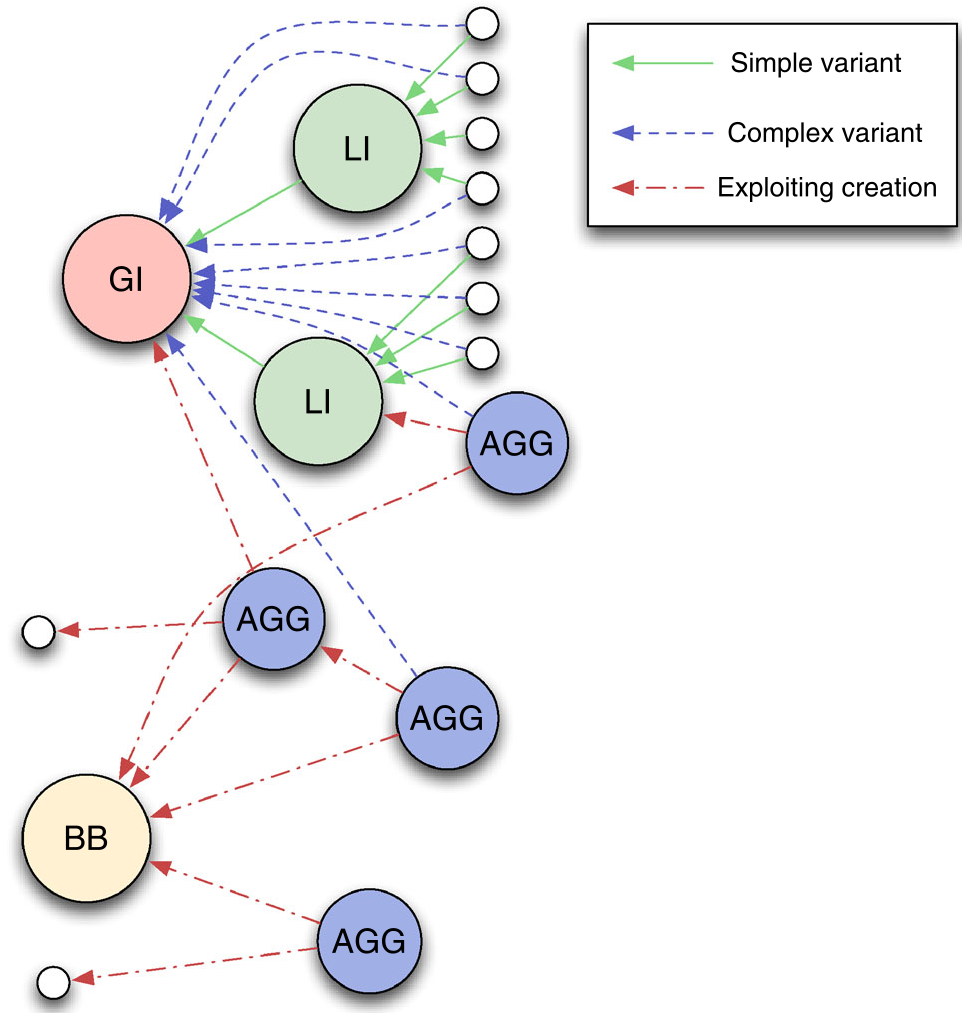 Figure: Visualizing the structure of Local vs. Global inspiration within NND subnetworks.
Experiments & Results: NND vs. The World
By comparing NND metadata (2.6 million videos) against DBLP (science), Twitter, and ENRON (email), the study reached a surprising conclusion: Artistic cooperation is functionally similar to a retweet.
| Network Type | SSI (Social Impact) | RI (Reciprocity) | CI (Concentration) | Profile |
|---|---|---|---|---|
| NND (Videos) | 0.36 | 0.023 | 0.37 | Diffusion |
| Twitter (Retweet) | 0.28 | 0.018 | 0.40 | Diffusion |
| Twitter (Mention) | 0.88 | 0.66 | 0.02 | Interpersonal |
| ENRON (Email) | 0.51 | 0.31 | 0.00 | Interpersonal |
Key Findings:
- Low Reciprocity: In NND, "Inspirers" rarely interact back with their "Adapters." It is a top-down influence flow.
- Role Disparity by Category:
- OriginalMusic is the king of Global Inspiration (high GI).
- 3DCG and Pictures are the "paints" and "bricks" of the ecosystem (high Building Block scores).
- Singing and Dancing videos are largely "Dead Ends"—they consume inspiration but rarely provide new seeds for others to build upon.
- The Super-Creator Correlation: There is a strong positive correlation between a user's activity level and the "Importance" (GI/LI/BB role) of the videos they produce. The most active users aren't just prolific; they are the structural pillars of the community.
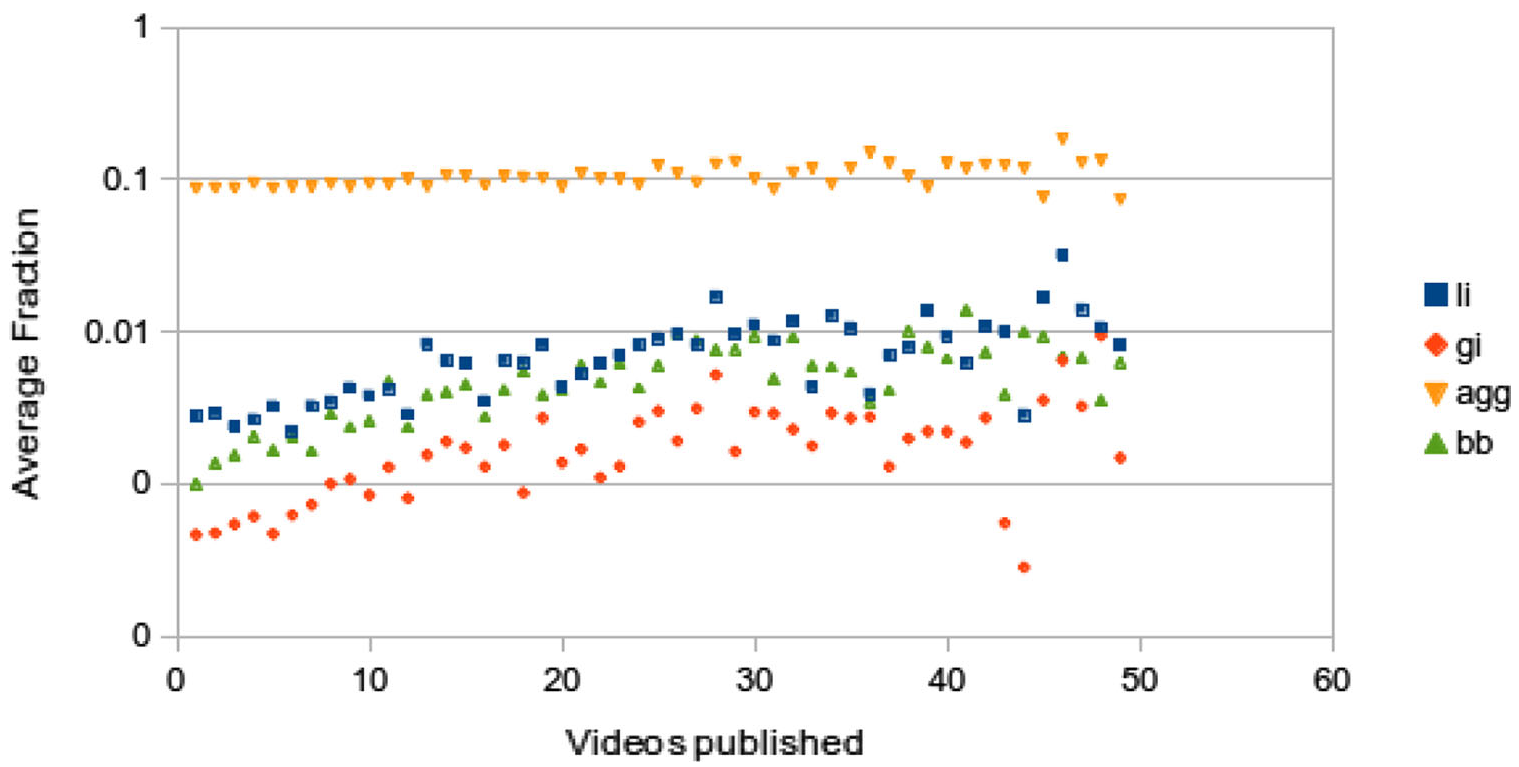 Figure: Analysis showing that as users publish more, their probability of producing "Inspirer" or "Building Block" content increases significantly.
Critical Insights & Conclusion
The value of this paper lies in its movement away from "human" social links to "content" reference links. It proves that Nico Nico Douga is not a community of peers talking to each other, but a factory of collective imagination driven by key influential assets.
Limitations
The study relies on explicit references (citations in descriptions). It may miss "soft" inspiration where a creator is influenced by a style but doesn't provide a link. Furthermore, the 2015-era data might not reflect current "short-video" trends where AI-driven algorithms (like TikTok) replace manual discovery.
Future Outlook
This methodology provides a roadmap for analyzing modern ecosystems like GitHub or HuggingFace, where "Models" and "Code" play the roles of Building Blocks and Inspirers. Understanding these topological roles is crucial for anyone trying to foster or manage large-scale digital cooperation.