
Beyond Efficiency: Balancing Task-Orientation and Sociability in Virtual Agents
Coordination and Sociability for Intelligent Virtual Agents
The paper introduces a multi-agent framework that combines BDI (Belief-Desire-Intention) agents with a social library to simulate Intelligent Virtual Agents (IVAs) with realistic human-like behaviors. By integrating ontologies for social relations and a market-based task exchange mechanism, the system achieves a state-of-the-art balance between task-oriented efficiency and social interaction.
TL;DR
Modern virtual environments often feel hollow because synthetic humans act as hyper-efficient robots rather than social beings. This paper presents a framework built on Jason (BDI agents) that integrates ontologies and a market-based auction model to simulate agents who can choose between being "productive" and being "social." By introducing a Sociability factor, the authors demonstrate how virtual characters can engage in reciprocity and planned social meetings, resulting in far more believable animations.
The "Robotic" Problem in Virtual Societies
In most multi-agent systems (MAS), the primary goal is optimization. Waiters in a virtual restaurant are usually programmed to serve the most customers in the shortest time. However, real humans don't work this way. We stop to chat with friends, we favor colleagues we owe favors to, and we occasionally prioritize social harmony over raw output.
The technical challenge lies in the Coordination Paradox:
- Self-interested agents cause resource conflicts (collisions at the coffee machine).
- Purely rational agents create efficient but "uncanny" robotic behaviors.
- The Solution: A system that balances rationality with a social network logic.
Methodology: The Social-Market Hybrid
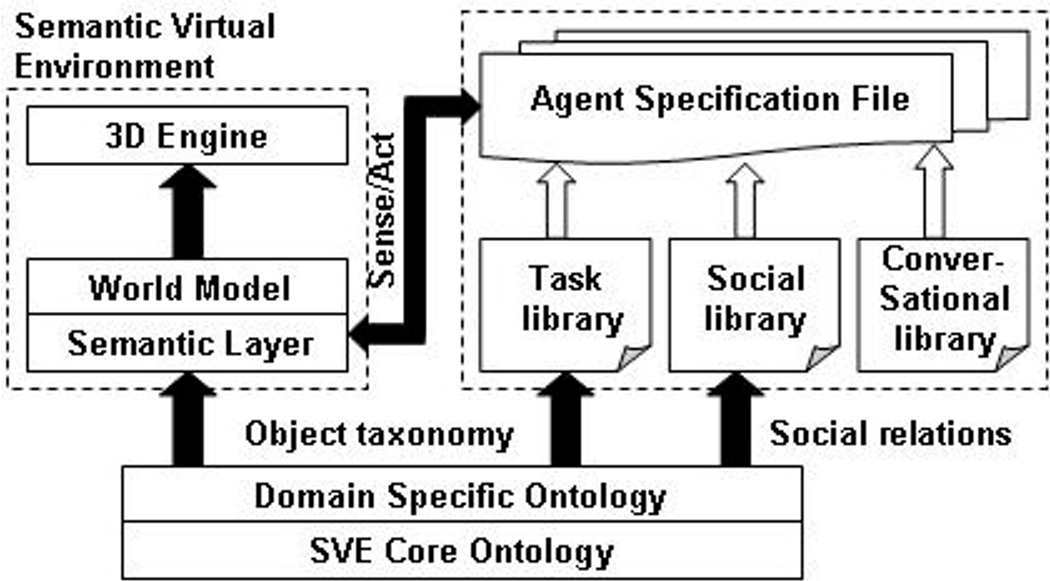
The core of this research is the Social Library, which operates alongside a Task Library and a Conversational Library.
1. Social Ontologies
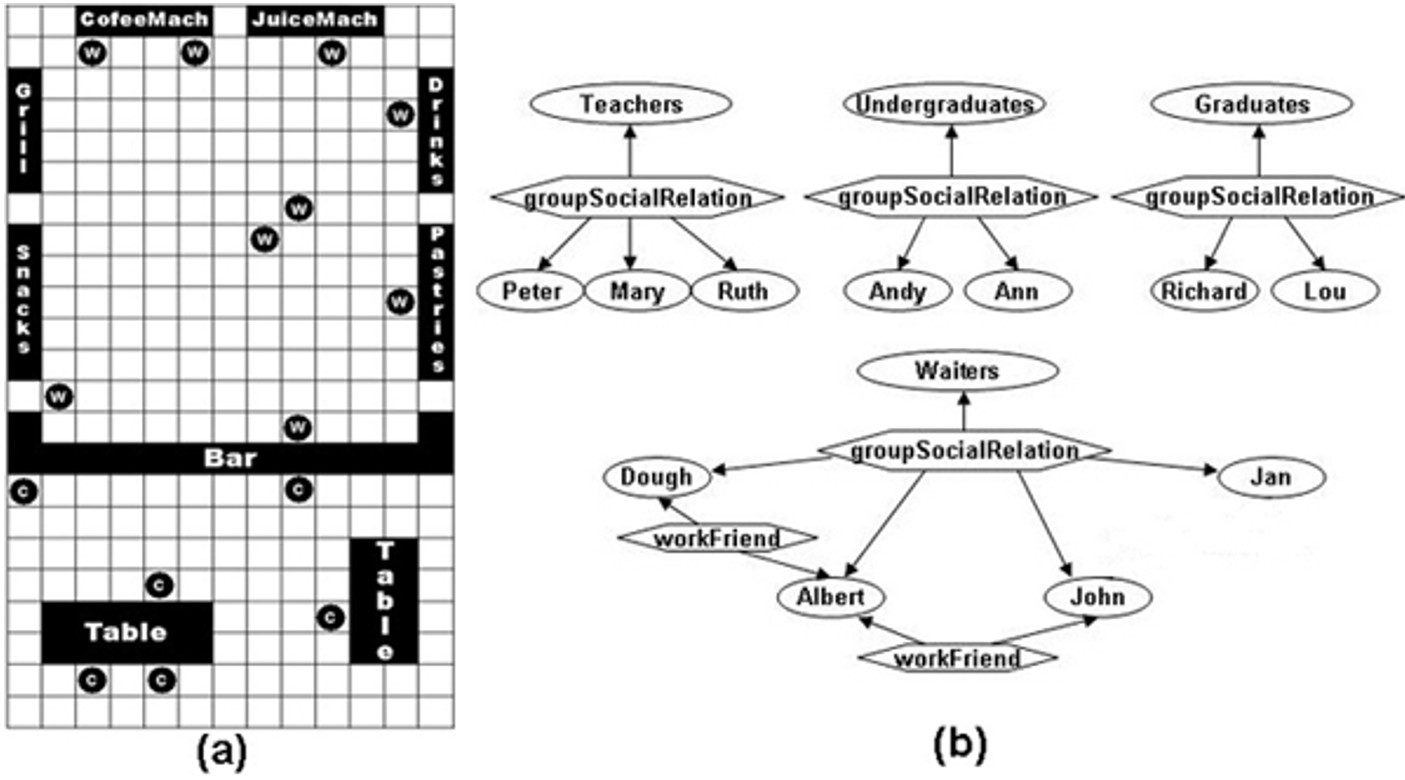
The system doesn't just "guess" who is a friend. It uses a structured ontology to define relations at two levels:
- Individual:
workFriend,parentOf, ormarriedWith. - Institutional: Membership in groups like
Waiters,Teachers, orGraduates.
2. The Auction Mechanism
To decide who performs a task, the agents run a First-Price Sealed-Bid (FPSB) auction. The winning bid is determined by two competing utility functions:
- Performance Utility (): "How fast can I do this?"
- Social Utility ( and ): "Will performing this task (or passing it) allow me to meet a friend or return a favor?"
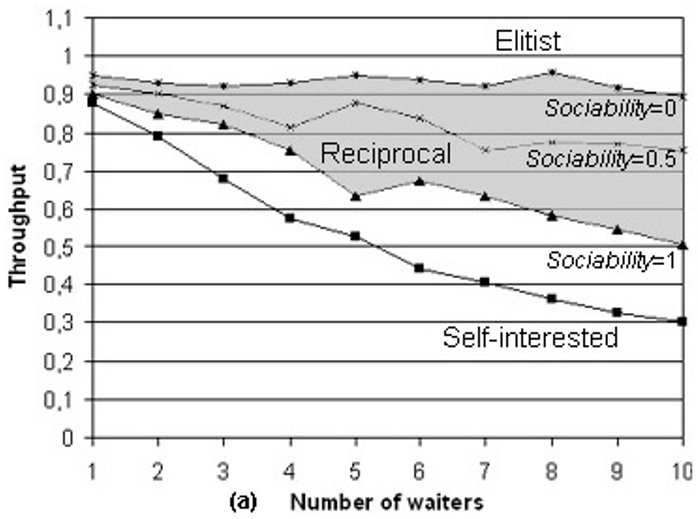
The Sociability Factor acts as the probability that an agent will choose the "Social Winner" over the "Rational Winner."
The Virtual Bar: A Proving Ground
The researchers tested their framework in a university bar scenario. They tracked two key metrics: Throughput (efficiency) and Animation Quality (social realism).
Key Findings:
- Reciprocity Matters: When , agents achieved an egalitarian workload. Instead of one waiter doing all the heavy lifting (specialization), the reciprocity factor () ensured tasks were exchanged fairly, echoing human social contracts.
- The "Social Sweet Spot": The study found that neither 0% nor 100% sociability was ideal. High sociability resulted in waiters chatting so much that customers went unserved, while low sociability felt lifeless. For the bar scenario, a factor between 0.1 and 0.3 yielded the most realistic "Animation" value.
Critical Insight & Future Work
The beauty of this work is its Inductive Bias toward social dynamics. It moves from "Agents as Tools" to "Agents as Society Members." While the current model uses static social relations, the authors suggest the next step is Dynamic Sociability—where agents adjust their social drive based on hunger, fatigue, or the shifting status of their relationships.
Conclusion
If we want Intelligent Virtual Agents to inhabit our digital worlds convincingly, we must stop treating them as solo optimizers. By formalizing "favors" and "friendship" into a mathematical auction, this framework provides a robust path toward more human-like, socially nuanced AI.