
Co-presence Communities: Mapping the Invisible Social Fabric through Pervasive Computing
Co-Presence Communities: Using Pervasive Computing to Support Weak Social Networks
The paper introduces "Co-presence Communities," a probabilistic framework for identifying groups of individuals who are regularly collocated in time and space using Bluetooth-enabled mobile devices. It presents a mining algorithm that combines edge detection (Laplacian of Gaussian) with incremental clustering (COBWEB/CLASSIT) to extract these communities from raw sensor data.
TL;DR
Researchers from the University of Southampton have developed a way to "see" the invisible social networks we inhabit daily—the people you see at the coffee shop or on your commute but never speak to. By mining Bluetooth data using a combination of signal processing (Laplacian of Gaussian) and incremental machine learning (COBWEB), they can automatically identify "Co-presence Communities" to facilitate ambient information sharing.
The "Familiar Stranger" Problem
Our lives are governed by temporal rhythms: the 8:05 AM train, the Tuesday project meeting, the Friday evening drinks. In these moments, we are surrounded by Familiar Strangers—weak social ties that lack formal support systems but are vital for community resilience and knowledge exchange.
Prior work in social networking has largely ignored these transient relationships because they are hard to track. Traditional sensors struggle to determine when a group becomes a "community" rather than just a random collection of people. This paper argues that if we can computationally represent these patterns, we can build systems like AIDE (Ambient Information Dissemination Environment), which acts as an automatic mailing list for people you are physically near.
Methodology: From Raw Signal to Community Insight
The "Co-presence Community Miner" algorithm treats human proximity as a signal processing challenge and a clustering problem.
1. Edge Detection via LoG
Instead of simply counting how many people are nearby, the system uses the Laplacian of Gaussian (LoG) operator. This is an elegant borrow from computer vision; just as LoG finds edges in images, it here finds "social edges"—the exact moments when the composition of a group changes significantly.
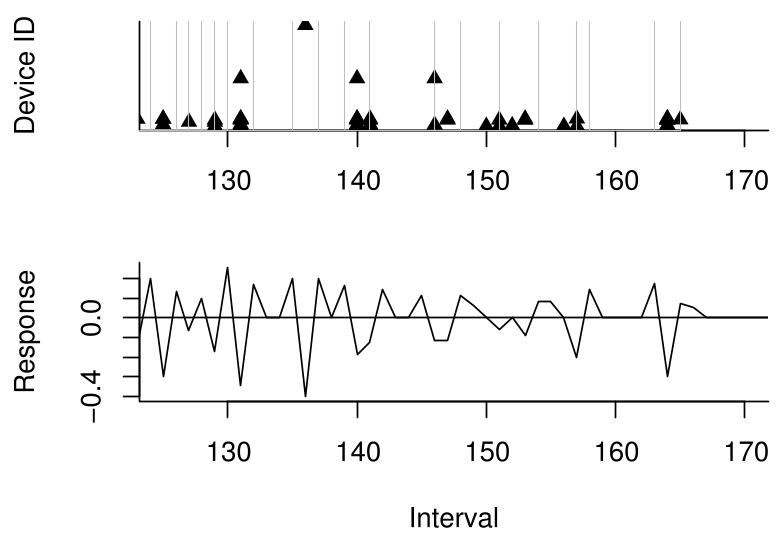 Figure: The response signal (blue) and period boundaries (grey) effectively delineate when a co-presence event starts and ends.
2. Incremental Clustering
Since social data arrives continuously, the authors chose COBWEB, an incremental clustering algorithm. They extended it to handle "set attributes" (the unique IDs of mobile phones), allowing the system to update its understanding of communities in real-time without needing to re-process all historical data.
Key Results
The authors validated their approach using PedSim, an agent-based simulator. In a controlled "home-work" movement pattern, the algorithm perfectly identified the expected communities.
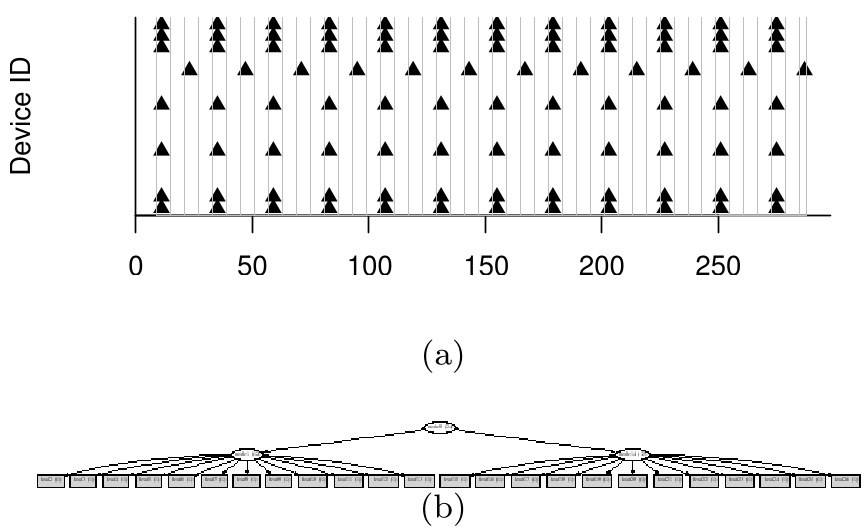 Figure: The resulting COBWEB hierarchy correctly maps the simulated agents into their respective spatial-temporal clusters.
In the "Reality Mining" dataset, the LoG operator proved robust enough to filter through the "dark matter" of the network—the many individuals who don't have their Bluetooth on—focusing only on the stable, observable patterns that constitute a community.
Critical Insight: Why This Matters
The genius of this work lies in its unobtrusiveness. It doesn't ask users to "check in" or "add friends." Instead, it uses the "embodied" nature of our daily routines to learn who matters to us.
However, the "Dark Matter" problem (low sensor density) remains a challenge. If only 10% of people use the system, the communities detected are fragmented. Furthermore, the paper raises interesting privacy questions: does a computational definition of a community infringe on our right to remain a "stranger" in public?
Conclusion
Co-presence Communities bridge the gap between our physical movements and our digital lives. By recognizing the value of weak ties, the researchers provide a framework for a more "ambient" internet—one where information flows based on where we are and who we are with, rather than just who we know on paper.