
CopyCatch: Neutralizing Spammer Armies via Lockstep Behavioral Analytics
CopyCatch: stopping group aacks by spoing lockstep behavior in social networks
CopyCatch is a graph-based anomaly detection framework designed to identify "ill-gotten" Likes on social networks by spotting lockstep behavior. It utilizes a novel formulation of Temporally Coherent Bipartite Cores (TBC) to detect groups of users liking the same set of Pages within synchronized time windows.
TL;DR
Social proof is the currency of the modern web, but "Likes" are often engineered by spammers. CopyCatch is a production-grade system developed at Facebook to detect coordinated attacks by looking for lockstep behavior: groups of users Liking the same sets of Pages at nearly the same time. By leveraging bipartite graph structures and temporal constraints, it effectively implements "multi-user rate limiting," making it economically unviable for attackers to reuse accounts.
Context: The Social Arms Race
In the social graph, a "Like" is more than a gesture; it's a signal used by algorithms to distribute content. Attackers attempt to exploit this via "ill-gotten Likes" using fake accounts, malware, or credential stealing. Conventional defenses focus on identity (detecting fake accounts) or individual behavior (per-user rate limits).
CopyCatch shifts the perspective to the collective behavior. The core insight is simple yet powerful: to turn a profit, a spammer must use a limited pool of accounts to attack many targets. This creates a structural signature—a dense, synchronized sub-graph that legitimate users almost never replicate.
Methodology: The Temporally Coherent Bipartite Core (TBC)
The paper introduces a formal definition of suspicious behavior called the [n, m, Δt]-Temporally Coherent Bipartite Core.
- Graph Structure: A bipartite graph between users and Pages.
- The Constraint: A cluster is suspicious if users like Pages, and for each Page, those users liked it within a narrow time window ().
Subspace Clustering at Scale
Finding these cores is an NP-hard problem. The authors frame it as a One-class Subspace Clustering problem. Instead of looking for global clusters, they seek local density.
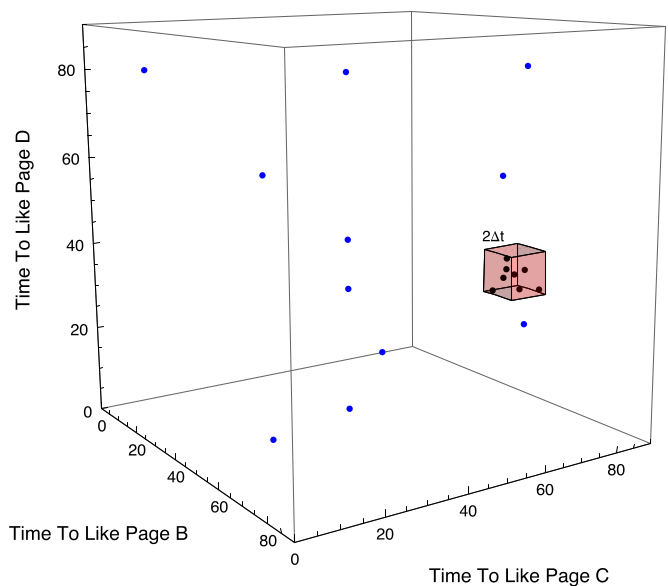 Figure 1: Example of subspace clustering where black dots represent suspicious users aligned across Page-time dimensions.
The algorithm (Algorithm 1) uses two alternating steps:
- UpdateCenter: Given a set of Pages, find the time centers () that maximize user coverage.
- UpdateSubspace: Given the time centers, select the top Pages that show the most coordinated behavior.
To handle Facebook-scale data (billions of edges), they implemented a MapReduce version. It uses random seeds from the graph edges to launch thousands of parallel local searches, converging in just a few iterations.
Theoretical Defense: The Zarankiewicz Problem
One of the most profound sections of the paper applies Extremal Graph Theory. The authors relate catching spammers to the Zarankiewicz Problem: What is the maximum number of edges in a bipartite graph that contains no (complete bipartite subgraph)?
By enforcing temporal coherence, CopyCatch forces an adversary into a dilemma:
- The Greedy Attack: If they like Pages quickly to provide immediate "value" to their customers, they get caught by the TBC signature.
- The Slow Drip: If they want to avoid the signature, they must add Likes so slowly (multi-user rate limiting) that their business model becomes unprofitable.
Experimental Results: Real-World Impact
The system was tested on datasets containing up to 10.4 billion Likes.
- Scalability: The runtime scales linearly with the number of edges. Doubling the data from 50GB to 100GB results in only a marginal increase in processing time due to efficient parallelization.
- Precision: In a manual audit of 22 caught clusters, 100% were verified as fraudulent (fake accounts, malware, or credential theft).
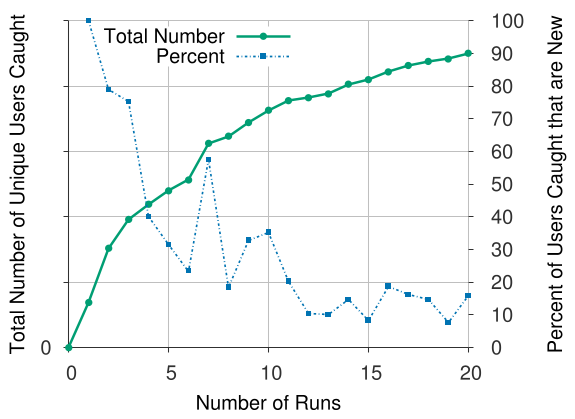 Figure 2: Real-world impact at Facebook showing the decrease in ill-gotten Likes after the deployment of CopyCatch.
Critical Insight & Conclusion
CopyCatch succeeds where others fail because it doesn't try to prove a user is "fake." Instead, it proves a group's coordination is "unnatural."
Takeaway: The "lockstep" signature is an inevitable byproduct of spammer economics. By targeting the coordination itself rather than the identity of the accounts, CopyCatch provides a robust defense that remains effective even as spammers obtain higher-quality (compromised real) accounts. This methodology is highly extensible to any domain involving user feedback, such as Amazon reviews or Twitter followers.