
Beyond the Linear: Why Machine Learning is Redefining Corporate Default Forecasting
Corporate Default Forecasting with Machine Learning
The paper evaluates the effectiveness of Machine Learning (ML) models, specifically Random Forest (RDF) and Gradient Boosted Trees (GBT), in forecasting corporate default risk compared to traditional statistical benchmarks like Logistic Regression. Utilizing a massive dataset of Italian non-financial firms (2011–2017), it identifies that ML significantly improves discriminatory power and precision, especially when data is restricted to public financial indicators.
TL;DR
Researchers from the Bank of Italy have demonstrated that ensemble Machine Learning models—specifically Random Forest (RDF) and Gradient Boosted Trees (GBT)—systematically outperform traditional Logistic Regression in predicting corporate defaults. The advantage is most pronounced when using only public financial data, where ML’s ability to capture non-linear relationships (like volatile sales growth) leads to a ~2.6% boost in discriminatory power (AuROC) and significantly more precise risk buckets.
The "Rigidity" Problem in Traditional Credit Scoring
For decades, the banking industry relied on Logistic Regression (LOG) and Linear Discriminant Analysis (LDA). These models are transparent and easy to interpret, but they come with a heavy "linearity bias." They assume that the impact of a financial ratio (like leverage) on risk is monotonic and additive.
However, the real economy is messy. During the Sovereign Debt Crisis, these models were often too slow to adapt. They failed to account for "threshold effects" where a variable might be benign in one range but catastrophic in another. Furthermore, the sheer volume of data now available from credit registers makes parsimonious statistical models feel increasingly like using a magnifying glass when a microscope is required.
Methodology: Trees, Forests, and the Bayes Correction
The authors pivoted to Ensemble Decision Trees. Unlike a single tree, which is prone to overfitting (high variance), RDF and GBT combine hundreds of trees to form a robust consensus.
The Architecture of a Decision
A key insight of the paper is how trees handle interactions. For instance, a firm’s liquidity might only be a critical risk factor if its leverage is already above a certain threshold. Decision trees map these "if-then" paths naturally.

Solving the Imbalance Problem
Since defaults are "rare events" (often <3% of the data), the authors used downsampling to create a balanced training set. To fix the resulting "distorted" probabilities (which would over-predict default), they applied a Bayes Correction formula: This ensures the final output is a statistically valid Probability of Default (PD) suitable for Basel III regulatory requirements.
Experimental Results: Where ML Shines
The study analyzed ~300,000 Italian firms. The results across the 2011–2017 period were telling:
- Public Info Gains: When only balance sheet data was used, GBT and RDF consistently outperformed LOG.
- The "Ceiling" Effect: When high-quality "Confidential Behavioral Data" (how a firm handles its current bank accounts) was added, the gap narrowed. Why? Behavioral data is such a strong signal that even simple models can't miss it.
- Data Hungry: When the dataset size was reduced to 10%, ML lost its edge. ML requires "big data" to learn the complex nuances that statistical models ignore.
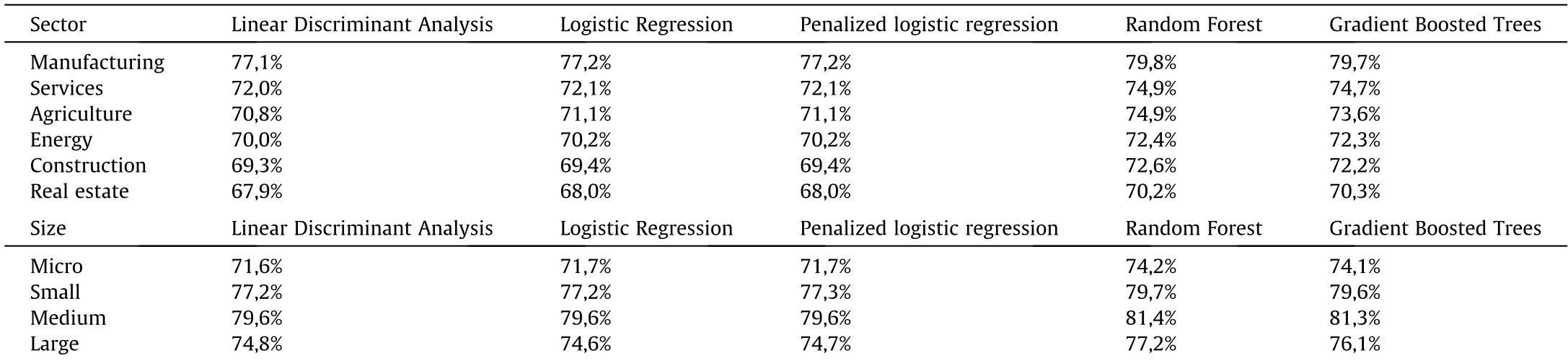 Table: ML provides the highest gains for "Micro" and "Large" firms, where traditional models typically struggle.
Deep Insight: Non-Linearity is the Secret Sauce
The authors conducted a Variable Importance analysis using permutation. They found that for traditional models, a few variables (like Cash Flow) do all the heavy lifting. ML models, however, are more "democratic"—they extract value from the entire information set.
More importantly, variables like Sales Growth and Payables Turnover—which have "U-shaped" (non-monotonic) relationships with risk—were significantly more useful to the ML models.
Critical Analysis & Conclusion
This work is a strong argument for the "Challenger Model" approach in banking. While regulations often demand the transparency of a Logistic model for "adverse action" notices, this paper proves that ML should be used to at least benchmark those scores.
The Takeaway: If you are a lender, ML allows you to grant more credit to the "right" large firms, effectively lowering your system-wide default rate. However, don't throw away your statistical models yet—if your dataset is small or your data is already highly refined, the "Black Box" of ML may not give you enough ROI to justify the lack of transparency.
Future Outlook: The next frontier is XAI (Explainable AI). If we can apply SHAP values to these Random Forests to explain why a loan was rejected, the "transparency argument" for Logistic Regression will finally reach its expiration date.