
Samsung vs. Apple: A Linguistic Deep Dive into Brand Attachment on Facebook
Corpus Linguistics and the Appraisal Framework for Retrieving Emotion and Stance – The Case of Samsung’s and Apple’s Facebook Pages
This pilot study explores the linguistic interactions on Samsung and Apple Facebook pages using a hybrid approach of Corpus Linguistics (CL) and the Appraisal Framework (AF). By analyzing user-generated comments, the researchers identify distinct patterns in "attitude" and "stance" towards these tech giants, concluding that Samsung users exhibit significantly higher brand affinity than their Apple counterparts.
TL;DR
In the battle of the brands, a "like" is only surface-deep. This study moves beyond simple metrics by utilizing Corpus Linguistics (CL) and the Appraisal Framework (AF) to dissect how users actually talk about Apple and Samsung. The verdict? While Apple has a larger vocabulary of users, Samsung fosters a stronger sense of "family" and positive interaction, whereas Apple’s Facebook page often serves as a lightning rod for "forceful" technical grievances.
Background: Beyond Sentiment Scores
In the era of Big Data, we are obsessed with "tracking the consumer’s voice." However, standard sentiment analysis often misses the "Attitudinal Positioning"—the subtle way a user pass judgment or associates emotional responses with a product. This study positions itself as a methodology-bridging work, combining the statistical rigor of CL with the granular, semantic depth of the Appraisal Framework (AF).
Problem & Motivation: The Limits of Frequency
Why can't we just count "good" vs. "bad" words? The authors argue that language is situated. A word might be factual in one context and evaluative in another.
- The Problem: Prior quantitative methods struggle with irony, jocularity, and implicit scaling.
- The Insight: By looking at Keywords in Context (KWIC) and applying AF categories (Affect, Judgment, Appreciation), we can see if a user is attacking the company's ethics (Judgment) or simply frustrated with a battery (Appreciation).
Methodology: The Hybrid Approach
The researchers built three corpora:
- SamsungCorpus: 5,216 tokens.
- AppleCorpus: 7,337 tokens.
- FBCorpus (Reference): ~93,000 tokens from top brands (Coca-Cola, Disney, etc.) to establish "normal" Facebook behavior.
The Appraisal Framework (AF) Breakdown
The core of the methodology involves mapping language onto three categories:
- Affect: Emotional response (e.g., "I am depressed," "I love it").
- Judgment: Evaluating people/companies' behavior (e.g., "You should be ashamed").
- Appreciation: Evaluation of things/artifacts (e.g., "Blazing fast processor," "Piece of shit hardware").
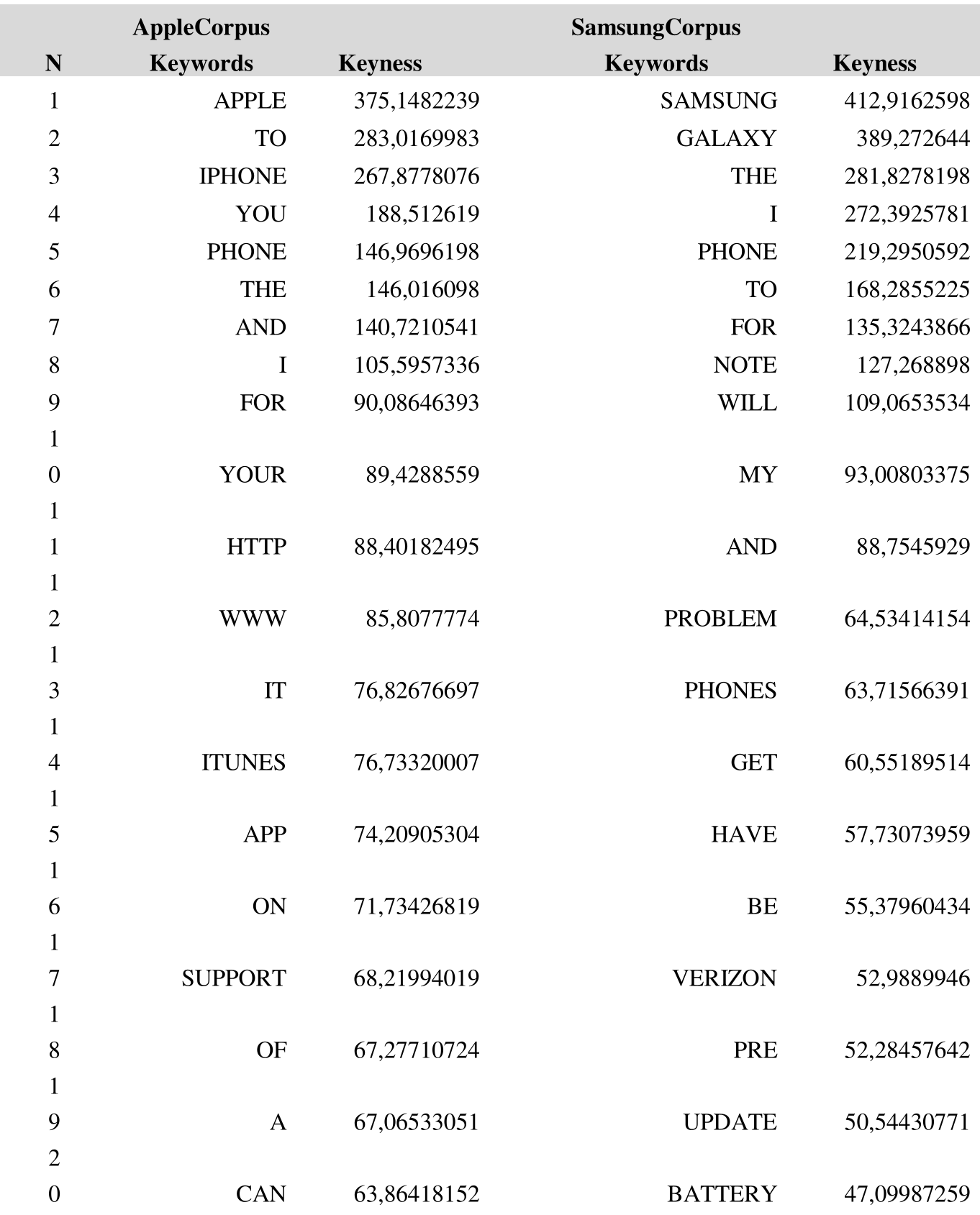
Key Results: Belonging vs. Betrayal
The keyword analysis yielded fascinating social insights:
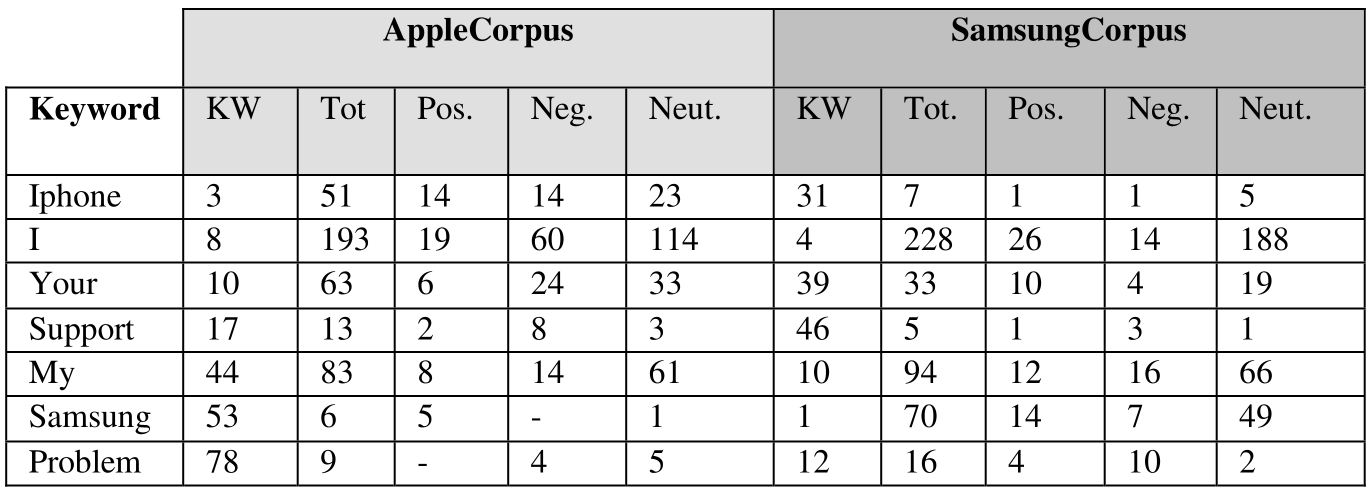
- Personal Pronoun Shift: Samsung users preferred "I" (denoting a sense of belonging and personal connection). Apple users preferred "You" (often used for confrontation or direct accusation towards the company).
- Emotional Intensity: While both groups used explicit evaluations, Apple’s negative feedback was more "forceful" and "vulgar," focusing on hardware failures and a lack of corporate listening.
- Positive Appreciation: Samsung users frequently praised new features and performance, creating a "virtuous cycle" of brand promotion.
The "Family" Factor
The qualitative data shows Samsung users feel like they are in a "Galaxy family," thanking the brand for manual replies. In contrast, Apple’s comments were "sparse and consistently overwhelmed by vigorously negative emotion-comments."
Critical Insight & Conclusion
This study proves that brand health isn't just about market share; it's about the discourse community.
- Takeaway: Samsung has successfully turned their Facebook page into a Customer Care hub, fostering "positive Affect." Apple’s page is used more for information sharing, which, without active moderation/interaction, can devolve into a space for public venting.
- Limitations: As a pilot study, the corpus size is relatively small (sample taken over 4 days). The findings are "situated" in a specific time-frame.
- Future Outlook: The future of market research lies in "multi-competence" approaches. We need systems that combine the speed of AI with the "Evaluative Responsibility" mapping found in the Appraisal Framework to truly understand the nuances of the modern consumer.