
CoDAE: Breaking Through Data Sparsity via Multi-Role Social Modeling
A correlative denoising autoencoder to model social influence for top-N recommender system
The paper introduces Correlative Denoising Autoencoder (CoDAE), a deep learning-based framework for Top-N recommendation that models users through three distinct roles: rater, truster, and trustee. It leverages shared parameter matrices and a novel related regularization term to bridge social influence and rating patterns, significantly outperforming SOTA baselines in MAP and NDCG.
TL;DR
Social-aware recommendation systems often struggle with the "double sparsity" of both user-item ratings and user-user social links. CoDAE (Correlative Denoising Autoencoder) addresses this by treating every user as a multi-faceted entity—a rater, a truster, and a trustee. By aligning these "personalities" through shared weights and hidden-layer regularization, the model learns robust representations that lead to higher precision in Top-N recommendations.
Problem & Motivation: The Sparsity Trap
Most modern recommender systems try to "borrow" information from social networks to fix the lack of rating data. However, they face two major hurdles:
- Single-Role Bias: Most models assume a user has one fixed "preference vector." In reality, how you rate a movie (rater) is influenced by whom you listen to (truster) and who listens to you (trustee).
- Overfitting on Sparse Data: Deep Learning models are "data-hungry." When social links are 99.9% empty, standard neural networks simply memorize the noise.
The authors' insight? Correlations are the key. Even if a user has few ratings, their behavior as a "truster" in a social network provides a latent signature that should correlate with their preferences as a "rater."
Methodology: The Architecture of CoDAE
CoDAE doesn't just throw all data into one bucket. It uses a structured synthesis of three subnetworks.
1. The Triple-Subnetwork Design
The model consists of three separate Denoising Autoencoders (DAEs):
- Rater DAE: Processes the user-item rating vector ().
- Truster DAE: Processes the outgoing trust vector ().
- Trustee DAE: Processes the incoming trust vector ().
2. Dual-Level Correlation
To force these networks to talk to each other, CoDAE introduces:
- Shared Weight Matrix (): Active at the input layer, this matrix captures the "universal" identity of a user across all three roles.
- Related Regularization (): At the hidden layer (), the model adds a penalty term that minimizes the distance between the three latent vectors (). It ensures that while the roles are distinct, they aren't contradictory.
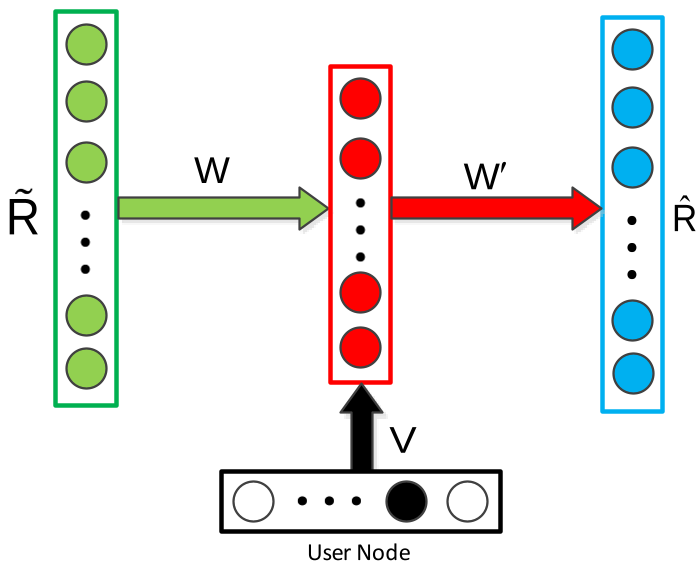 The model architecture shows how three DAEs are tied together by a shared matrix M and hidden layer constraints.
Experiments & Results
The authors tested CoDAE on the Ciao and Epinions datasets against heavyweights like BPR, SBPR, and the original CDAE.
Key Findings:
- Performance Lift: On the Ciao dataset with , CoDAE achieved a MAP@10 of 0.0329, a significant improvement over TDAE (0.0320) and CDAE (0.0291).
- Handling Spare Users: As shown in the figure below, CoDAE consistently outperforms other methods across the board, even for users with fewer than 10 ratings. This proves that the "multi-role" information effectively fills the gaps left by missing ratings.
- The Power of and : Ablation studies show that setting the shared parameter influence () to 0.6 and the regularization strength () to specific thresholds (0.1 for Ciao) is crucial. Too much regularization leads to overfitting; too little, and the roles become disconnected.
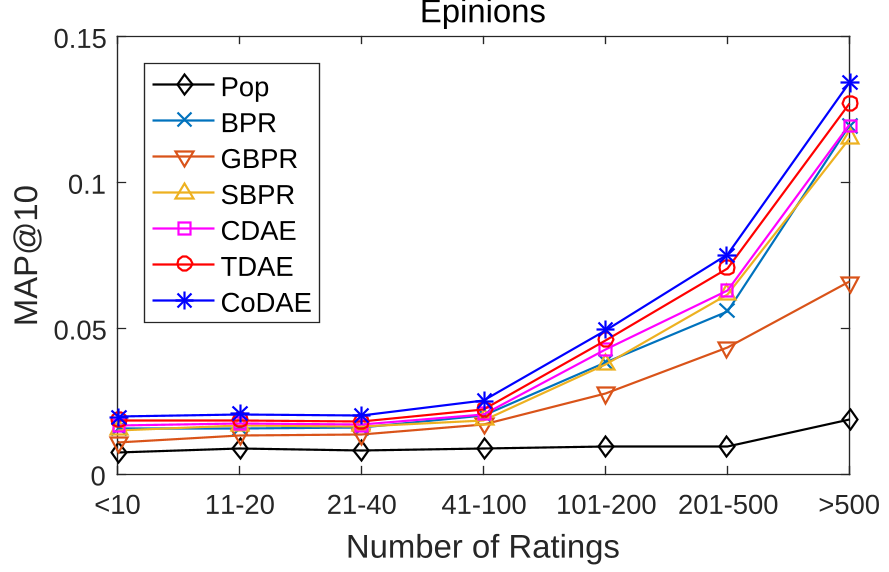 Performance across users with varying numbers of ratings.
Critical Analysis & Conclusion
Takeaway
CoDAE successfully shifts the paradigm from "Social as an Auxiliary Feature" to "Social as a Parallel View." By treating social trust as an auto-encoding task rather than just a regularization constant, the model extracts much richer latent features.
Limitations
- Computational Overhead: Training three autoencoders is more expensive than one, although the authors argue it scales linearly with the number of users .
- Static Social Network: The model assumes social links are static. In real-world platforms, trust evolves over time, which CoDAE does not yet account for.
Future Outlook
The next step for this line of research is likely the integration of Multi-modal data (like product images or review text) into the same "correlative" framework, potentially using Knowledge Distillation to compress these multiple "roles" into a single, lightning-fast inference model.
Source: Pan, Y., He, F., & Yu, H. (2026). A Correlative Denoising Autoencoder to Model Social Influence for Top-N Recommender System.