
COSINE: Reimagining Software Development through Collective Intelligence and Ecosystems
COSINE:a software development model integrating collective intelligence, service and ecosystem
The paper introduces COSINE, a novel software development model that integrates Collective Intelligence (Crowdsourcing), Service-Oriented Computing (SOC), and Software Ecosystems. It aims to create a dynamic, internet-based development paradigm where distributed crowds collaborate across the entire software lifecycle.
TL;DR
The COSINE model (Collective Intelligence, Service, and Ecosystem) is a response to the rigid nature of traditional software engineering. By treating software as a service and the development process as a crowdsourced ecosystem, it breaks geographical barriers and adapts to the "irregularly changing" internet environment. It moves the focus from internal production to global, collaborative co-creation.
Problem & Motivation: The Rigidity of the Old Guard
Traditional models like Waterfall or Prototyping were built for stable, predictable environments. Today’s software landscape is the opposite. The authors identify three critical pain points:
- Low Adaptability: Linear models (Waterfall) have poor backtracking and fail to keep pace with shifting user demands.
- Resource Constraints: Internal teams are finite; they cannot match the diverse expertise available in the global talent pool.
- Isolation: Software is often treated as a standalone product rather than a living component within a broader Service-Oriented environment.
The motivation behind COSINE is to synchronize Crowdsourcing (the "Who"), Service-Oriented Computing (the "How"), and Software Ecosystems (the "Environment") into a unified lifecycle.
Methodology: The COSINE Lifecycle
The COSINE model isn't just a high-level idea; it’s a structured pipeline that redefines every phase of the Software Development Life Cycle (SDLC).
1. Crowdsourced Requirements & Modeling
Rather than a single analyst writing a SRS (Software Requirement Specification), COSINE uses the crowd. The platform rewards "Crowds" for analyzing user feedback on social media and forums, building a domain knowledge base via topic modeling and feature recognition to identify "common needs."
2. Architecture & Service Strategy
The model views software as a composite of services.
- Architecture Design: Crowds define service components and interconnection mechanisms.
- Service Recommendation: Instead of writing every line of code, the system recommends existing services from a repository using machine learning, addressing the "cold start" problem for new projects.
3. The Implementation Flow
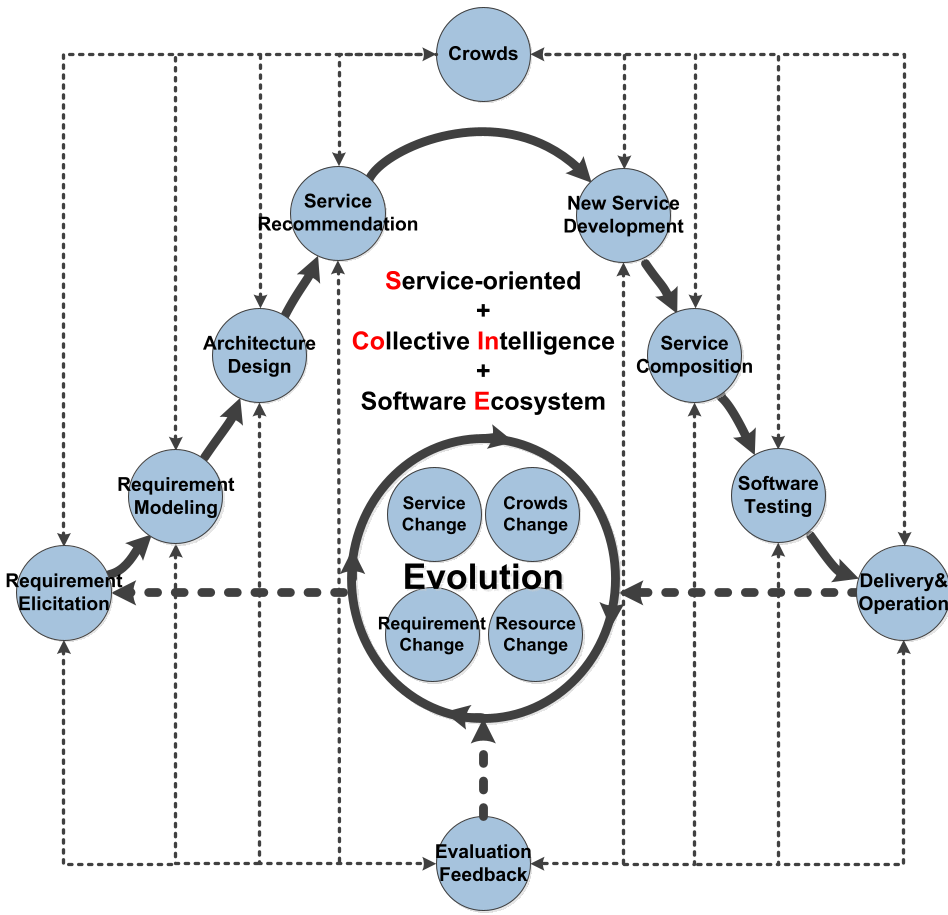
As shown above, the Platform acts as the intermediary. Requesters publish tasks, and a global forum is established for real-time collaboration. This "open-call" mechanism ensures that only the most fit solutions (vetted by experts and requesters) make it into the final product.
Experiments & Results: Real-World Validation
The authors validated COSINE through two main avenues:
- Educational Deployment: 500+ students used the COSINE platform to complete innovative software projects, proving its efficacy in collaborative learning and development.
- Industrial Application: A Knowledge Management system was developed for Landray.
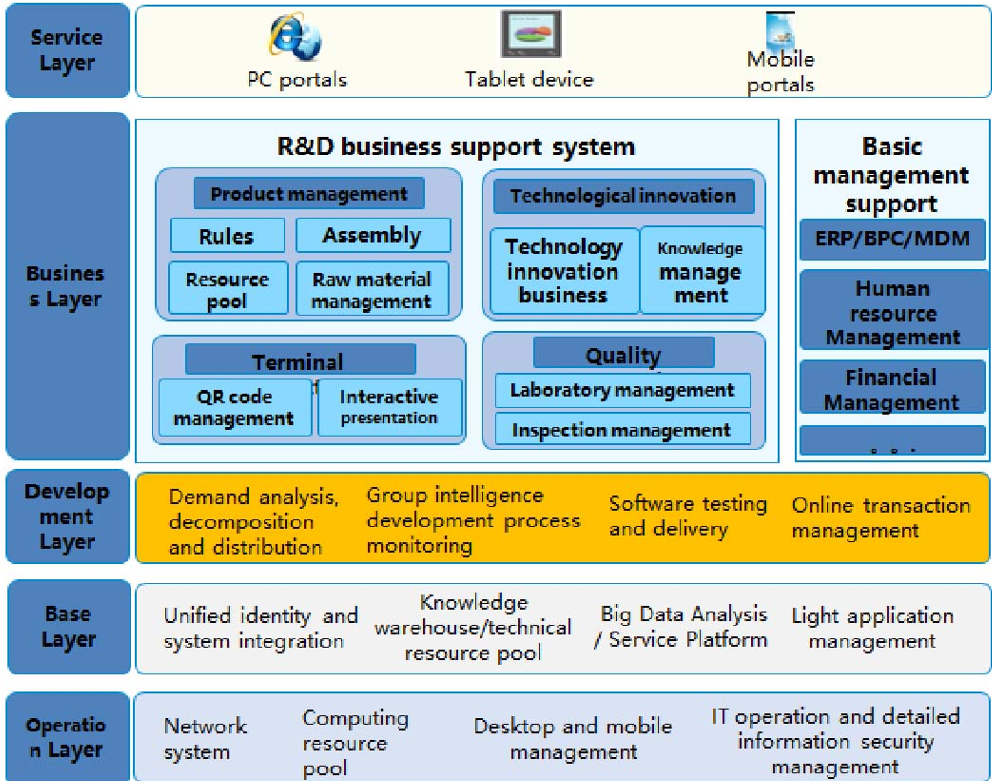
The architecture generated (shown above) illustrates a sophisticated four-layer approach (Public Service, Plugin, Application, Presentation). The use of SEHMES (Software Ecosystem Health Metric Evaluation System) allowed the team to measure the "health" of the project across four dimensions: Activity, Diversity, Availability, and Sustainability.
Critical Analysis & Conclusion
Takeaway
COSINE successfully shifts the paradigm from "Software as a Product" to "Software as an Evolving Organism." By decentralizing the development process, it taps into a level of creativity and scalability that traditional internal teams simply cannot reach.
Limitations & Future Work
While the model is robust, two major challenges remain:
- Incentive Mechanisms: How do platforms consistently attract high-quality software practitioners in a competitive "gig" economy?
- Ecosystem Vitality: Managing the long-term evolution and preventing "code rot" in a micro-ecosystem requires even more sophisticated governance.
The authors plan to focus future research on the adaptive evolution laws of software ecosystems, potentially integrating more automated decision-making tools to keep the ecosystem healthy without constant manual intervention.