
COSMOS: Bridging Mythology and Art via AI-Powered Graph Visualizations
COSMOS. Cultural Osmosis - Mythology and Art - A Data Organization and Visualization Platform, with the Use of AI Algorithms
COSMOS is an innovative AI-driven platform designed to organize and visualize the vast complex of Greek mythology and its artistic depictions. By integrating Natural Language Processing (NLP) and Graph Databases (Neo4j), it transforms linear narratives into a multi-dimensional, interactive network of myths, characters, and locations.
TL;DR
COSMOS is a sophisticated platform that moves beyond the traditional, linear way of reading Greek myths. By utilizing Natural Language Processing (NLP) and Graph Databases, it connects myths, characters, and physical artifacts (pottery, sculpture, etc.) into a cohesive 3D ecosystem. It transforms an ancient "voluminous and expensive work" into an interactive, machine-readable knowledge graph for educators and researchers alike.
The Challenge: Breaking the Linear Narrative
Greek mythology is inherently a network—a web of interconnected genealogies, overlapping adventures, and recurring locations. However, most digital archives treat these stories like a dictionary: a list of names with static text.
The authors identified two major gaps:
- The Connectivity Gap: Existing apps don't show how a hero in one story influences a location in another.
- The Tangible-Intangible Gap: Mythological stories (intangible) are rarely linked directly to the archaeological artifacts (tangible) found in museums worldwide.
Methodology: The "Brain" Behind the Myths
COSMOS isn't just a UI; it's a Knowledge Management System (KMS). The architecture is split into two halves: extraction and presentation.
1. Knowledge Organization (The Backend)
The researchers used spaCy as their NLP engine but found that standard models failed to recognize specific mythological contexts. To solve this, they employed Transfer Learning on a curated corpus of 129 Greek mythology stories.
- Named Entity Recognition (NER): Identifies Persons and Locations within raw text.
- Neo4j Graph Database: Stores relationships using Cypher queries, allowing the system to find "Secondary Connections" (e.g., two heroes who never met but visited the same island).
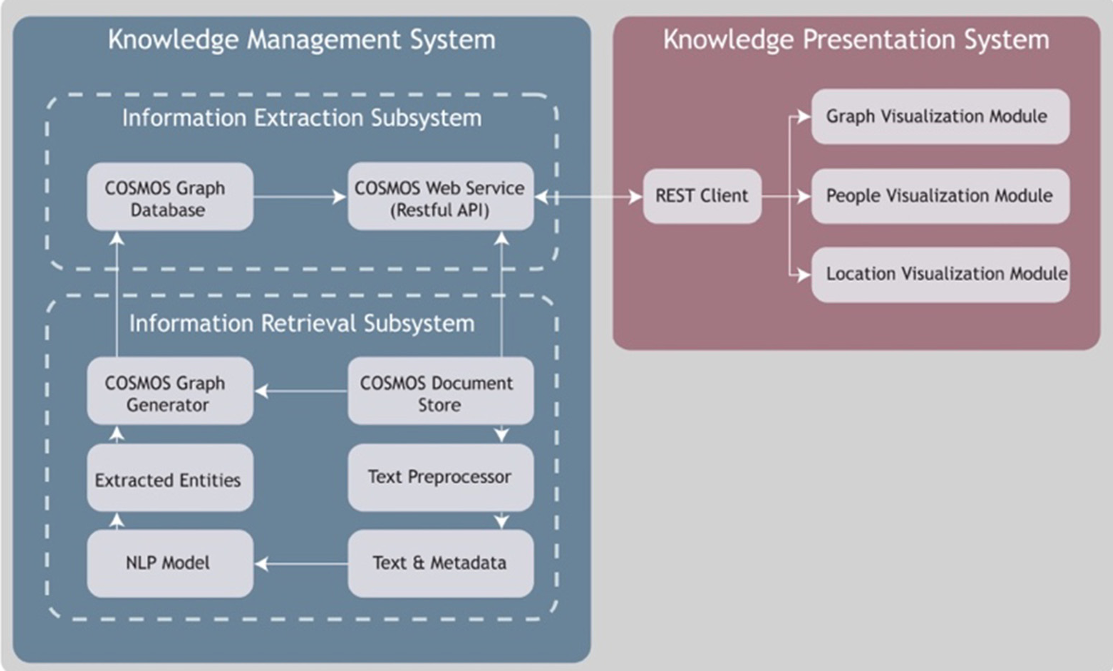
2. Knowledge Presentation (The Frontend)
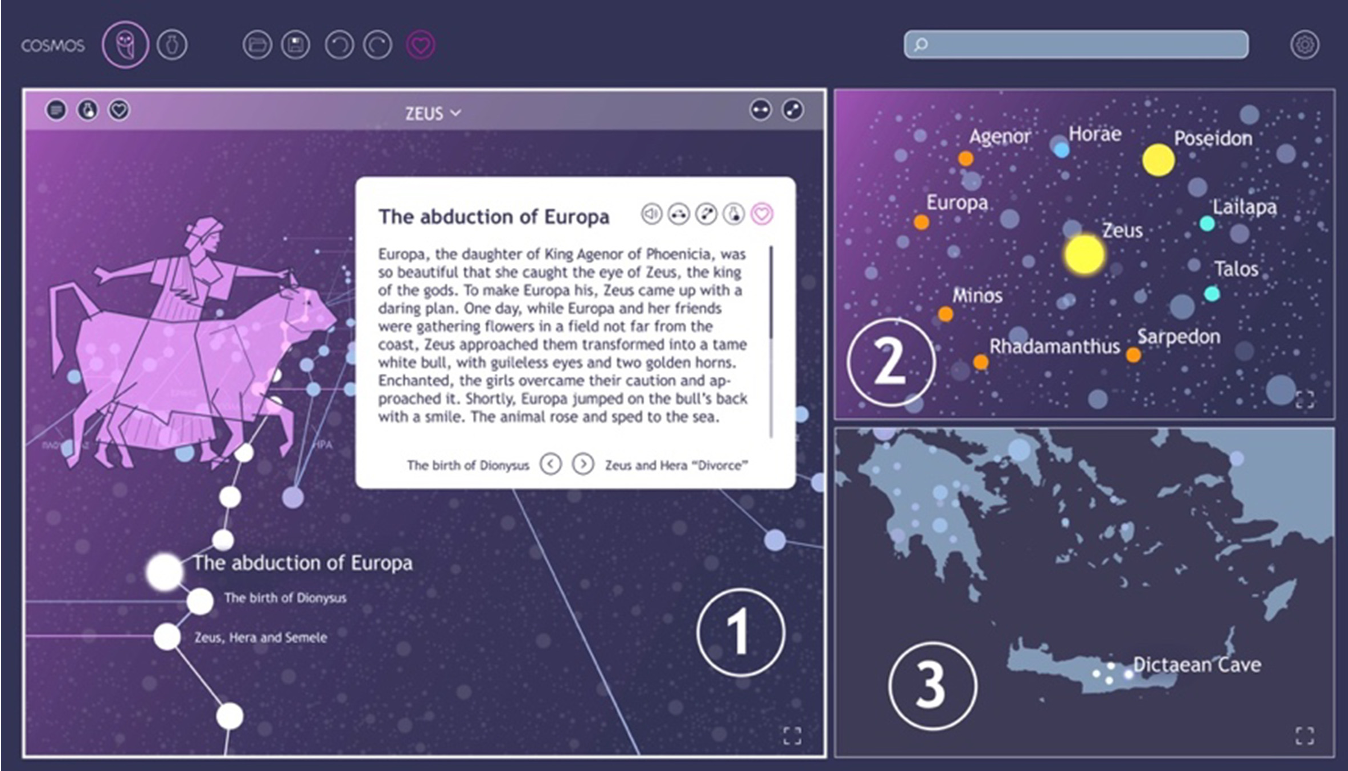
The system visualizes data in two interrelated units: Myths and Art. Each unit uses three dynamic windows:
- Stories Window: Uses a "Mythical Timeline" built around Landmark-Stories. Since myths don't have absolute dates, Landmark-Stories serve as chronological anchors.
- Characters Window: Color-coded nodes (Gods, Heroes, Creatures).
- Places Window: A 2D map showing where the action happened.
Experiments & Performance
The decision to train a domain-specific model paid off significantly. The "COSMOS model" outperformed the general-purpose "OntoNotes 5" model across all metrics.
| Metric | Pre-trained (Person) | COSMOS (Person) | Pre-trained (Loc) | COSMOS (Loc) |
|---|---|---|---|---|
| F1-Score | 63.85 | 96.29 | 21.95 | 85.71 |
The lower score for "Location" compared to "Person" is attributed to the raw texts having fewer geographical references, making it harder for the model to generalize location patterns.
User Experience Evaluation
A prototype test with 42 participants revealed that 68.29% of users found the "innovative presentation" the most compelling feature. Interestingly, 100% of participants agreed the tool was highly suitable for educational environments.
Critical Insight & Future Outlook
COSMOS represents a significant shift in Digital Humanities. By treating culture as "Linked Data," it allows users to navigate the "Cultural Osmosis" between story and physical object.
Potential Limitations:
- Scalability of Truth: Mythology often has conflicting versions; the current graph relies on one primary source (Kakridis). Managing contradictory "edges" in the graph remains a future challenge.
- Geolocation Accuracy: Mythological maps often contain fictional or debatable locations, which can be difficult to map onto modern coordinates precisely.
Future Prospect: The authors suggest expanding COSMOS to compare mythologies (e.g., Celtic vs. Nordic), which would allow the AI to identify cross-cultural archetypes automatically. This could revolutionize how we teach global history and literature.
Final Takeaway
COSMOS proves that AI is not just for technical problem-solving—it is a powerful lens for magnifying the hidden patterns within our shared human heritage.