
Beyond Fixed Budgets: Maximizing the Profit/Cost Ratio in Viral Marketing
Cost-efficient viral marketing in online social networks
The paper introduces the General Ratio Maximization (GRM) problem for viral marketing, moving beyond fixed budgets to optimize the profit/cost ratio. It develops the SmoothGreedyGRM algorithm, achieving a (1+ε)/2 approximation ratio, and provides a MapReduce-based distributed implementation for large-scale Online Social Networks (OSNs).
TL;DR
Viral marketing is no longer just about picking people to start a trend. This paper introduces a General Ratio Maximization (GRM) framework that treats the budget as a flexible variable. By optimizing the Profit/Cost ratio, the authors account for the influence of existing products and reward intermediate "influencers," achieving superior efficiency on million-node social networks.
The Problem: The Arbitrary "k" and the Multi-Product Reality
Most classic Influence Maximization (IM) research asks: "Given seeds, how do we maximize spread?" But for a real-world CMU, setting or is often a shot in the dark.
Moreover, users don't exist in a vacuum. If a user already owns a 4K monitor, they are more likely to buy a high-end GPU (positive complementarity) but less likely to buy another monitor (negative competition). Current models largely ignore these cross-product impacts and the fact that intermediate users who help spread the message—not just the initial seeds—deserve a slice of the reward.
Methodology: Redefining Influence and Profitability
The authors propose a general influence measure that combines:
- Topology & Intimacy: Based on interaction frequency rather than just binary connections.
- Product Awareness: A term that captures the willingness to adopt product A given existing products .
The Objective Function
Instead of maximizing influence , they maximize the ratio: Where Cost includes rewards for initial seeds and intermediate influencers who successfully convert others.
The SmoothGreedy Algorithm
The challenge? This ratio is non-monotone submodular. Adding a seed might actually decrease your efficiency. The authors use a double-greedy approach with a probabilistic "smooth" decision-making process.
 Figure 1: The dual-factor influence model accounting for social intimacy and product coexistence.
Scalability through MapReduce
To handle graphs like the 4.8M node LiveJournal dataset, the authors designed DismoothGreedyGRM. They solve the "serialization bottleneck" of greedy algorithms by treating selection actions as transactions and using a MapReduce framework to filter and select candidates in parallel.
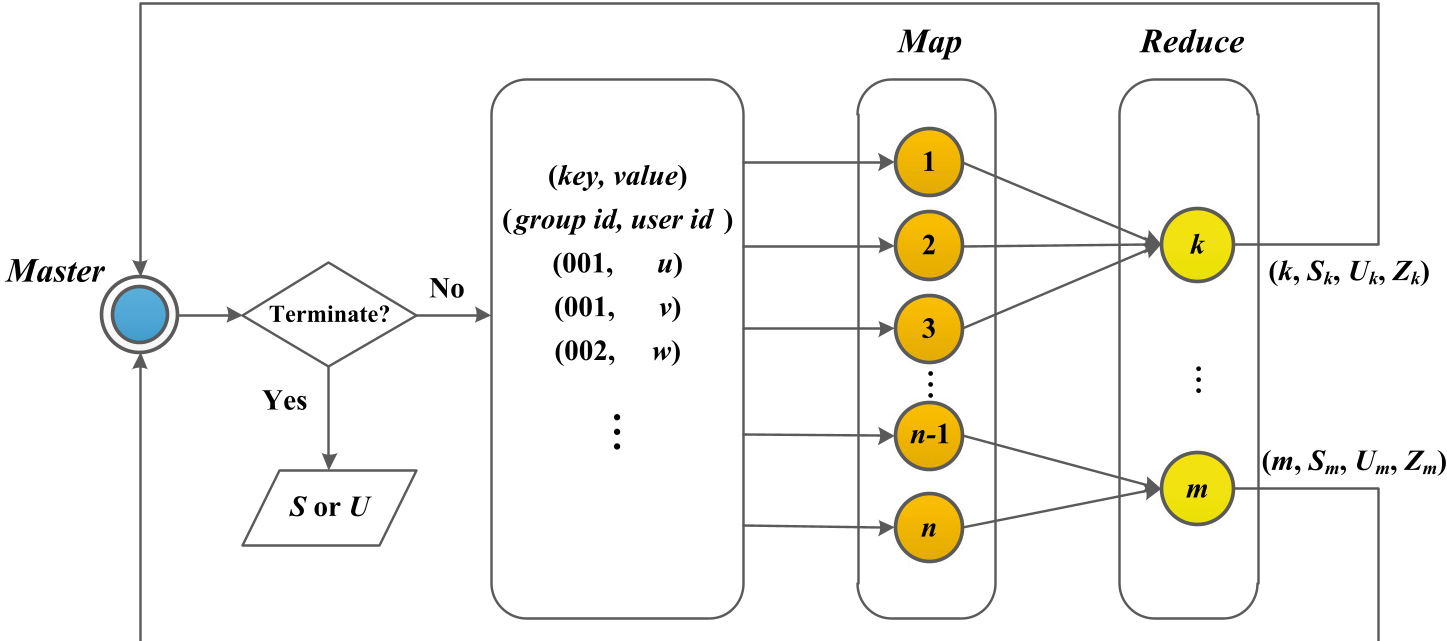 Figure 2: The iterative MapReduce workflow for parallelizing seed selection.
Experiments and Results
The researchers tested their approach against SOTA baselines (CELF, PMIA, IMM).
- Efficiency: As the cost of seeds increases, SmoothGreedyGRM maintains a significantly higher profit/cost ratio, while fixed-budget models see their efficiency plummet.
- Speed: Their linear-time complexity ensures constant running time regardless of the seed set size, unlike traditional greedy methods where time grows with .
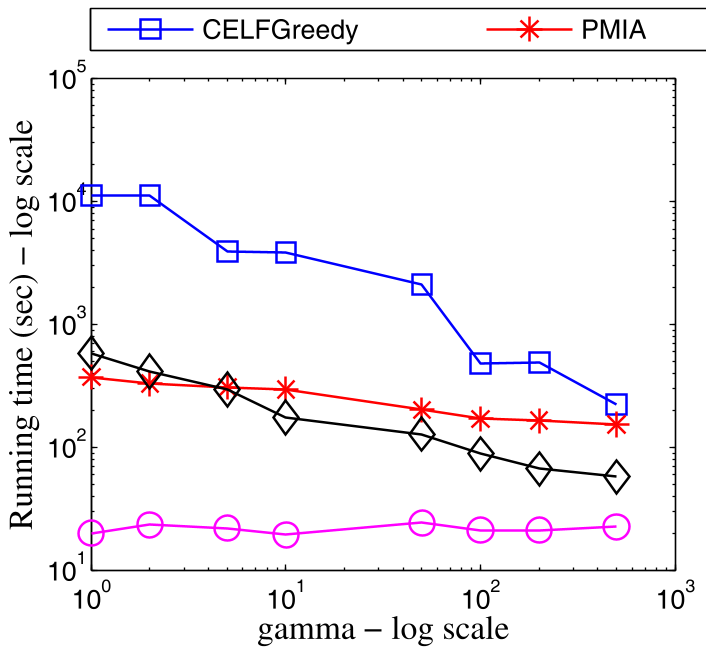 Figure 3: Performance comparison showing SmoothGreedyGRM's resilience to rising seed costs.
Critical Insight & Future Work
The core value of this work is the abandonment of the fixed budget. By proving that the profit/cost ratio inherits submodularity, the authors provide a mathematically grounded way to find the "sweet spot" of marketing spend.
Limitations: The model assumes we have access to user-product interaction data , which may be proprietary or difficult to obtain in cross-platform marketing. Future research could explore Transfer Learning to estimate these weights across different social domains.
Conclusion
This paper represents a shift towards Cost-Efficient AI in marketing. It successfully bridges the gap between theoretical submodular maximization and the practical complexities of modern online ecosystems.