
ERLT-RIM: Quantifying the Hidden Opportunity Cost of Influencer Marketing
A cost optimized reverse influence maximization in social networks
This paper introduces the Reverse Influence Maximization (RIM) problem and proposes the Extended Randomized Linear Threshold RIM (ERLT-RIM) model. Unlike traditional Influence Maximization (IM) which seeks to maximize spread from a seed set, RIM aims to find the minimum "opportunity cost"—the smallest number of nodes required to activate a predefined target set of influential users.
TL;DR
In the world of social media marketing, we often ask "How many people can this influencer reach?" but rarely "What does it actually take to influence the influencer?" This paper introduces Reverse Influence Maximization (RIM) and the ERLT-RIM algorithm to calculate the minimum number of nodes (opportunity cost) needed to activate a specific set of target users. By optimizing for already-active neighbors and shared connections, the authors provide a pathway to more cost-effective viral marketing.
Problem & Motivation: The Influencer’s Influencer
Standard Influence Maximization (IM) assumes that once you pick a "seed set," the game begins. However, this ignores the acquisition cost. In reality, influential users aren't just bought with free samples; they are motivated by their own social circles.
The authors identify a critical gap: existing models don't account for the minimum effort required to "flip" these targets. They formulate this as a Reverse Influence Maximization problem, proving it is NP-Hard by reducing it to the classical Knapsack Problem.
Methodology: The ERLT-RIM Framework
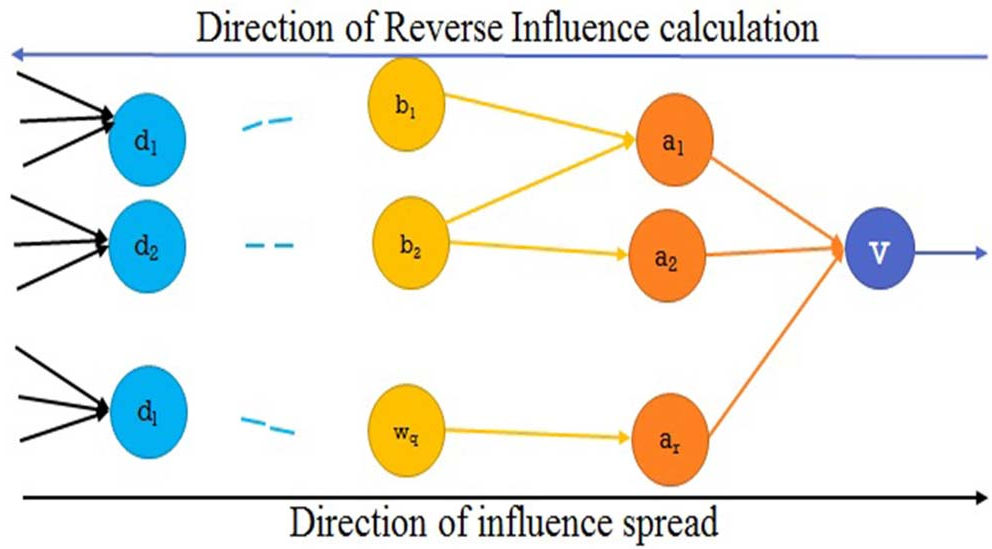
The core innovation lies in the Extended Randomized Linear Threshold (ERLT-RIM) model. To make cost estimation tractable, the authors decompose the network into Basic Network Components (BNC) and focus on a 2-hop predecessor limit.
The Two Pillars of Optimization
- Already Activated Nodes: Before picking new neighbors to influence a target, the model checks if any of the target's in-neighbors are already active (perhaps as part of another target's influence chain). Using these nodes first reduces the "new" cost to zero for that specific connection.
- Commonality Discount: This is a sophisticated deduplication logic. If a node is serving double duty—for instance, as a target itself and as a second-hop motivator for another target—it is only counted once in the final budget.
Experiments & Results: Efficiency at Scale
The authors tested ERLT-RIM against three real-world datasets: Facebook (low scale), Twitter (high scale), and Epinions (trust-based).
Key Findings
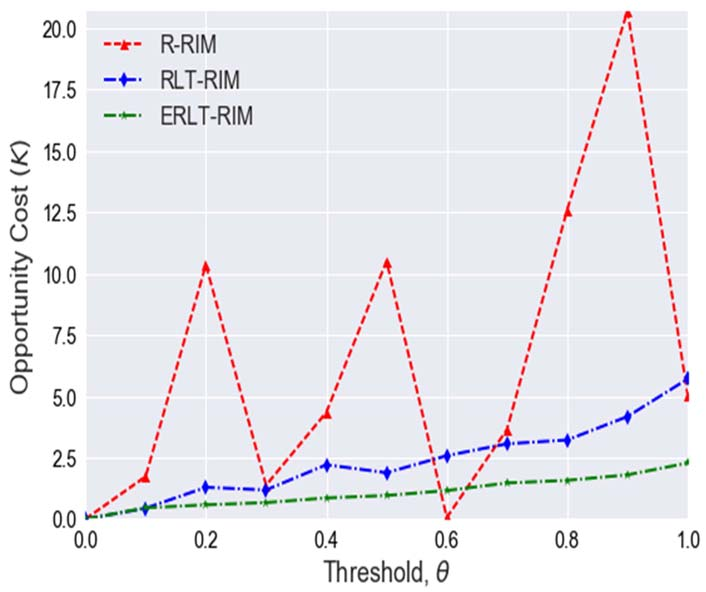
- Cost Reduction: ERLT-RIM consistently identified a smaller "opportunity cost set" compared to basic Randomized RIM (R-RIM) and the standard RLT-RIM.
- Activation Success: The model achieved a higher "Activation Rate," meaning it was more successful at actually triggering the target nodes even when thresholds were high.
- The Trade-off: Because ERLT-RIM performs extra checks for commonality and active nodes, its running time is slightly higher than baseline random models, though it remains within the same complexity class, .
Critical Insight & Conclusion
The true value of this work is the formalization of network commonality. In a dense social network, influence paths overlap significantly. By "discounting" these overlaps, the ERLT-RIM model proves that the cost of a viral campaign is often lower than it appears, provided you target the right "pre-predecessors."
Future Outlook: While the 2-hop limit keeps the math manageable, future research could explore adaptive hop-counts for "super-influencers" who may require deeper social proof to be activated. This paper serves as a foundational bridge between network theory and Strategic Accounting.