
Countering Android Malware: A Scalable Semi-Supervised Approach for Family-Signature Generation
Countering Android Malware: A Scalable Semi-Supervised Approach for Family-Signature Generation
This paper introduces a scalable semi-supervised framework for Android malware family identification and automatic YARA signature generation. By employing an iterative HDBSCAN clustering process and a heuristic-driven rule optimization algorithm, the system identifies new malware families within massive datasets and produces human-intelligible signatures with high precision.
TL;DR
Malware analysts are currently losing the "detect-and-repackage" arms race. This paper presents a deployed system that uses iterative HDBSCAN clustering to group millions of Android apps into families and then automatically writes YARA signatures. It achieves a 100% recall on identified families and significantly outperforms human-written rules in breadth without introducing false positives.
Problem & Motivation: The Bottleneck of Human Expertise
By 2018, the Android ecosystem mirrored the earlier PC era: malware developers used automated repackaging and obfuscation to churn out polymorphic variants. Traditional Antivirus (AV) companies relied on manual signature generation, which is:
- Slow: Humans cannot analyze thousands of samples per day.
- Brittle: Minor code changes break syntactic signatures.
- Conservative: To avoid false positives (legal/reputational risks), analysts often leave suspicious samples unlabeled.
The authors' core insight was that while syntactic representations (code) change, the statistical behavior and structural properties (API calls, permissions, network traffic) of a malware family remain consistent.
Methodology: From Raw Data to Formal Rules
The framework operates in a sophisticated loop that combines the best of unsupervised learning and expert-defined constraints.
1. Feature Engineering & Scaling
Instead of raw bytecode, the team extracts 35 statistical features ranging from Manifest permissions to dynamic network indicators like DNS resolutions. To handle the "Big Data" problem, they use an Iterative Clustering approach, splitting the dataset into chunks and re-clustering outliers.
2. The Semi-Supervised Extension
The "Clustering Assumption" is key here: if an unknown application falls into a dense cluster primarily composed of known malware, it is likely a variant of that family. This allows the system to label "Type 2" and "Type 3" families (mixes of known and unknown samples) with high confidence.
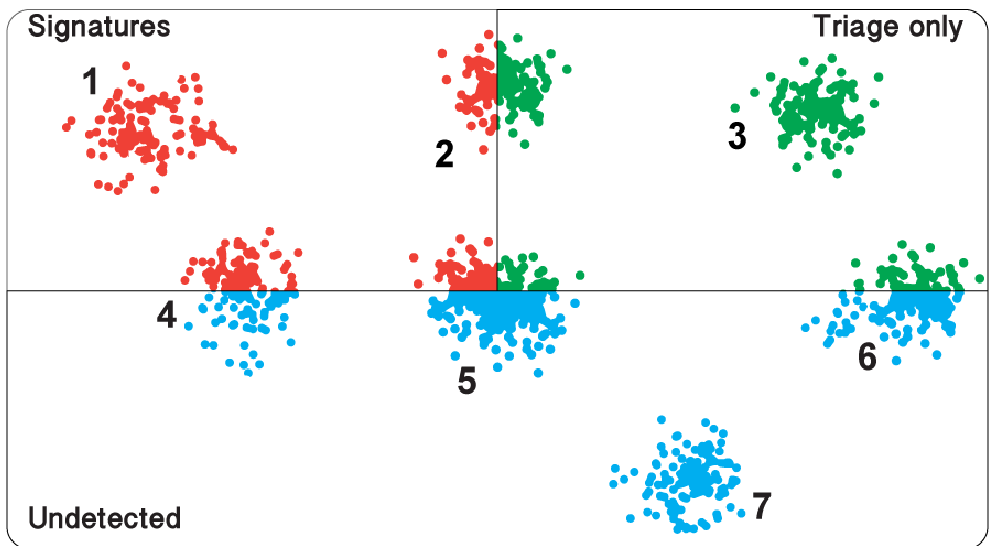 Figure: The seven-type family classification based on existing knowledge vs. cluster membership.
3. Automated YARA Generation
The system doesn't just label apps; it explains why. It builds YARA rules using a three-step optimization process:
- Step 1: Find common features among family members.
- Step 2: Check against a "goodware" database for false positives.
- Step 3: If collisions occur, refine the rule into a disjunction of more specific clauses.
The "Intelligibility" of these rules is secured by a Simplex-optimized scoring system that assigns weights to literals (like URLs or suspicious API calls) based on how expert analysts historically valued them.
Experimental Results: Beating the Experts
The framework was tested on a massive dataset of 1.5 million apps and has been live on the Koodous platform since 2018.
- Detection Boost: For the "Volcman Dropper" family, the auto-generated rule improved detection by 131.2% over human rules.
- Accuracy: The system maintained a minimum precision of ~86-91% even without human verification of the clusters.
- Efficiency: Clustering 1 million apps takes a few hours, but generating a final, optimized signature for a discovered family takes less than 60 seconds.
 Table: Comparison of expert-written vs. auto-generated rule detection rates.
Critical Insight & Conclusion
The true value of this work lies in its Signature Quality Heuristic. By using linear programming to ensure rules aren't "too specific" (leading to 0 generalization) nor "too generic" (leading to false positives), the authors created a tool that security analysts actually trust.
Limitations: The system still struggles with "time-bombs" or trigger-based malware that stays dormant during dynamic analysis. However, by shifting the analyst's job from "writing rules" to "validating families," it effectively scales human expertise to match the speed of modern malware development.