
Unlocking the Unknown: Estimating Social Network Structures via Random Walks
Counting Edges and Triangles in Online Social Networks via Random Walk
This paper introduces a novel random walk-based framework for estimating edge and triangle counts in Online Social Networks (OSNs) where full topology access is restricted to public APIs. The core methodology leverages subgraph relationship graphs (SR graphs) and expanded Markov chains to derive efficient estimators for both |E| and triangle counts (N), achieving high accuracy with minimal node sampling.
TL;DR
How do you count the millions of triangles and edges in a social network when you can't see the whole map? This paper proposes a breakthrough framework using Random Walks on Subgraph Relationship (SR) Graphs to accurately estimate global network statistics using only limited API queries. By sampling a mere 2% of nodes, the authors achieve high-precision estimates of a network's fundamental properties.
The "Opaque Network" Problem
In the era of Big Data, we often assume we have the "whole graph" at our fingertips. For researchers studying Online Social Networks (OSNs), the reality is different. Platforms like Facebook and Twitter keep their full topologies under lock and key. External access is restricted to API-based queries: you can ask for a user's neighbors, but you cannot download the entire database.
Why is this hard?
- No Global View: Standard algorithms (like Wedge Sampling) require knowing all degrees or edges in advance.
- Bias: Simple random crawling often over-samples high-degree nodes, leading to skewed results.
- Scale: With millions of nodes, counting triangles (groups of three connected users) becomes a "needle in a haystack" problem if you can't browse the whole graph.
The Core Insight: Subgraph Relationship (SR) Graphs
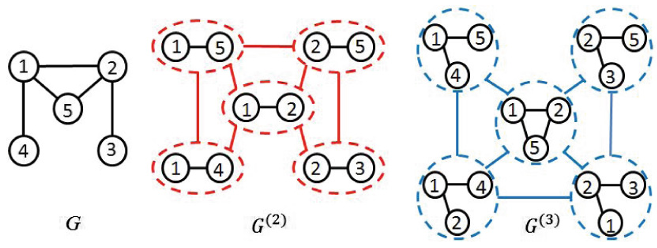
The authors solve this by transforming the problem. Instead of walking on the original graph , they propose walking on a Subgraph Relationship Graph .
- Nodes as Structures: In an SR graph, each "node" represents a small subgraph (like a single node, an edge, or a 3-node chain).
- Expanded Markov Chains: They build a Markov chain where each state remembers the history of the walk. This allows them to "see" triangles as they occur during the walk.
- Stationary Distribution (): The key technical contribution is defining a unique stationary distribution for these walks, ensuring the "samples" collected via API calls can be mathematically corrected to represent the whole population.
Methodology: The SRW1-3 Framework
The researchers tested three variants, categorized by the dimension of the subgraphs:
- SRW1 (): The "Classic" walk on nodes, but tracking 3-step sequences to detect triangles.
- SRW2 (): Walking on edges.
- SRW3 (): Walking directly on 3-node induced subgraphs.
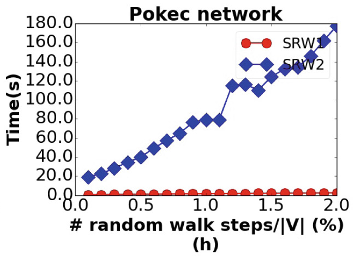
While SRW3 sounds mathematically more direct for counting triangles, the authors discovered a critical "API Efficiency Trade-off." SRW1 requires far fewer API calls because moving from one node to the next only costs one query, whereas moving between 3-node subgraphs is computationally expensive (high degree in the SR graph).
Experimental Results: Precision with Tiny Samples
The team validated their math on massive datasets, including Orkut (117M edges) and Pokec.
Key Findings:
- Accuracy: SRW1 achieved an NRMSE (Normalized Root Mean Square Error) as low as 0.033.
- Speed: On the Orkut dataset, SRW1 provided an estimate in just 13 seconds, while SRW2 took over 10 minutes for the same sample size.
- Sample Efficiency: Even at a 2% sampling rate, the 95% confidence intervals remained remarkably tight for most networks.
Critical Insight & Conclusion
This paper proves that SRW1 (Node-based walk with 3-state memory) is the "sweet spot" for real-world OSN analysis. It balances mathematical elegance with the practical reality of API rate limits.
Limitations:
- The method assumes a "connected" network.
- It requires the walk to reach a "mixing time" (stationary state) before sampling becomes accurate, which can be challenging in extremely sparse or disjointed graphs.
Future Outlook: This framework opens the door for estimating even more complex motifs (like 4-node or 5-node graphlets) in restricted-access environments, providing a vital tool for sociologists and data scientists to audit massive social platforms without needing full database access.