
Enhancing COVID-19 Misinformation Detection: The Power of Hybrid Embeddings
Analysis of COVID-19 Misinformation in Social Media using Transfer Learning
This paper presents a transfer learning approach for detecting COVID-19 misinformation on social media by combining General Twitter Embeddings (GTE) with domain-specific Context-Specific Embeddings (CSE). Using SVM and MLP classifiers on the CONSTRAINT 2021 dataset, the study demonstrates that concatenating general and context-specific vectors significantly outperforms individual embedding models.
TL;DR
In the face of the COVID-19 "infodemic," the ability to automatically flag fake news is critical for public health. This research from the University of Alberta demonstrates that we don't have to choose between "broad knowledge" and "domain expertise" in NLP. By concatenating general Twitter embeddings with COVID-specific ones, the authors achieved a statistically significant boost in detection accuracy, proving that hybrid models are the key to tackling specialized misinformation.
The Infodemic Challenge: Motivation
During the pandemic, social media became a double-edged sword: a vital tool for professional communication and a breeding ground for conspiracy theories. The primary bottleneck in fighting this is that manual fact-checking is slow and expensive.
From an AI perspective, the problem lies in representation. General embeddings (like those trained on millions of random tweets) often miss the specific medical context of "vaccine" or "quarantine" in 2020. Conversely, domain-specific embeddings have a tiny vocabulary and struggle with general language nuances. The authors' insight was simple yet powerful: Why not use both?
Methodology: Bridging the Gap with Transfer Learning
The authors explored two primary strategies to fuse knowledge:
- Augmentation Transfer Learning (ATL): Training a neural network to "translate" general embeddings into the context-specific space.
- Concatenation Transfer Learning (CTL): Simply joining the feature vectors from different embeddings to create a single, richer representation for the classifier (SVM or MLP).
Architecture & Workflow
The team utilized the CONSTRAINT 2021 dataset, comprising over 8,000 real and fake posts. They compared five embedding types, ranging from off-the-shelf General Twitter Embeddings (GTE) to their own Context-Specific Embeddings (CSE) trained on 179k pandemic-era tweets.
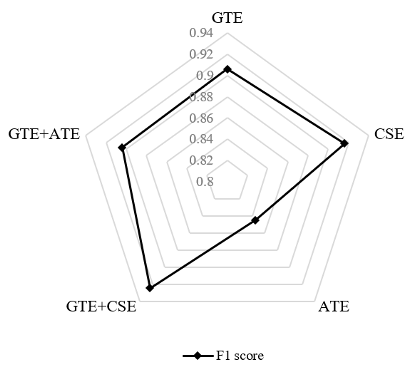 The radar charts illustrate how different embedding strategies perform across various metrics for SVM and MLP.
Proving Significance: The 5x2 CV f-test
A common pitfall in AI research is reporting a 1-2% gain without knowing if it's statistically significant or just "noise." This paper distinguishes itself by using the Combined 5x2 CV f-test. This method involves five iterations of 2-fold cross-validation to ensure that the observed improvements are mathematically robust.
Key Results
- The Winner: The GTE+CSE (Concatenated) model provided the best results.
- MLP vs. SVM: For Multi-Layer Perceptrons, the concatenation method was significantly better (p < 0.05) than using either embedding alone.
- The Vocabulary Advantage: While the specialized CSE was accurate, it only knew 22k words. The concatenated version maintained the 3 million-word reach of the general model while gaining the medical nuance of the specific one.
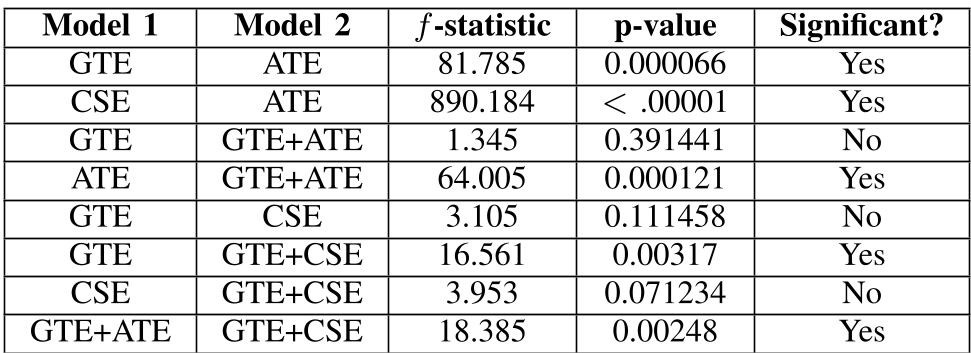 Table I: Detailed significance testing showing that GTE+CSE consistently outperforms Constituent models.
Critical Insight & Future Outlook
The core takeaway is that feature-level fusion (concatenation) is a high-yield, low-complexity way to improve specialized classifiers. While modern Transformers like BERT often dominate the conversation, this study shows that smart embedding engineering still provides massive value, especially when computational resources or labeled data are limited.
Limitations: The study primarily focuses on Word2Vec structures. Future work should investigate if this "concatenation logic" holds the same weight when using the internal hidden states of large-scale Transformers like RoBERTa or GPT.
Conclusion: As we prepare for future health crises, building automated systems that can rapidly ingest local context while maintaining global linguistic understanding is no longer optional—it is a prerequisite for effective public health response.