
Empowering Educators: Creating Affective Tutoring Characters for Remote Learning
Creating tutoring characters through a Web-based authoring tool for educational software
The paper presents a Web-based authoring tool designed for teachers to create customized educational software featuring parameterized animated tutoring characters. By utilizing a speech-driven cartoon-bear agent, the system enables non-technical educators to personalize pedagogical interactions through adjustable voice attributes and body language.
TL;DR
The transition to online education often strips away the vital emotional connection between teacher and student. This paper introduces a Web-based authoring tool that allows human teachers to reclaim this connection by designing customized, animated "tutoring characters." By tweaking vocal parameters like pitch and speed alongside physical gestures, teachers can create virtual assistants that mirror their own instructional empathy and style.
The Emotional Gap in E-Learning
While Web-based education offers unparalleled flexibility in time and location, it suffers from a significant "human deficit." Students often feel isolated, which negatively impacts their cognitive processing—a phenomenon backed by Goleman’s theories on emotional intelligence.
The problem with existing Intelligent Tutoring Systems (ITS) is their rigidity. Most systems come with "canned" behaviors that feel robotic and fail to align with a specific teacher’s vision. How can we make a computer feel more like a mentor and less like a machine?
Methodology: The Anatomy of a Virtual Tutor
The authors propose a system where the "Tutoring Character" is not just a static image, but a dynamic, parameterized entity.
1. The Power of the Cartoon Persona
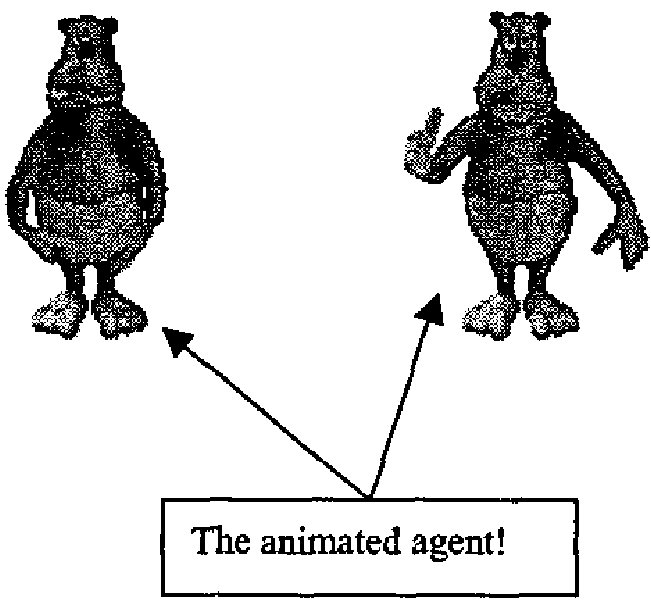
Interestingly, the research found that a cartoon-bear agent (Figure 1) was more effective than a human-like (anthropomorphic) avatar. This "Persona Effect" suggests that students find cartoons less stressful and more approachable in a digital learning environment.
2. Parameterization of Voice and Body Language
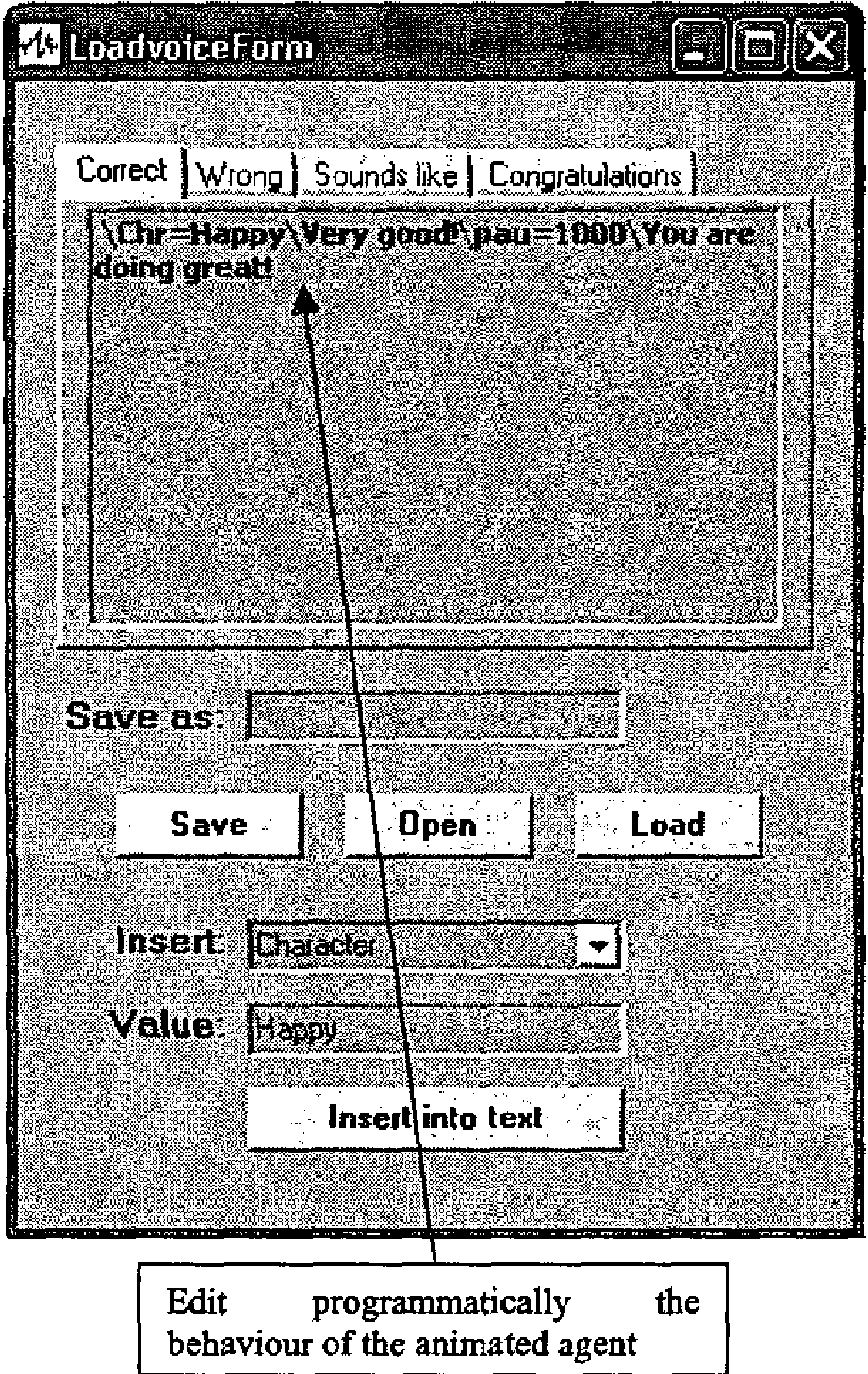
The core innovation lies in the Authoring Interface. Instead of writing complex code, teachers use intuitive sliders (Figure 2) to adjust:
- Pitch, Speed, and Volume: High pitch and speed can simulate excitement or "anger" (for careless errors), while lower volumes can simulate a supportive "whisper."
- Gestures: Over 60 animation commands control the face, hands, and feet to show boredom, wonder, or congratulatory approval.

3. Intelligence via Student Modeling
The agent's behavior isn't random. It is driven by a Student Modeling Component that tracks:
- Knowledge Level: Using Overlay and Stereotype techniques to see what the student knows.
- Intent Recognition: Distinguishing between an "accidental slip" and a "persisting misconception."
If a student makes a spelling error rather than a domain-specific mistake, the teacher can program the agent to provide a gentle hint rather than a full correction (Figure 4).
Remote Accessibility
Technologically, the tool is ahead of its time by providing a Web-based facility. Teachers can modify their tutoring characters' parameters via mobile devices or remote PCs, ensuring that they can update the curriculum or the "emotional tone" of the lesson without needing to be physically present at the student's terminal.
Critical Insights & Takeaways
The brilliance of this work lies in its Human-in-the-Loop approach. Rather than attempting to build a fully autonomous AI that replaces the teacher, the authors built a tool that extends the teacher’s presence.
Key Strengths:
- Low Barrier to Entry: Non-programmers can build complex interactions.
- Affective Design: Acknowledges that learning is as much an emotional process as a logical one.
Limitations:
- The reliance on "Speech Engines" of that era might lead to somewhat mechanical-sounding voices compared to today's Neural TTS (Text-to-Speech).
- The cartoon-bear might not be suitable for older, professional trainees, a factor the authors acknowledge but focus primarily on school-aged students.
In conclusion, this paper serves as a foundational blueprint for modern AI agents in education, proving that the most effective virtual tutors are those that carry the distinct "voice" and "spirit" of a human educator.