
Creative Data Ontology: Solving "Metadata Amnesia" with the Russian Doll Principle
Creative Data Ontology: ‘Russian Doll’ Metadata Versioning in Film and TV Post-Production Workflows
This paper introduces an OWL-based Creative Data Ontology specifically designed for metadata versioning in film and TV post-production. It utilizes a unique 'Russian Doll' principle to wrap records within records, ensuring metadata persistence and provenance across complex media workflows like VFX and unscripted TV.
TL;DR
Film and TV post-production often lose essential metadata during handovers, leading to costly delays and errors. This paper presents a new OWL-based ontology that treats metadata as a nested, versioned entity—much like a Russian Doll—allowing every change in a media project's lifecycle to be tracked, verified, and recovered.
Background: The Hidden Chaos of Post-Production
In the visual effects (VFX) and television industry, "metadata" isn't just a file size or a name. It includes "Hard" metadata (camera focal length, frame rates, lens serials) and "Soft" metadata (creative notes, clapper board info, script supervisor annotations).
The industry's current pain point is that this data is often "traveled with" but not "linked to" the media. When a project moves from the film set to a post-production house, these snippets of information frequently get lost or mismatched, forcing practitioners to "reverse engineer" technical details from visual cues.
Methodology: The "Russian Doll" Architecture
The core innovation is the "Russian Doll" data design principle. Instead of simply overwriting metadata, the system wraps records within records.
The Versioning Mechanism
The ontology distinguishes between DataItems (the entity) and Record (the metadata about that entity).
- Every
DataItemis assigned aRecordupon creation. - When metadata changes, the system doesn't modify the record; it creates a new instance of the
DataItemand wraps it in a newRecord. - These records are then linked via a symmetric
hasRecordVersionproperty.

This creates an immutable audit trail of every technical amendment across a project's history.
Industry Use Cases & Impact
The researchers applied this sub-ontology (a refined set of 350 key fields) to three critical scenarios:
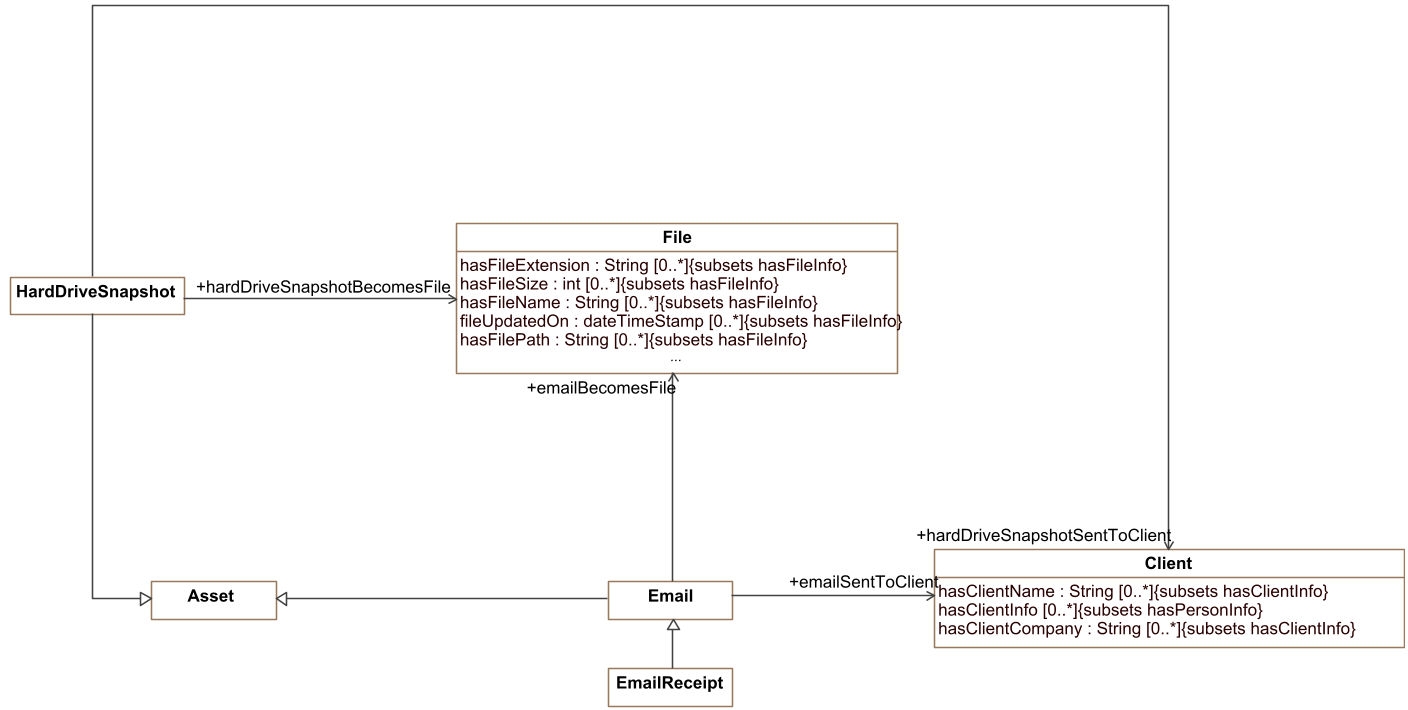
1. Television Media Support
Avoids the "feedback loop" where post-production staff spend hours asking production crews for missing roll numbers or technical receipts. The ontology tracks email communications and folder snapshots as linked assets.
2. Live Logging in Unscripted TV
In documentary filming, "loggers" tag footage in real-time. Normally, these tags are lost during re-edits. The ontology ensures LoggingTags persist by linking them to persistent timecodes and clip IDs.
3. VFX On-Set Shoot Data
VFX requires specific data (e.g., "is the lens anamorphic or spherical?"). The ontology maps these technical properties to a Shoot and Scene hierarchy, allowing artists to query the original set conditions months after the cameras have stopped rolling.
Critical Analysis: Is it Scalable?
While the Russian Doll principle provides excellent provenance, the authors acknowledge a hurdle: Scaling. The full industry metadata set numbers in the thousands.
Strengths:
- Ethno-centric Design: Developed via ethnographic research with actual practitioners, ensuring the "common vocabulary" satisfies real-world needs.
- Open Source Kernel: Designed to be a foundational layer upon which companies can build proprietary tools.
Limitations:
- The paper focuses on a "sub-ontology" for three use cases; integrating the full thousands-of-fields set may introduce significant complexity in graph queries and performance.
Conclusion
The Creative Data Ontology moves beyond simple archiving. By shifting the focus to the dynamic "production workflow" and utilizing a recursive versioning structure, it provides a blueprint for an industry-wide common vocabulary. As media production becomes increasingly digital and decentralized, this "Russian Doll" approach may become the standard for ensuring data integrity from the first take to the final frame.