
The Creative Link: Quantifying "Group Flow" Through Social Network Analysis
The creative link: Investigating the relationship between social network indices, creative performance and flow in blended teams
This study investigates the "Networked Flow" framework, identifying how social network indices relate to collective flow and creative performance in blended learning teams. By utilizing longitudinal Social Network Analysis (SNA), the authors demonstrate that decentralized and highly interactive group structures are strong predictors of optimal group experiences and superior creative outcomes.
TL;DR
Can we actually measure the "vibe" of a high-performing creative team? This study says yes. By tracking how students talk to each other over 12 weeks, researchers found that decentralized communication and high interaction density are the mathematical signatures of "Networked Flow"—a collective state of mind that leads to more original and useful creative products.
Background: Beyond the Lone Genius
For decades, creativity was seen as a solo sport—a matter of individual IQ and personality. However, the modern world runs on blended teams: groups that mix face-to-face meetings with digital tools like Slack or Google Workspace. The authors of this paper argue that the secret to a team's success lies in "Networked Flow." This happens when a group enters a "collaborative zone of proximal development"—a sweet spot where individual skills and collective goals are perfectly balanced.
The "Networked Flow" Methodology
The researchers didn't just ask students if they felt creative; they mapped their digital DNA using Social Network Analysis (SNA). They monitored:
- Density: How many people are talking to everyone else? (A proxy for neighbor interaction).
- Centralization: Is one person hogging the microphone, or is the power shared? (A proxy for decentralized control).
- Cliques Participation Index (CPI): Are members floating between different sub-discussions? (A proxy for social presence).
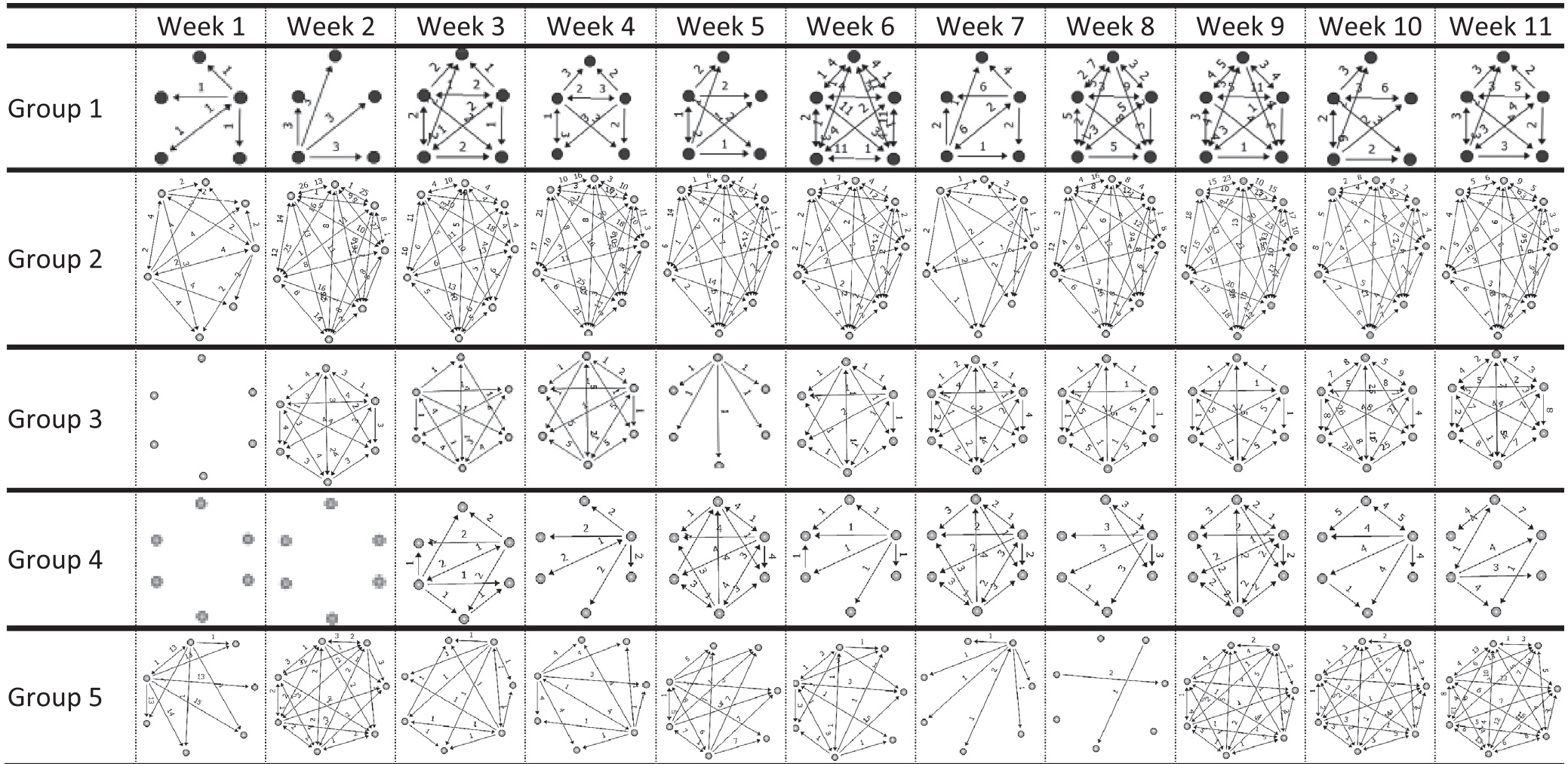 The figure above illustrates how team interaction patterns evolve over time, moving from scattered contacts to dense, interconnected webs.
Key Insights: Why Structure Matters
The study compared a high-performing group (Group 5) with a low-performing one (Group 4). The differences were stark:
- Distributed Power vs. Monarchy: Group 5 had high density and low centralization. Everyone was involved. Group 4 was dominated by one or two members who "monopolized the discussion," leading to the lowest creativity scores.
- The Flow Connection: Density wasn't just a stat; it was highly correlated with the Flow State Scale. When teams had many active links, members felt a better "Challenge-Skill Balance" and higher concentration.
- The Narrative of Failure: In Group 4, flow actually decreased over 12 weeks. Their lack of a collaborative zone prevented the "group mind" from forming, resulting in a product that lacked novelty and resolution.
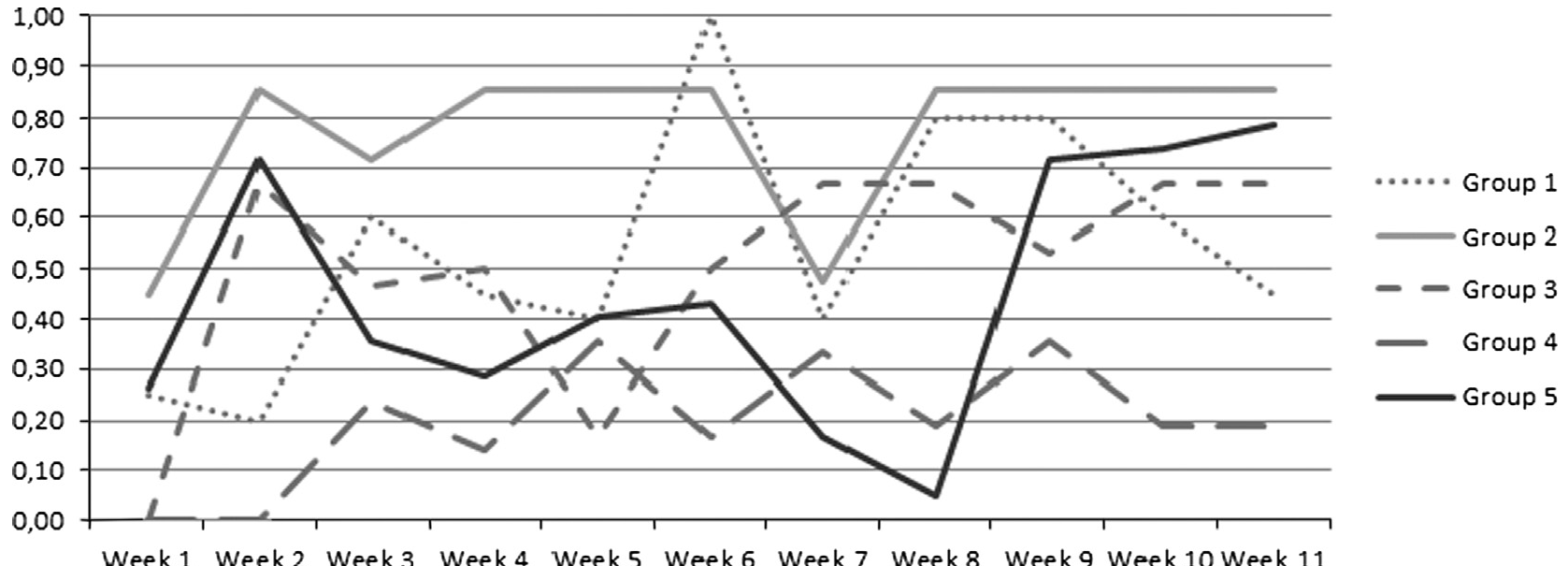 Performance metrics like Density and Centralization reveal the underlying health of a team's creative process long before the final project is due.
Critical Analysis & Conclusion
This paper serves as a bridge between hard-data sociology and "soft" psychology. It proves that structural decentralization is a prerequisite for collective inspiration.
Limitations: The study size is small (30 students), and there is a "ceiling effect"—in very small groups, SNA indices can hit 100% easily. Also, the flow assessment was subjective (survey-based) while the interaction data was objective (logs).
Future Outlook: Imagine a Slack bot that monitors your team's centralization index. If it detects that only two people are talking, it prompts others to chime in, theoretically "engineering" the conditions for Networked Flow. In the era of remote work, these SNA metrics may become the new KPIs for team health and innovation potential.