
Cross-Platform Veracity: Using Wikipedia's "Search History" to Fact-Check Social Media
Credibility Assessment Using Wikipedia for Messages on Social Network Services
The paper introduces a cross-platform credibility assessment framework that validates Social Network Service (SNS) messages against Wikipedia content. It utilizes a novel "survival ratio" algorithm based on Wikipedia's edit history to weight the reliability of reference texts before performing semantic similarity mapping with SNS threads.
TL;DR
Researchers from Nagoya University have developed a system that treats Wikipedia's massive edit history as a "peer-review" filter to verify SNS messages. By calculating how long specific texts survive under the scrutiny of Wikipedia editors, the system assigns a "trust score" to reference data, which is then used to audit the credibility of threads on platforms like Facebook or LinkedIn.
The Credibility Vacuum in Social Media
The "Pain Point" is clear: SNS platforms are breeding grounds for misinformation. While previous research (like WikiTrust) focused on Wikipedia's internal reliability, or Twitter-specific models relied on the presence of external URLs, there was no bridge for the "citation-less" post. If a user makes a claim without a link, how do we verify it?
The authors' key insight is that Wikipedia is not just a collection of facts, but a battlefield of edits. A sentence that survives 100 edits by 10 different high-reputation editors is statistically more "credible" than a newly added sentence.
Methodology: The Survival of the Fittest (Text)
The system follows a three-step pipeline:
1. The Recursive Trust Metric
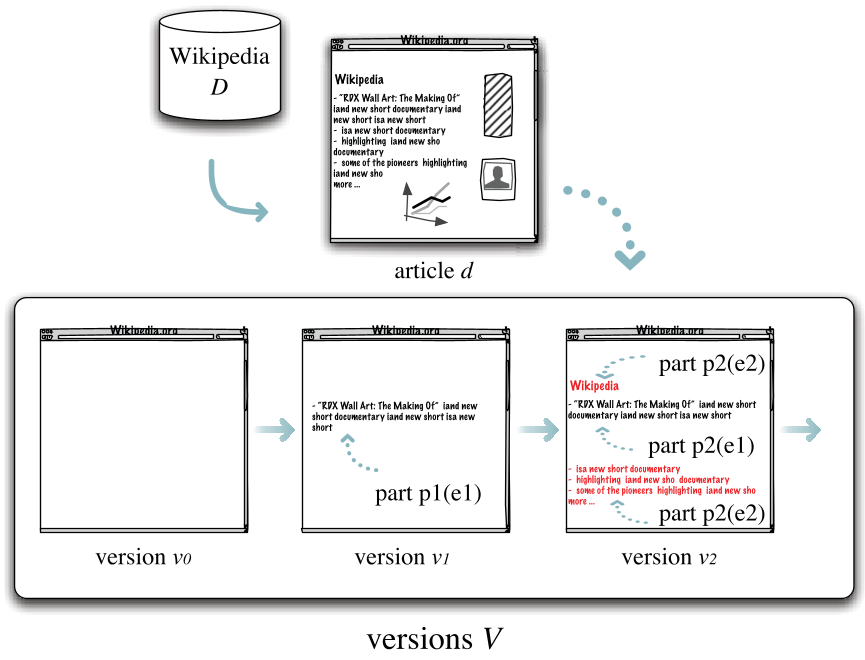
Instead of assuming all Wikipedia content is equal, the model uses a recursive calculation:
- Part Credibility: Calculated by the survival ratio of characters.
- Editor Credibility: Determined by the average survival rate of the content they contribute across multiple articles.
- Normalization: Unlike previous models, this system normalizes scores (0 to 1) and uses a log scale to prevent "length-bias" (where long, low-quality additions might overwhelm short, high-quality ones).
2. Semantic Mapping
To compare a short SNS message with a long Wikipedia article, the authors employ a Topic Structure Model. This extracts "Subject Terms" (proper nouns) and "Content Terms" (co-occurring words). The system doesn't just look at the primary article; it explores a "Link Graph" to find:
- Interactive Links: Bi-directional links indicating high relevance.
- Content-based Targets: Articles with high paragraph-level similarity even if not directly linked.
Experimental Results
The researchers tested their approach on three topics: "Inter" (soccer), "Migraine" (medical), and "Nagatomo" (athlete).
Key Performance Insights:
- Domain Sensitivity: The system excelled in the Medical domain (Migraine). Factual, stable information on Wikipedia provided a solid "ground truth" for verifying SNS messages.
- The "Subjectivity" Trap: For the soccer team "Inter," precision plummeted. Why? Sports fans often write subjective, opinionated content on both SNS and Wikipedia. When the reference source becomes a "fan wall" rather than an encyclopedia, the credibility calculation breaks down.

Critical Analysis & Future Outlook
This work provides a robust framework for grounded credibility. By linking the "chaos" of social media to the "consensus-building" of Wikipedia, it offers a path toward automated fact-checking.
Limitations:
- Temporal Decay: Facts change (e.g., "Barack Obama is President"). The system currently lacks a "freshness" component.
- Source Monopoly: Relying solely on Wikipedia limits coverage. Integrating other "Gold Standard" sources like PubMed or official news wires would increase robustness.
- Opinion vs. Fact: The authors honestly note that "Impressions" (e.g., "This player is great!") shouldn't be measured for credibility, but the system currently struggles to filter them out.
Final Takeaway
The "Survival Ratio" of text is a powerful proxy for truth in collaborative environments. As we move into the era of LLMs, grounding AI-generated content in these "surviving" human-verified consensus points will be vital for maintaining information integrity.