
Beyond the Follower Count: Decoding Credibility in Social Networks
Finding Credible Information Sources in Social Networks Based on Content and Social Structure
This paper presents a framework for identifying and ranking credible information sources in social networks like Twitter. By combining structural social link analysis with Latent Dirichlet Allocation (LDA) topic modeling, the authors developed a Beta-Binomial ranking algorithm that outperforms standard search and commercial "opt-in" expert directories.
TL;DR
In the era of information overload, who should you follow? This research moves beyond the "million follower fallacy" to propose a system that identifies true experts by analyzing both who follows whom and what they actually talk about. By combining Bayesian statistics (Beta-Binomial distribution) with Topic Modeling (LDA), the authors built a system that identifies credible sources more accurately than commercial expert directories.
The Credibility Paradox
Why is finding experts on social media so hard? Traditional search engines rely on keywords, but on platforms like Twitter, the most recent post isn't necessarily the most authoritative. Furthermore, 140-character tweets are too brief for standard NLP algorithms to grasp "expertise."
The authors identified a critical "Credibility Paradox": Information consumers need to trust a source, but the signals for trust (like social network structure) and expertise (topical relevance) are often obscured by noise or "general popularity" (e.g., a celebrity ranking high for a topic they mention once).
Methodology: The Hybrid Intelligence Approach
The proposed algorithm operates in three distinct phases:
- Candidate Identification: It starts with a standard search for a topic. The users who recently tweeted about it are labeled "Voters." The "Candidates" are then anyone followed by these Voters. This leverages the wisdom of the crowd—if people interested in "Hadoop" all follow a specific person, that person is likely an expert.
- The Beta-Binomial Social Filter: Ranking by raw follower count is biased toward celebrities. Ranking by the ratio of "voter followers" to "total followers" is biased toward tiny niche accounts. The authors use a Beta-Binomial model to smooth this data, providing a statistically sound way to weight the "votes" a user receives relative to their size.
- Content Analysis (LDA): To ensure a candidate isn't just socially popular but actually knowledgeable, the system aggregates all of a user's tweets into one document and runs Latent Dirichlet Allocation (LDA). This calculates the probability that the user’s overall "persona" matches the search query.
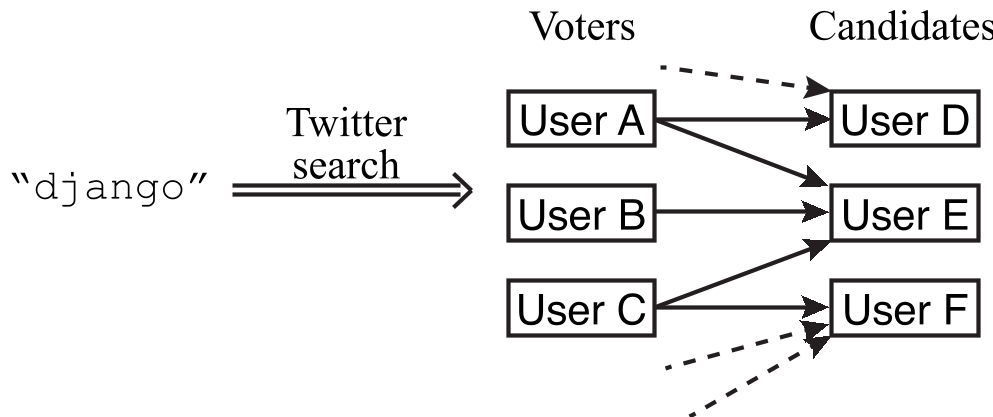 Figure 1: The flow from query-based "Voters" to discovery of "Candidates" via the social graph.
Proving Credibility: Experimental Insights
Before building the algorithm, the authors conducted a "used car appraisal" study to see what humans actually trust. They found that:
- Context is King: Expertise in "dating" actually lowered a user's perceived credibility in "car pricing" compared to a random user.
- Visualization Matters: Presenting a "Word Cloud" (summary) together with "Specific Tweets" resulted in the highest credibility ratings. Words clouds show relevance, while tweets show style and quality.
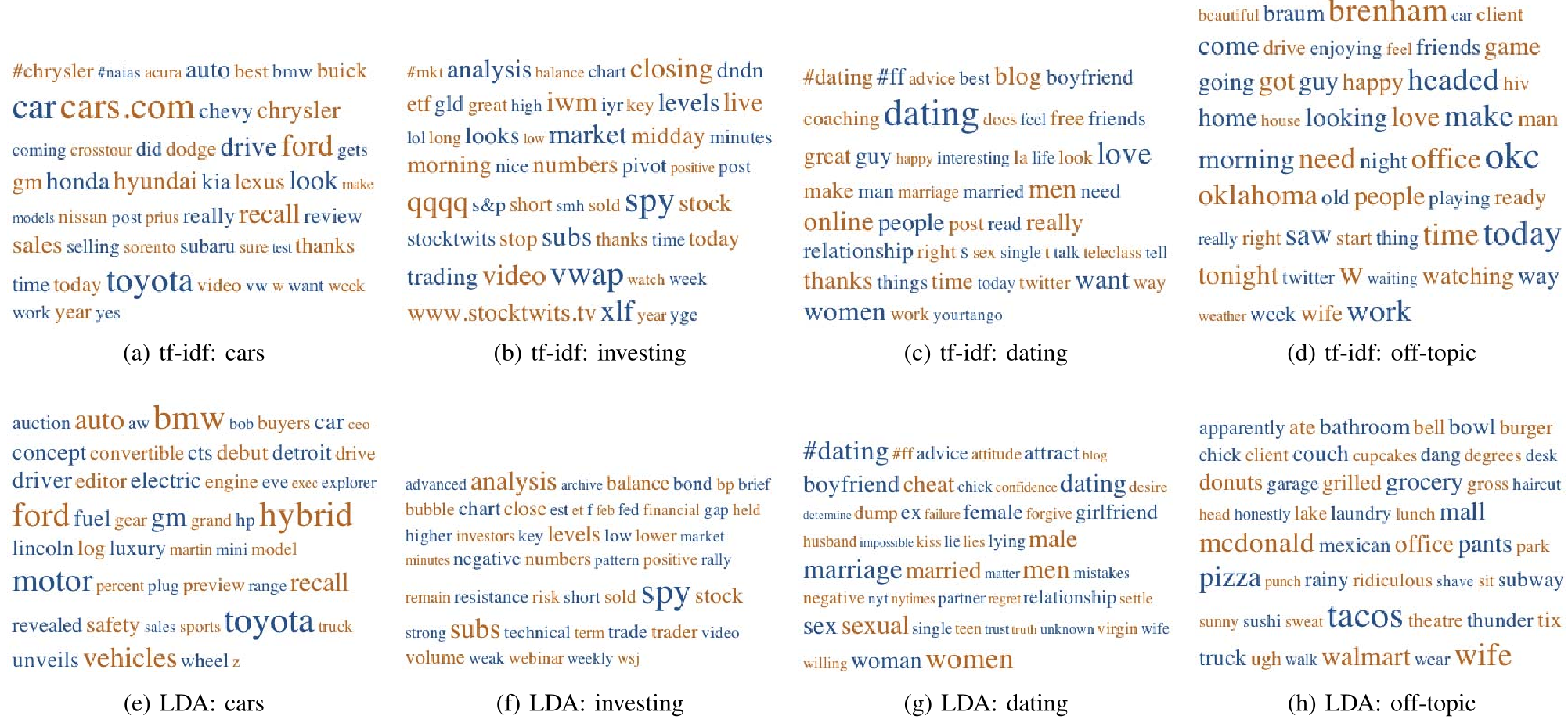 Figure 2: Examples of TF-IDF vs. LDA word clouds used to represent user expertise.
Results & Competitive Edge
When tested against WeFollow (a major commercial directory of the time), the algorithm's Beta-Binomial and LDA components achieved superior Precision and Recall. Specifically, in the "Django" case study, the model identified 19/20 relevant experts, outperforming simple vote-counting and chronological search.
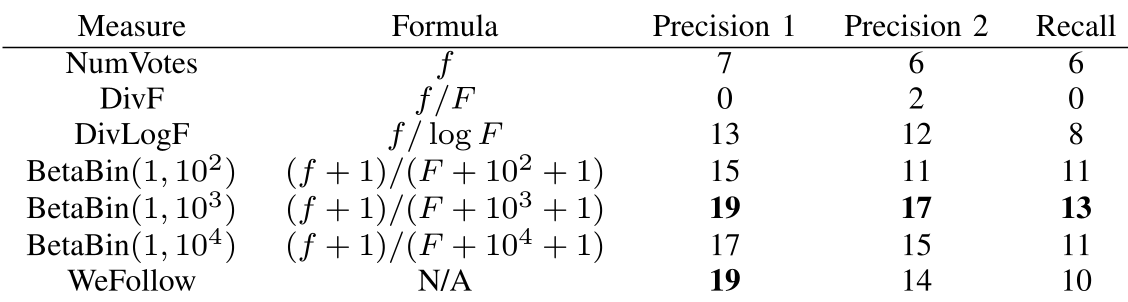 Table 1: The Beta-Binomial model (BetaBin 10^3) significantly outperforming standard frequency-based metrics (NumVotes) and ratios (DivF).
Critical Insight & Future Outlook
The genius of this work lies in its temporal adaptation. Because it seeds its candidate pool from a live search, the expert list evolves as the topic does.
Limitations: The reliance on followers-as-votes assumes a "clean" graph, which is increasingly susceptible to bot manipulation in the modern era.
Future Work: Modern iterations of this research would likely replace LDA with Transformer-based embeddings to better capture the nuance of short-form text, but the fundamental Bayesian logic for balancing social "votes" remains a gold standard for recommendation systems.