
From Amps to Trust: How Electrical Grid Principles Solved Social Network Credibility
3526_From credit and risk to trust towards a credit flow based trust model for social networks.
This paper introduces CoreTrust (Credit Over Risk Equals Trust), a novel trust model for social networks that metaphorically treats social interactions as power flows in an electrical grid. It achieves personalized trust measures by tracing credit flows based on user expertise and bias, significantly outperforming global reputation systems like EigenTrust.
TL;DR
Trust in online social networks is notoriously difficult to quantify. Global "reputation" scores are too generic, while local "web of trust" models are often too sparse to be useful. This paper introduces CoreTrust, a model that treats social credit as electrical power. By applying Load Flow Analysis—the math used to manage power grids—the authors have created a system that is both personalized and mathematically rigorous, outperforming established algorithms like EigenTrust by over 30% in accuracy.
Contextualizing Trust: Why Current Models Short-Circuit
In the digital world, trust is the currency of collaboration. However, current systems face a "Goldilocks" problem:
- Global Models (e.g., PageRank, EigenTrust): They focus on objective reputation. If everyone likes Bob, the system tells you to like Bob. But trust is subjective; your interest in classical music shouldn't force you to trust Bob's opinions on heavy metal.
- Local Models (e.g., TidalTrust, MoleTrust): These rely on direct "friend-of-a-friend" links. The problem? Most social graphs are incredibly sparse. If there isn't a direct path, the model has no data.
The authors argue that we need to consider Risk and Expertise. A novice's high rating for a product carries more risk than a professional critic's low rating.
The "CoreTrust" Insight: Social Networks as Power Grids
The core innovation is a physical metaphor. In an electrical grid, power flows from generators to loads through wires with resistance. The authors propose the following mapping:
- Buses (Nodes) = Users
- Power = Credit (derived from the "wisdom of crowds" and rating patterns).
- Voltage = Risk (lower risk = higher expertise).
- Current = Trust (the actual flow of confidence).
The Methodology
The authors use the Newton-Raphson method, a standard iterative algorithm in electrical engineering, to solve "Credit Balance Equations."
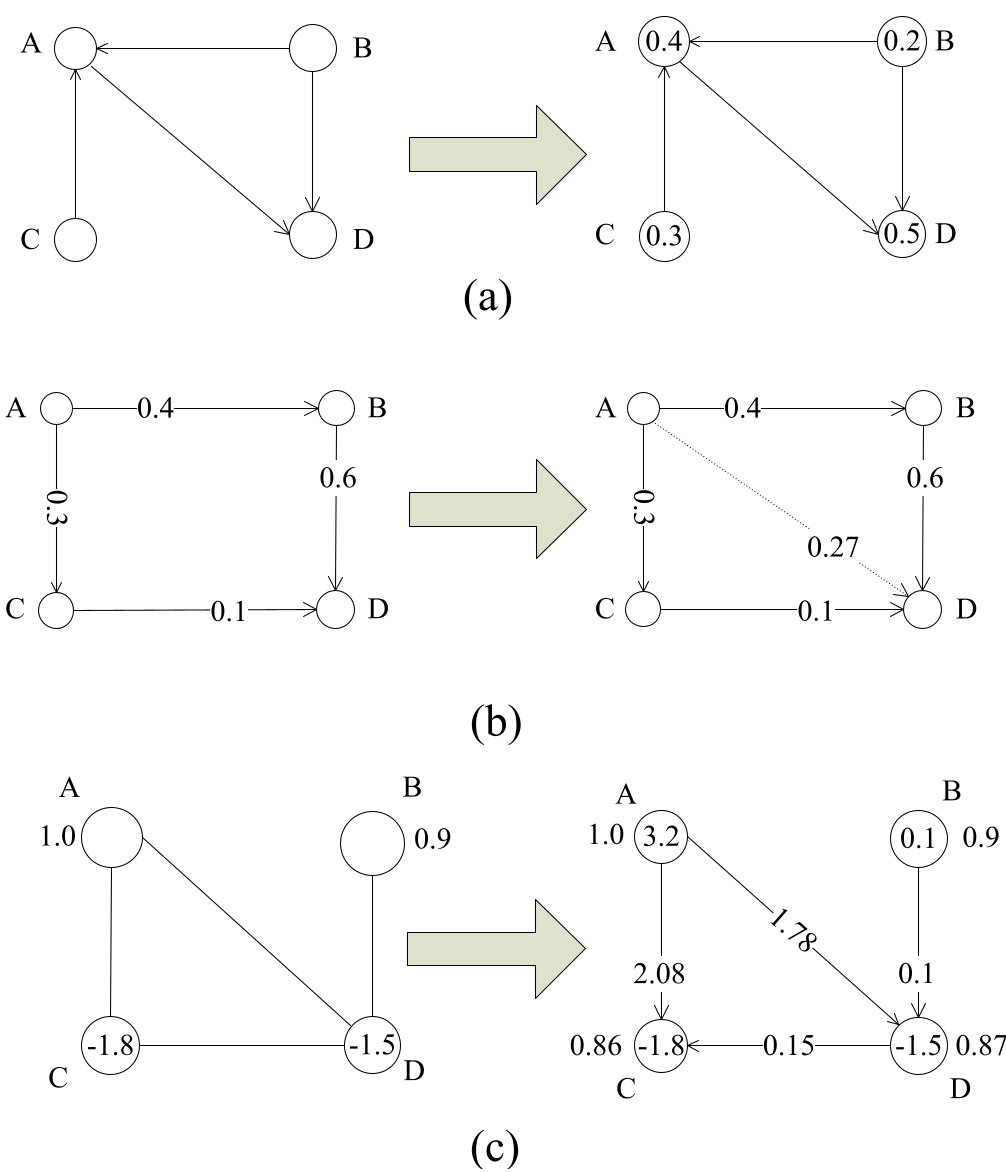 Figure 1: Comparison between Objective, Subjective, and Credit Flow metrics.
Unlike simple path-averaging, this model considers the Admittance Matrix of the entire network. Trust isn't just a number on an edge; it’s a dynamic flow that balances across the whole system. If an "Appraisal User" (Generator) gives credit, it flows toward "Beneficiary Users" (Loads) who take credit. The "Risk Factor" acts like voltage; just as current flows from high to low voltage, trust flows naturally toward those with the highest expertise (lowest risk).
Methodology Breakdown: Solving for Trust
The process follows a strict 7-step pipeline:
- Calculate Credit: Compute real credit (relevant to the category) and reactive credit (irrelevant/noise).
- Define a Source: Pick the user whose perspective we are calculating.
- Admittance Matrix: Build a topological map of how everyone is connected.
- Solve Equations: Use the balance equations to find the "potential" (risk) of every node.
- Infer Trust: Calculate the flow between the source and all other users.
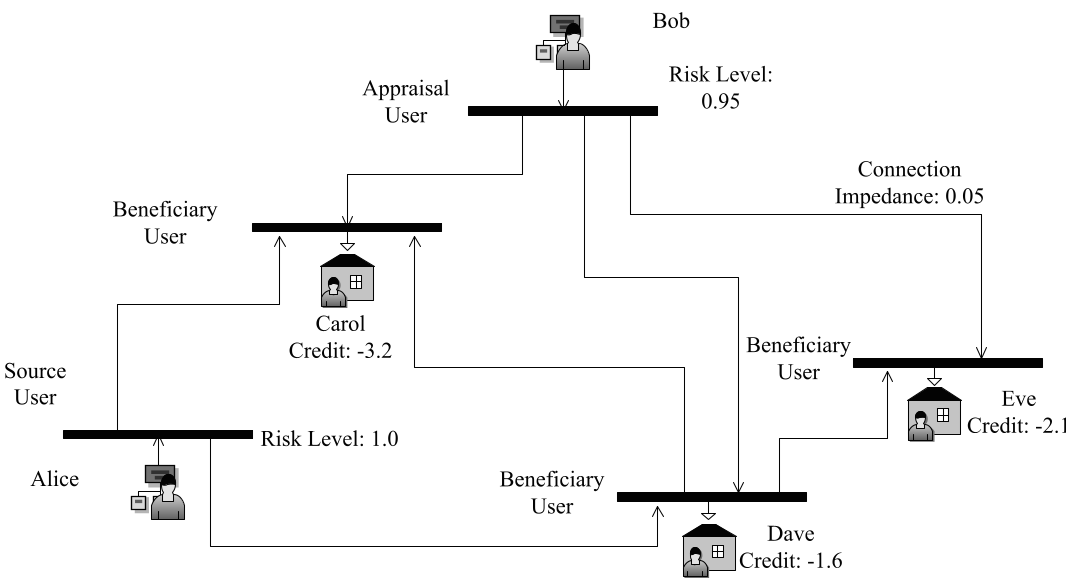 Figure 2: A practical example of how Alice (source) projects trust across a network using derived Risk factors.
Putting it to the Test: The Epinions Evaluation
Using a massive dataset from Epinions (6,847 users, 77,965 trust edges), the authors pitted CoreTrust against the industry standards.
Key Findings:
- Precision/Recall: CoreTrust achieved an F1-score of 0.81, compared to 0.61 for EigenTrust. This suggests that adding the "expertise/risk" factor makes the model much better at predicting who a user will actually trust.
- Sparsity Handling: While local models like MoleTrust fail when there are no direct paths, CoreTrust’s flow-based approach maintains high Accuracy and AUC (Area Under Curve) because it leverages the network's global "credit" data.
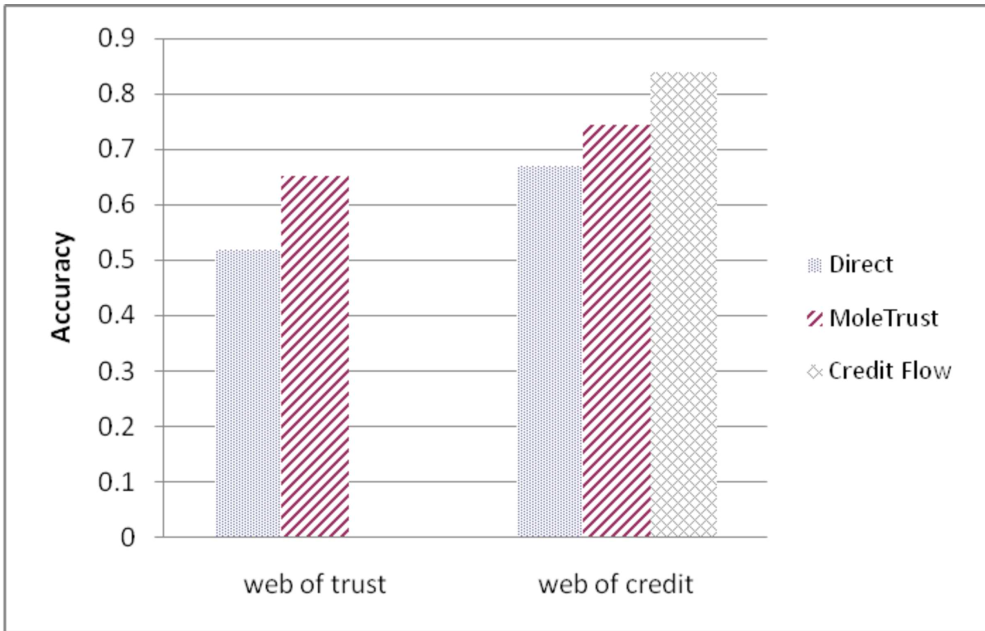 Figure 3: Accuracy vs. Threshold. CoreTrust consistently stays above traditional local propagation methods.
Critical Insight & Future Outlook
The brilliance of this work lies in its Inductive Bias. By assuming trust behaves like a physical flow, the authors bypass the subjectivity trap.
Limitations: The computational complexity of the Newton-Raphson method is high for real-time applications involving millions of nodes. Additionally, the model currently treats "distrust" as a secondary factor, whereas in modern social media, distrust/bot-detection is often as important as trust.
Takeaway: This paper is a masterclass in cross-disciplinary engineering. It proves that the solutions to social software problems might already exist in the textbooks of classical physics and power systems.