
CTFO: Bridging the Gap Between Rigid Hierarchies and Fuzzy Realities in Social Networks
Crisp to fuzzy ontology conversion in the context of social networks: A new approach
The paper introduces CTFO (Crisp To Fuzzy Ontology Conversion), an automated framework designed to transform existing binary crisp ontologies into fuzzy ontologies within social network contexts. It utilizes Cluster Validation Indices (CVI) and social network distance matrices to calculate membership degrees, achieving a balance between semantic richness and computational efficiency.
TL;DR
In the world of the Semantic Web, data is rarely "black and white." Yet, most existing ontologies are "crisp"—meaning a concept either belongs to a category or it doesn't. This paper presents CTFO (Crisp To Fuzzy Ontology Conversion), an ingenious algorithm that takes these rigid, binary structures and injects them with the "shades of grey" required for real-world uncertainty, all while slashing the computational complexity from exponential to near-linear scales.
The "Precision" Trap: Why Crisp Ontologies Fail
Traditional ontologies act like a rigid filing cabinet. In a social network context, a user might be classified as an "Influencer" or a "Follower." But what if they are partially both? Linguistic vagueness, multiple meanings of words, and the fluid nature of social connections make binary logic insufficient.
The problem is that building Fuzzy Ontologies from scratch is computationally expensive. Prevailing methods like FCA (Formal Concept Analysis) grow exponentially in complexity (), making them "choke" on large-scale social data.
Methodology: The "Decoupling" Insight
The authors' core insight is that you don't need to learn the structure and the fuzziness at the same time. By separating the two, they allow researchers to use fast, mature crisp clustering techniques to build the "skeleton" first.
The CTFO Algorithm
Once the skeleton (crisp ontology) is ready, CTFO performs a Depth-First Search (DFS) traversal. For every node, it asks: "How well does this specific sub-cluster fit compared to its siblings?"
- Distance Matrix: It uses a distance matrix derived from social network statistical analysis.
- CVI (Cluster Validation Index): It calculates a validation index for each cluster. If a cluster is very compact and far from its neighbors, it gets a high membership degree (closer to 1.0).
- Fuzzy Mapping: These CVI values are mapped onto the [0, 1] interval and assigned to the taxonomic relations.
 Fig 1: The process of linearly partitioning an ontology into sibling clusters to evaluate validity indices.
Experiments & Efficiency
The paper provides a rigorous complexity analysis comparing CTFO against the industry standards:
- FCA-Based: — Virtually unusable for large datasets.
- Hierarchical FCM: — Better, but still struggles with scalability and has "weak traceability."
- CTFO (with K-Means): — Highly scalable and efficient.
Practical Example
The authors demonstrate the algorithm on a sample ontology where nodes (C1-C10) are processed step-by-step. By calculating the CVI of against its siblings , the algorithm assigns a realistic "level of belonging" to the parent concept.
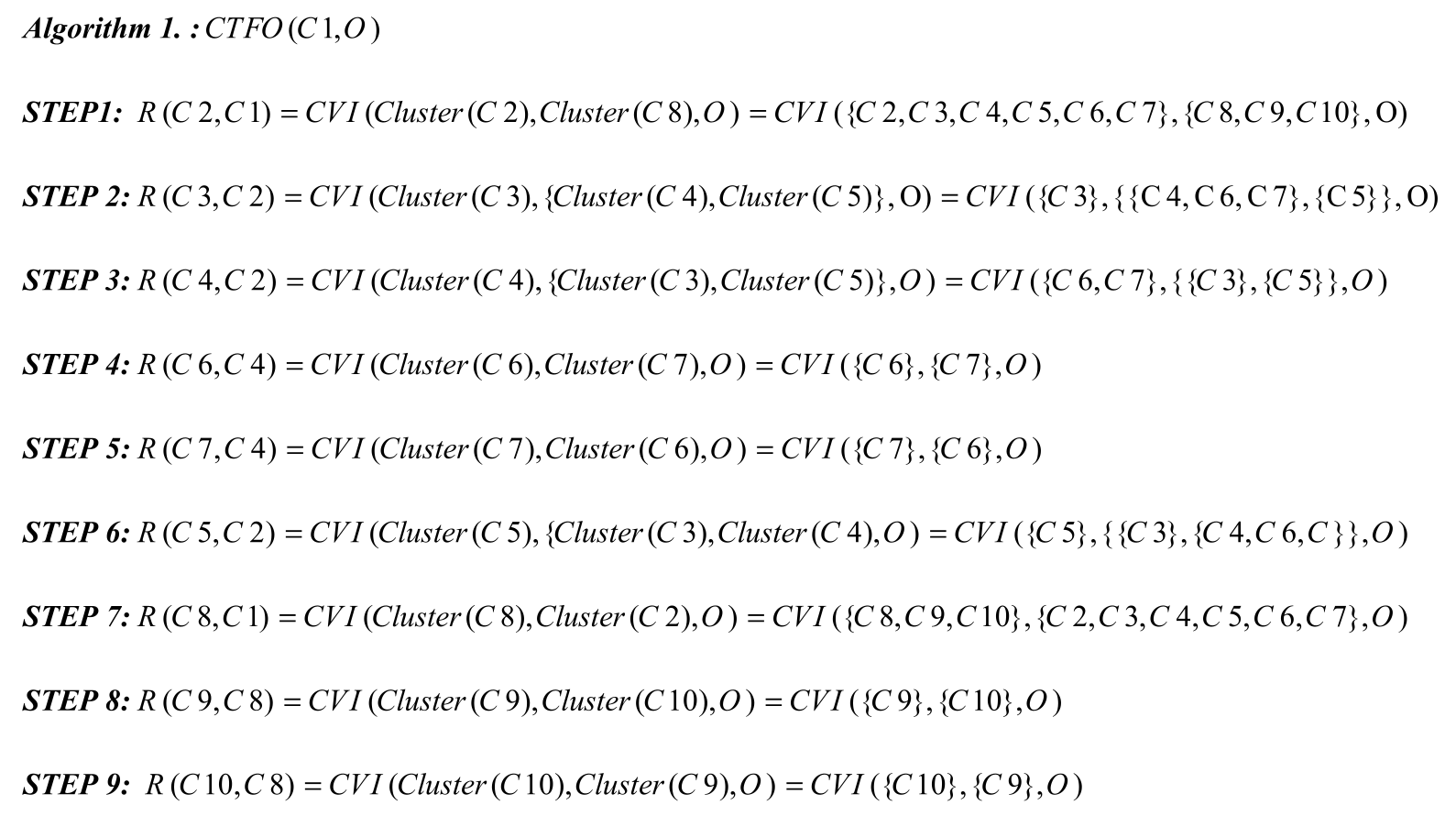 Fig 2: The trace of the CTFO algorithm calculating fuzzy values across the ontology tree.
Deep Insight: Why This Matters
The true value of this work isn't just the speed—it's Legacy Compatibility. There are decades worth of manually curated crisp ontologies (like Gene Ontology or WordNet). CTFO provides a mathematical "lens" to convert these million-dollar assets into fuzzy-logic-ready systems without having to re-invent the wheel.
Conclusion & Future Outlook
CTFO proves that fuzzy logic doesn't have to be a "computational nightmare." By leveraging Cluster Validation Indices, the authors have provided a scalable bridge between rigid machine logic and the nuanced, uncertain reality of human social networks.
Future Work: The authors suggest moving toward even higher degrees of uncertainty handling (perhaps Type-2 Fuzzy Logic) and refining the CVI selection for different domains.
Takeaway Table
| Method | Complexity | Flexibility | Traceability |
|---|---|---|---|
| FCA | Low | Good | |
| H-FCM | Low | Weak | |
| CTFO (Proposed) | High | Fair/Good |