
Defining Social Playability: A Critical Review of Game Evaluation Heuristics
Critical review on video game evaluation heuristics: social games perspective
This paper provides a critical review of existing video game evaluation heuristics and proposes the first set of domain-specific heuristics for "social games" (e.g., FarmVille, Mafia Wars). It synthesizes prior models from Federoff, Desurvire, Korhonen, and Pinelle to establish a 10-point framework tailored for the social media gaming context.
TL;DR
In the era of Facebook-based gaming, traditional "fun" heuristics often fail. This paper by Janne Paavilainen critiques the aging models of game evaluation and introduces a specialized 10-point heuristic framework for Social Games. It shifts the focus from deep mechanical complexity to virality, asynchronicity, and interruptibility.
Problem & Motivation: Why Traditional Heuristics Fail Social Games
By 2010, games like FarmVille were attracting 80 million monthly users, yet the academic community lacked a rigorous way to evaluate them. Existing models like HEP (Heuristics for Evaluating Playability) or Federoff’s model were built for consoles or PCs.
The author points out a fascinating paradox: while traditional design rules say "avoid boring or repetitive tasks," social games thrive on them for relaxation. Traditional heuristics assume a dedicated gaming session; social games assume you are checking your crops between emails. There was a desperate need for a model that understood the Social Network Service (SNS) context.
Methodology: The Evolution of Game Evaluation
The paper performs a meta-analysis of four key pillars in game heuristics:
- Federoff (2002): Focused on literature and a single-team case study; criticized for being too abstract.
- Desurvire et al. (2004 - HEP): Extensive but criticized for containing subjective items that are hard to evaluate.
- Korhonen & Koivisto (2006): The most rigorous model, focusing on mobile and multiplayer games.
- Pinelle et al. (2008): Focused strictly on usability (UI/UX) rather than "engagement."
The Proposed Social Game Framework
Paavilainen synthesizes these with social-specific frameworks to create a 10-point checklist.
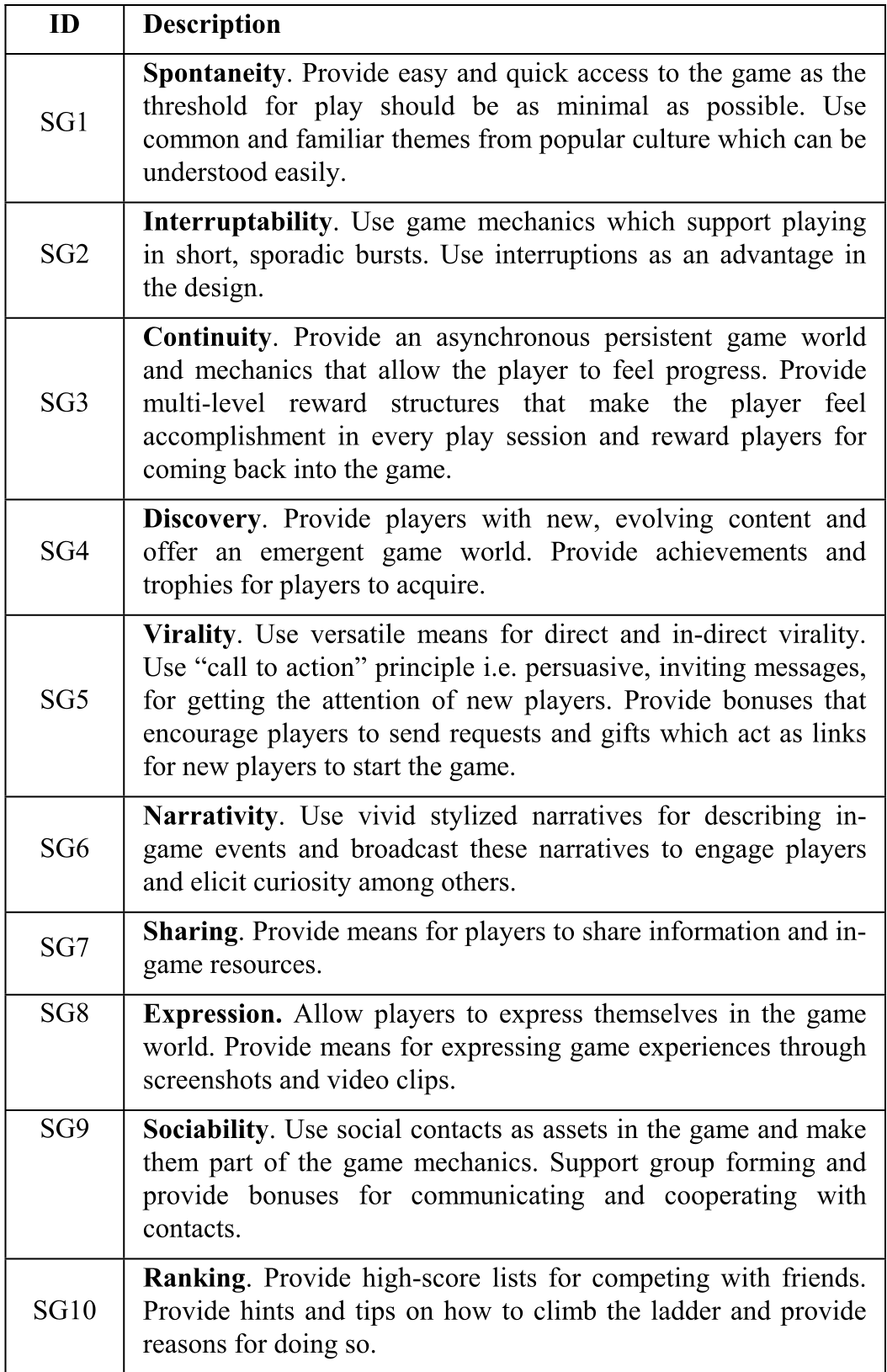
Core Insight: The 10 Commandments of Social Games
The methodology moves away from the "PC gamer" mindset. Key highlights from the SG1-SG10 heuristics include:
- Interruptibility (SG2): Unlike a raid in World of Warcraft, a social game must support short, sporadic bursts of play.
- Continuity (SG3): Asynchronicity is king. The world must persist even when the player is offline.
- Virality (SG5): This isn't just "multiplayer"; it's about the "call to action"—incentivizing players to bring their literal social circle into the game.
- Sociability (SG9): Making social contacts "assets" in the game mechanics (e.g., needing neighbors to expand your farm).

Experiments & Results: Bridging Research and Design
The author discovers that while social games share the "User Interface" requirements of traditional games, their "Gameplay" requirements are closer to casual games.
The review reveals a significant gap: prior models had almost zero focus on virality or narrativity through social feeds. By testing these new heuristics against existing design drivers (like Järvinen’s "Symbolic Physicality"), the author validates that these 10 items cover the "blind spots" of previous research.
Critical Analysis & Conclusion
Takeaway
Social games are not just "lite" versions of video games; they are a hybrid of social media and playful interaction. A successful social game must minimize the "threshold for play" (Spontaneity) and maximize the "reasons to return" (Continuity).
Limitations & Future Work
The author admits that these 10 heuristics are "high-level" and need further refinement. The "subjective grading" problem (e.g., what constitutes a '3' vs. a '4' in Virality?) remains a challenge for heuristic evaluation.
Future research (under the SoPlay project) aims to validate these by comparing expert heuristic results against actual user playtesting—moving from theory to empirical SOTA.