
Harmonizing the Skies: Cross-Calibration of the FY-3A TOU with NASA’s OMI
Cross-Calibration of the Total Ozone Unit (TOU) With the Ozone Monitoring Instrument (OMI) and SBUV/2 for Environmental Applications
This paper presents a cross-calibration technique for the Total Ozone Unit (TOU) onboard the Chinese FengYun-3/A satellite using NASA's Ozone Monitoring Instrument (OMI) as a reference. By applying a regression-based correction to radiance biases, the authors successfully aligned TOU's total column ozone products with SOTA sensors, achieving consistency within 3% of OMI and 5% of ground-based measurements.
TL;DR
The first generation of China's Total Ozone Unit (TOU) on the FengYun-3A satellite initially faced significant data biases due to instrumentation and calibration gaps. This paper details a successful mission-recovery strategy: using NASA's OMI as a "gold standard" to reverse-engineer radiance corrections. The result is a high-fidelity ozone dataset that aligns within 1% of international benchmarks, enabling its use in global climate monitoring.
Background: Monitoring the Atmospheric Shield
Since the discovery of the Antarctic ozone hole in the 1970s, continuous monitoring of stratospheric ozone has been critical for environmental safety. While ground stations provide local data, spaceborne Backscatter Ultraviolet (BUV) instruments offer the global coverage necessary to track planetary-scale changes. In 2008, China launched the TOU on FY-3A to join this global effort. However, early data revealed a major hurdle: the radiance levels measured by the TOU were significantly higher than those from established instruments like NOAA's SBUV/2.
The Problem: The Prelaunch Blind Spot
The technical investigation revealed that the TOU's response function—calculated before launch—was only measured for a limited range of radiance. When the satellite encountered extremely bright scenes (such as dense cloud cover near the equator), the sensors entered high-gain ranges that hadn't been fully characterized. This led to "saturated" signals and a "jump" in the data behavior around the 6.6–7.0 μW/cm²/sr/nm threshold.
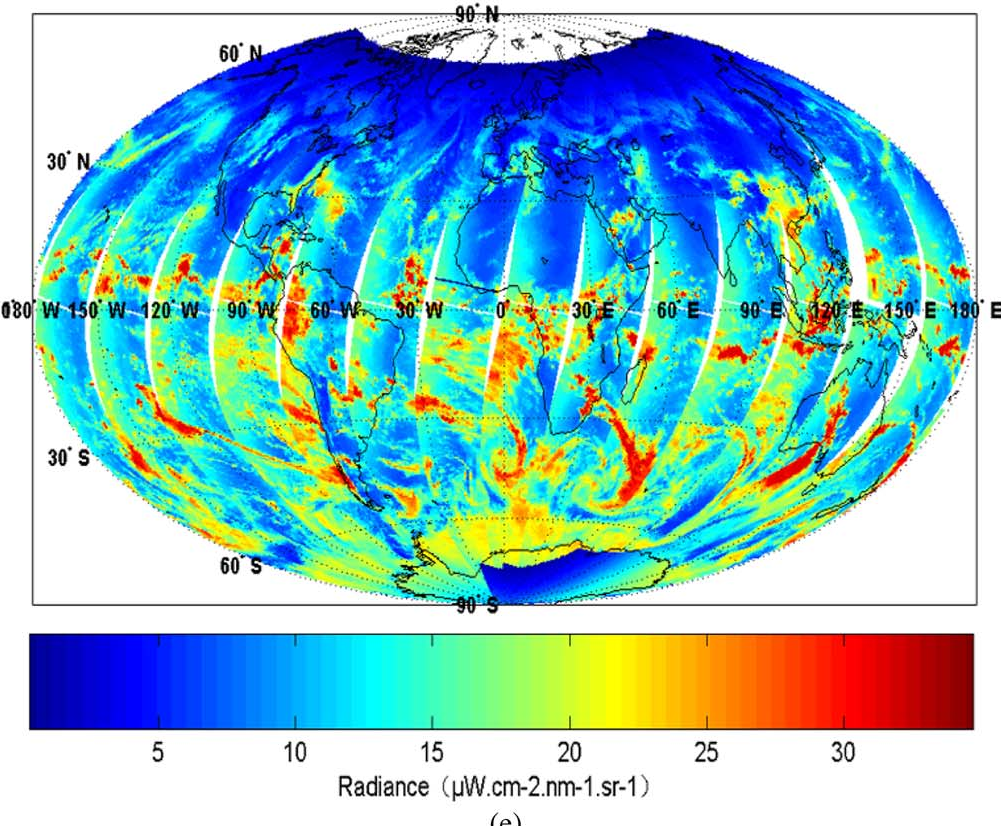 Figure: The sudden shift in ozone bias when plotted against radiance intensity in Channel 6.
Methodology: Intercalibration as a Correction Key
To fix these biases without physical access to the satellite, the researchers turned to Cross-Calibration.
- Truth Modeling: They used NASA OMI Level 3 ozone data as input for a Radiative Transfer Model (RTM) to simulate what the TOU should have seen.
- Clear-Sky Filtering: By focusing on the Pacific Ocean (a stable target), they isolated "clear-sky" pixels to establish a baseline.
- Recursive Correction:
- First, they corrected the 360nm channel (Channel 6).
- Then, they used the corrected Channel 6 to estimate cloud fractions, which in turn helped calibrate the shorter, ozone-absorbing wavelengths (Channels 2-4).
- Mathematical Regression: For low radiance, a simple linear shift sufficed. For higher radiances involving saturation, they employed third-order polynomial equations to handle non-linearities.
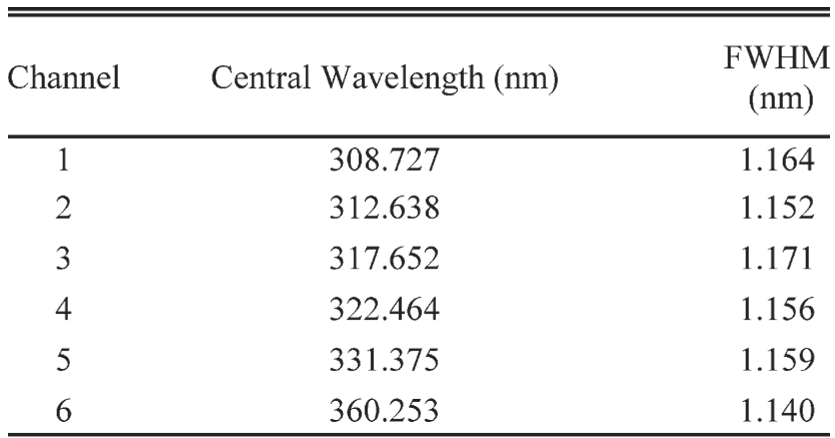 Table: The six spectral bands of the TOU used in the Huggins absorption bands for ozone retrieval.
Performance: Closing the Gap
The results of this recalibration were dramatic. The previously erratic ozone maps were smoothed, and the average difference between TOU and OMI dropped from a significant error margin to just 0.65%.
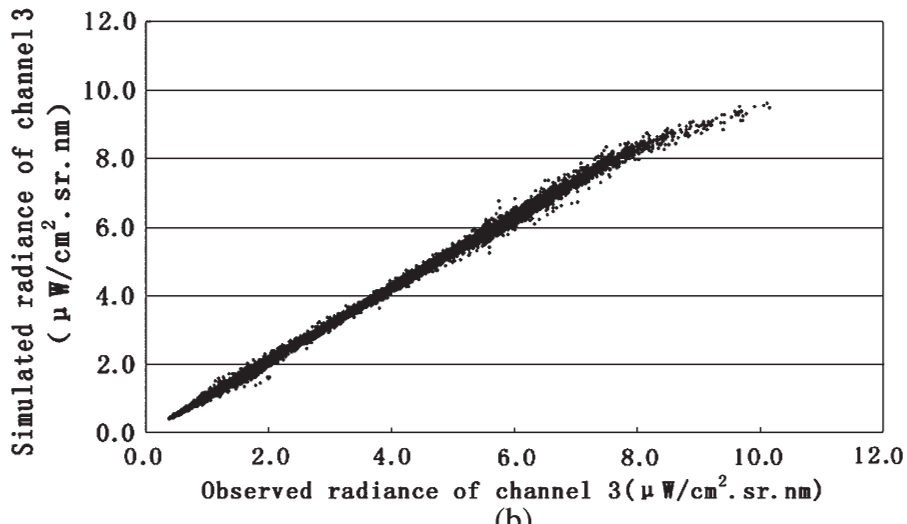 Figure: After intercalibration, the bias across radiances was nearly eliminated, centering around zero.
Comparing the corrected TOU data against 74 ground-based stations (Dobson and Brewer instruments) showed an overall bias of just -0.38%, proving that the FY-3A/TOU could now serve as a reliable tool for global environmental science.
Critical Insight: The "Why" and the "What's Next"
The core achievement here isn't just a "fix" for one satellite; it's a demonstration of the power of inter-agency data fusion. In an era of "New Space" where many countries are launching their own sensors, this methodology provides a blueprint for ensuring that data from different nations is comparable and scientifically valid.
Limitations: The study notes that the TOU's diffusers (used for solar calibration) have degraded by over 50% since launch, and stray light affects the accuracy of on-orbit sensitivity monitoring. Future missions (like FY-3B and beyond) must ensure broader prelaunch testing across all dynamic ranges to avoid such post-launch mathematical heavy-lifting.
Conclusion (Takeaway)
The FY-3A TOU cross-calibration transformed a potentially compromised mission into a valuable scientific asset. It highlights that the "Truth" in remote sensing is often found by looking at the harmony between multiple eyes in the sky.