
Legal Concepts Across Boundaries: A Bayesian Approach to Inferential Semantics
Cross-categorization of legal concepts across boundaries of legal systems: in consideration of inferential links
The paper introduces a cross-categorization framework for mapping legal concepts between heterogeneous legal systems (Japan and Denmark). It combines the Bayesian Model of Generalization (BMG) with the Infinite Relational Model (IRM) and its normal variant (n-IRM) to provide an automated, probabilistic approach to ontology alignment in the legal domain.
TL;DR
How does a Japanese lawyer understand Danish educational law? This paper moves beyond simple keyword matching to propose a Cross-Categorization Framework. By combining Bayesian Generalization with Infinite Relational Models, the authors simulate the cognitive process of a "reasoner" interpreting an alien legal system through the lens of their own, uncovering deep-seated inferential structures.
Backgound: The Problem of "Legal Translation"
In legal theory, concepts like "citizenship" or "Bachelor's degree" are not isolated labels. According to scholars like Giovanni Sartor, they are inferential nodes: a bundle of preconditions (why you get it) and consequences (what rights it grants).
The difficulty arises when crossing borders. A Danish researcher sees a Japanese legal term and doesn't just look for a translation; they look for a concept in their system that shares similar "causes and effects." Standard AI models for ontology alignment often fail here because they assume a neutral, objective mapping, whereas real human reasoning is inherently biased by one's own background knowledge.
Methodology: Simulating the "Reasoner's View"
The authors propose a multi-stage mathematical pipeline to bridge this gap:
1. The Bayesian Model of Generalization (BMG)
Instead of using standard symmetric metrics (like Jaccard Similarity), the authors employ BMG.
- The Intuition: If I know the Japanese system (Referent) and I see a Danish concept (New), I only care about the features I recognize.
- Feature Weighting: Rare features are given more weight. If only two degrees in Japan require a specific exam, and a Danish degree requires it too, that feature is a powerful "signal" for mapping.
2. The Normal Infinite Relational Model (n-IRM)
Once similarity scores are calculated, the n-IRM performs joint clustering. It doesn't just cluster Japanese concepts and Danish concepts separately; it looks for "blocks" of interaction, identifying which categories in Japan "behave" like categories in Denmark.
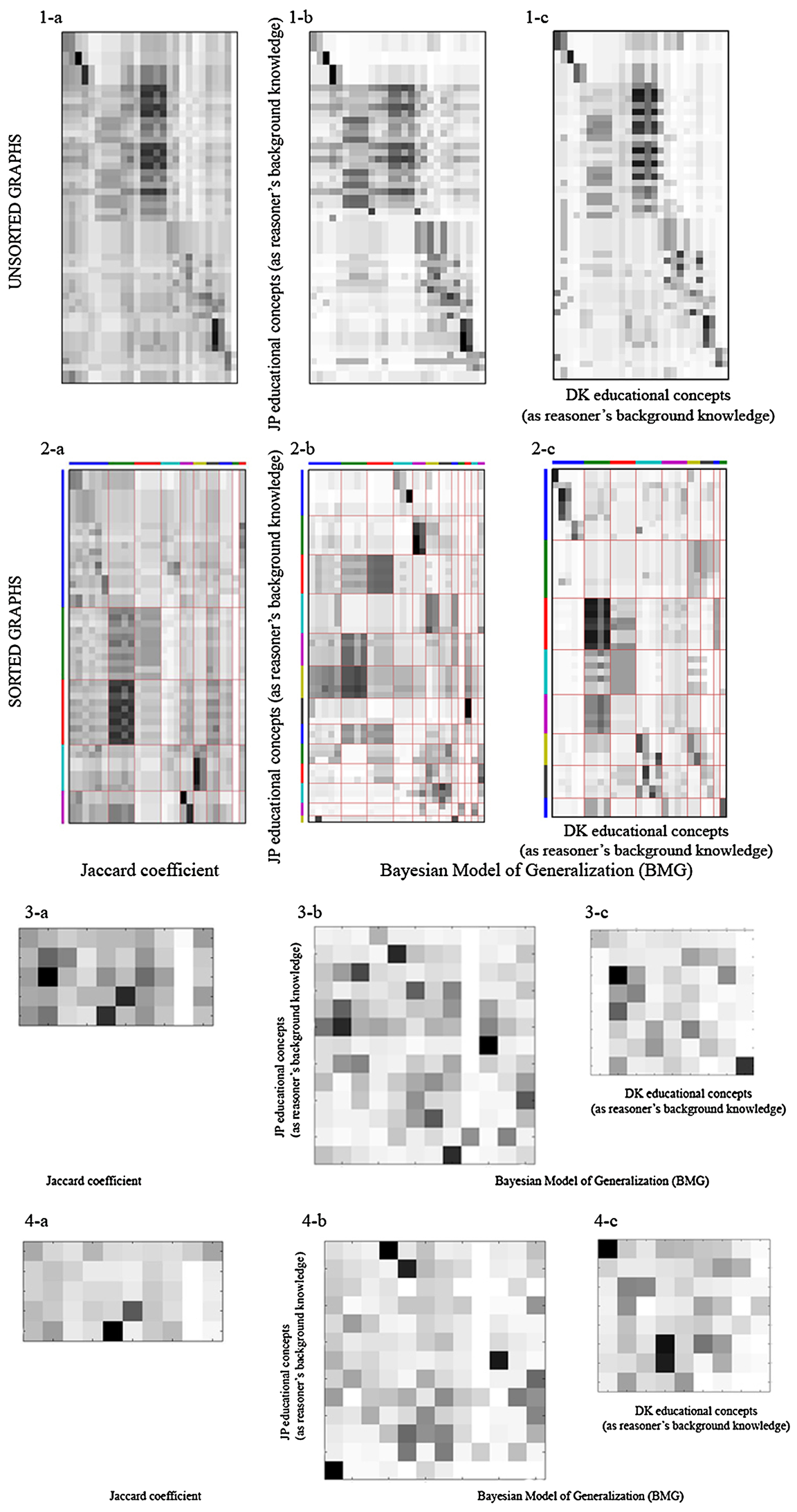 Figure: The workflow showing BMG score calculation followed by n-IRM and IRM clustering.
3. Inferential Link Analysis (IRM)
Finally, the IRM is used to cluster the features themselves. This creates a "Theory of the System," showing which conditions (e.g., "Starting age 18") and consequences (e.g., "ISCED Level 5") define each cluster.
Experimental Showdown: BMG vs. Jaccard
The authors tested their approach on educational legal data (ISCED standards) from Japan and Denmark.
- Jaccard Results: Produced "coarse" and "blurry" clusters. It failed to distinguish between subtle differences in higher education tiers.
- BMG Results: Provided sharp, fine-grained categories. When the "Japanese Reasoner" view was applied, the model successfully linked "Junior College" (Japan) to "Short Cycle Tertiary Education" (Denmark) by identifying unique shared inferential links.
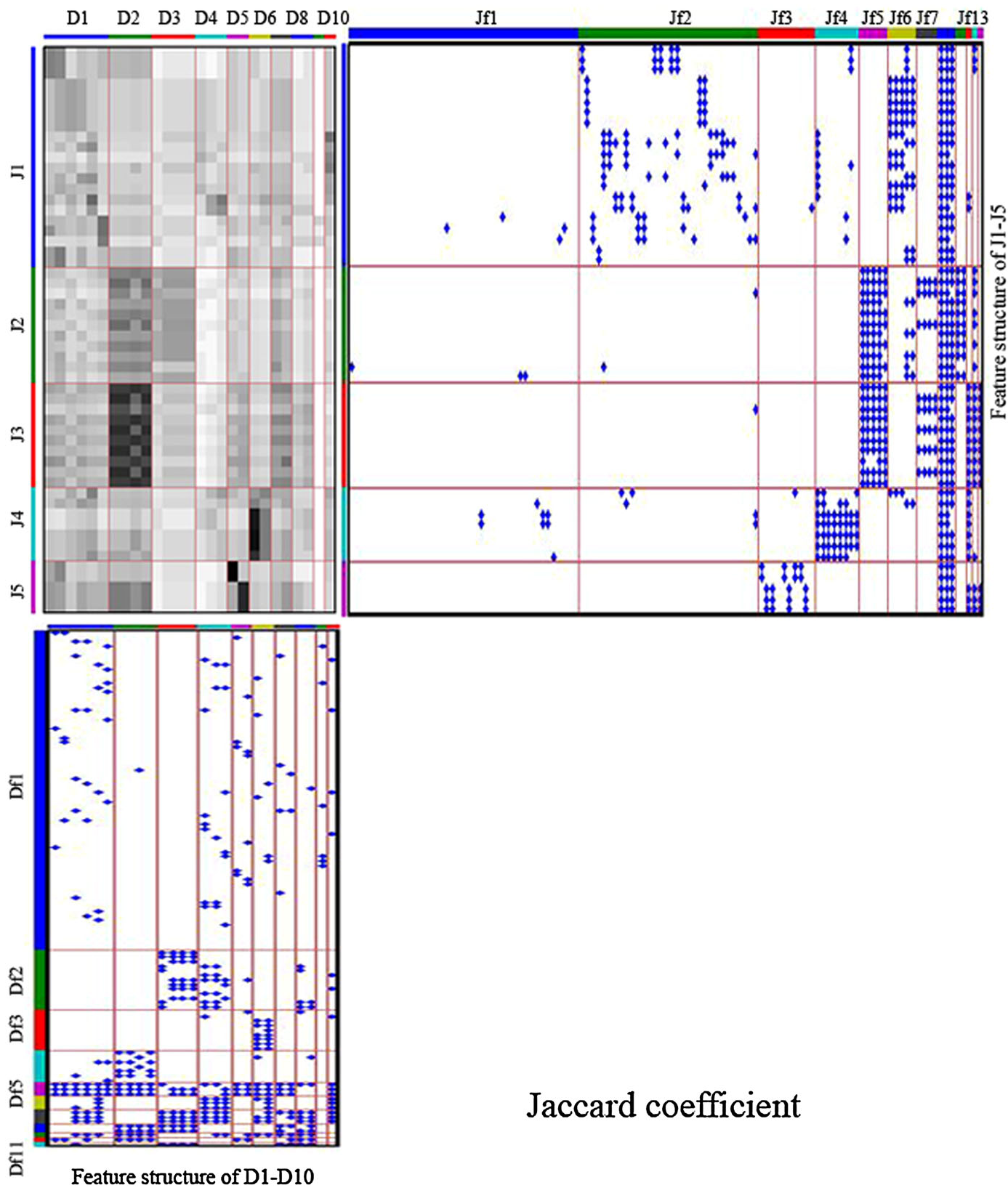 Figure: Detailed heatmaps contrasting Jaccard and BMG-based clustering blocks.
Qualitative Evidence: The Hierarchical Ontology
By applying Formal Concept Analysis (FCA) to the model's output, the authors generated a "Terminological Ontology." This visualizes how features are inherited. For instance, a "Master's" cluster in Japan inherits the general traits of "Higher Education" but is distinguished by specific "Non-inherited" features like "2nd degree qualification."
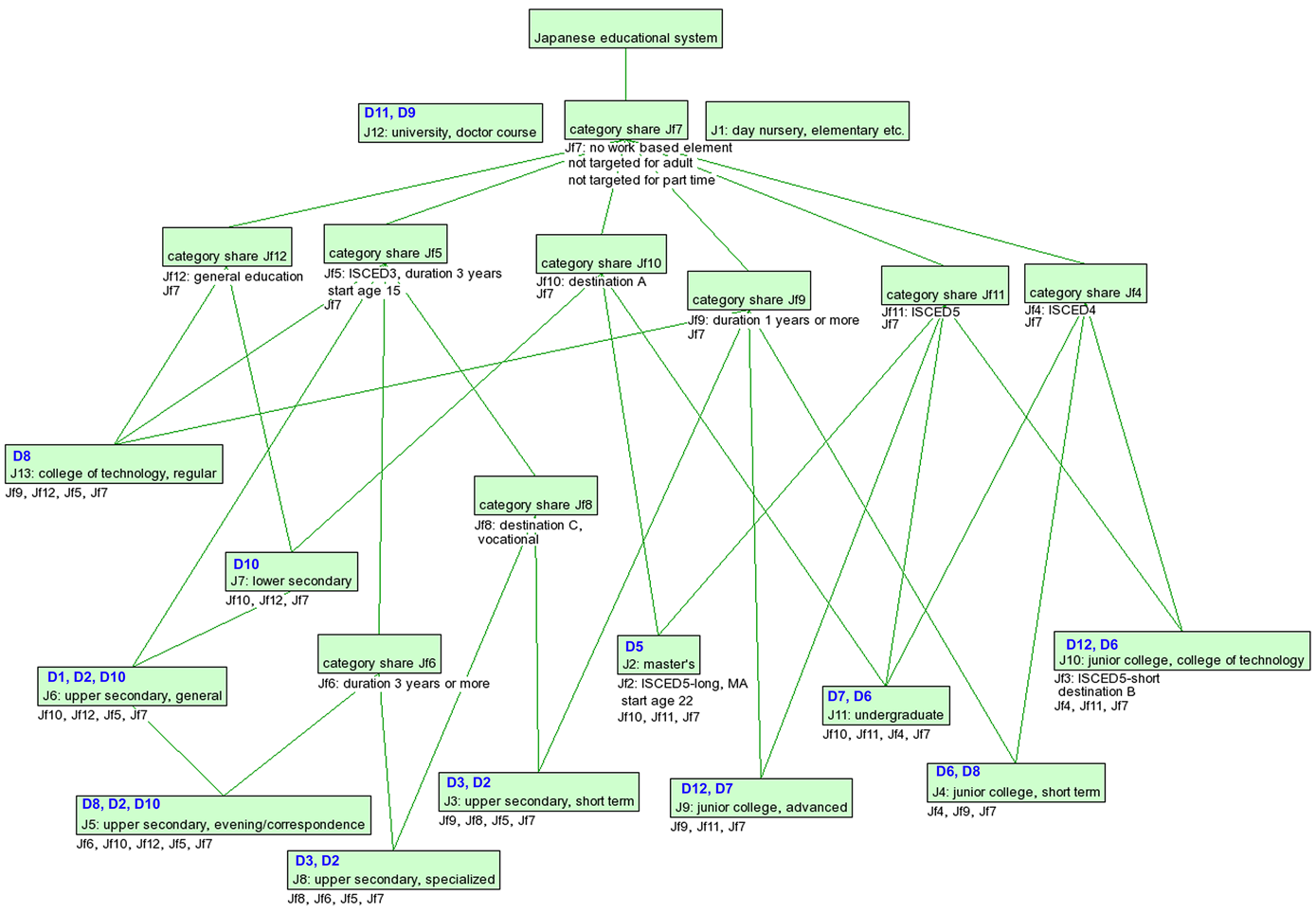 Figure: Hierarchical graph showing the "Japanese Educational System" as viewed by the model.
Conclusion & Insights
This paper represents a significant leap in Computational Law. It shifts the focus from "what words are similar" to "how do systems interact."
Takeaways for the Industry:
- Context is King: For cross-border AI (like automated tax or pension compliance), similarity must be asymmetric and "reasoner-dependent."
- Probabilistic Logic: Legal systems are essentially "intuitive theories." Using Infinite Relational Models allows AI to discover the underlying structure of these theories without manual labeling.
While the study is limited by its reliance on standardized UNESCO (ISCED) data, the framework itself is a "plug-and-play" architecture for any domain where two complex, rule-based systems need to shake hands.