
Bridges of Sound: Decoding Global Social Ties in Music Networks
Cross-country User Connections in an Online Social Network for Music
This paper investigates cross-country user connections within the Last.fm music social network to understand how cultural and geographic factors influence social ties. Using the LFM-1b dataset, the authors identify "attractor" countries and map the propensity for users to form intra-country versus trans-border friendships.
TL;DR
Music is often called a universal language, but our social habits suggest it remains deeply rooted in cultural and geographic silos. Analyzing the Last.fm network, this study reveals that while the US and UK act as global "attractors" for music fans, many nations remain highly insular. Understanding these cross-country patterns—driven by shared history and language—provides a blueprint for the next generation of culturally-aware recommender systems.
The Social-Cultural Blind Spot
In the world of Recommender Systems (RS), we know that friends influence our taste (social ties) and where we live shapes our worldvview (culture). However, most algorithms treat these as separate variables. The authors of this study argue that this is a missed opportunity. Why do users from certain countries look abroad for musical social circles while others stay local? By bridging the gap between social network analysis and cultural studies, this research seeks to identify the "gravity" certain nations exert on the global music community.
Methodology: Mapping the Music Diaspora
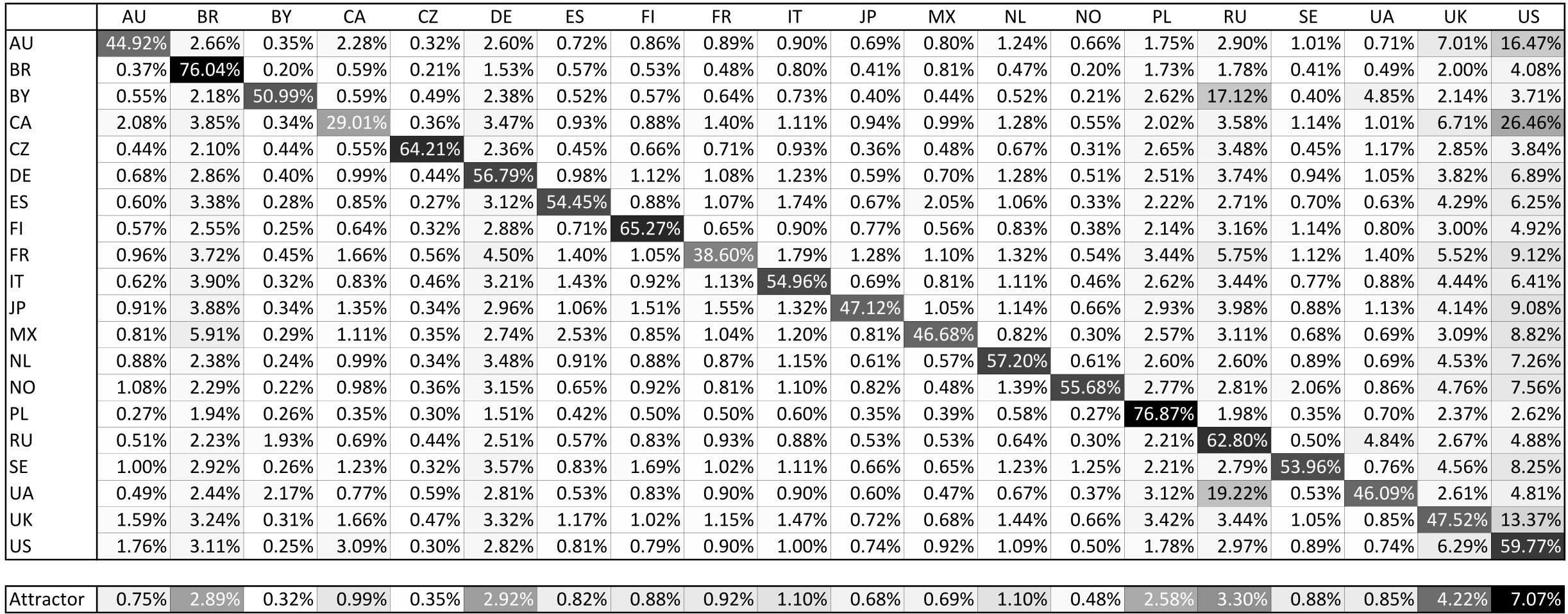
The researchers utilized the LFM-1b dataset, specifically filtering for users with valid country data. By extracting 1,087,662 bidirectional connections, they built a Normalized Country Connection Matrix.
The "Attractor" Logic
To determine which countries are global hubs, the authors proposed the Attractor Measure. Instead of a simple average (which could be skewed by two neighboring countries having a massive shared bond), they used the median share of incoming connections from all other countries. This ensures that a true "attractor" is a country that draws interest globally, not just from its immediate neighbor.

Key Findings: Local Fortress vs. International Hubs
1. The Insular Nations
The study found that Poland (76.87%) and Brazil (76.04%) have the most "introverted" social networks, with over three-quarters of their users' friends residing within the same borders. This suggests a strong local music identity or language barrier that discourages international friending.
2. The Gravity of "Attractors"
The United States (7.07%), United Kingdom (4.22%), and Russia (3.30%) were identified as the top three attractors. These nations possess a "soft power" in music that transcends borders, drawing in fans from vastly different geographic locations.
3. Cultural and Linguistic Homophily
The data confirms that digital borders often mirror historical ones.
- Canada to US: 26.46% of Canadian connections are with Americans.
- Ukraine to Russia: 19.22% of Ukrainian connections are with Russians.
- The US Exception: Interestingly, US users are highly insular themselves, with their only significant international connection being the UK (6.29%).
Deep Insight: Beyond "What" to "Why"
Why does this matter for AI and Product Design? Current recommendation engines often suffer from the Cold Start problem—when we know nothing about a new user, we don't know what to suggest. This paper suggests that "Country" is a dominant proxy for social behavior. If we know a user is from Canada, we can weight US-based trends more heavily in their initial feed than if they were from Brazil.
Furthermore, the asymmetry in connections (e.g., Belarusians connecting to Russians at a much higher rate than vice versa) reveals a directional flow of cultural influence. This "Influence Gradient" can be used to predict how new music hits might propagate across borders.
Conclusion & Future Outlook
This work highlights that even in a digital "global village," geographic and cultural proximity still dictate our social architecture. While the US and UK remain the primary exporters of musical social influence, the high insularity of countries like Poland and Brazil suggests a need for localized recommendation strategies.
Future Directions: The authors suggest expanding this to professional networks (LinkedIn) or video platforms (YouTube) to see if these "attractor" patterns hold across different types of media consumption.
Final Takeaway
For developers of global platforms, the lesson is clear: Culture is the silent architect of the social graph. Ignore it, and your recommendations will remain tone-deaf to the historical and linguistic ties that bind us.