
Driving Across Borders: Decoding Cross-Cultural Trends in Next-Gen In-Vehicle Services
Cross-cultural differences in the use of in-vehicle technologies and vehicle area network services: Austria, USA, and South Korea
This research investigates cross-cultural differences in the adoption and perception of Vehicle Area Network (VAN) services among drivers in Austria, the USA, and South Korea. Using a multi-country survey, the study identifies that while safety-related services (V2I/V2V) are universally valued, South Korean and American drivers are significantly more open to social and proactive in-vehicle technologies compared to more conservative Austrian drivers.
TL;DR
As vehicles transform into "offices-on-the-move," the industry faces a critical question: Can one interface satisfy a global driver base? This study reveals that while everyone wants safety, the appetite for social car networks and proactive AI agents varies wildly by culture. Koreans and Americans are ready for the "connected car" revolution, whereas Austrians remain deep skeptics of data-sharing and privacy.
The "Cultural Blind Spot" in Automotive Design
For years, Vehicle Area Network (VAN) services have been designed by engineers obsessed with what the technology can do, rather than who is using it. While we have standardized the mechanics of driving, the psychological and social aspects of being in a car are deeply rooted in heritage. The ENGIN project sought to bridge this gap by comparing drivers from three distinct regions: Austria (representing Western Europe), the USA (North America), and South Korea (East Asia).
Methodology: The VAN Concept Stress-Test
The researchers presented 16 futuristic concepts to drivers, ranging from V2I (Vehicle-to-Infrastructure) like parking finders to V2V (Vehicle-to-Vehicle) like sharing navigation intent with surrounding cars. They didn't just ask about the tech; they looked at "The Good Samaritan" scenarios and transmission preferences (Manual vs. Automatic) as predictors of technological trust.
Core Findings: Privacy vs. Progress
The study unearthed several high-impact insights:
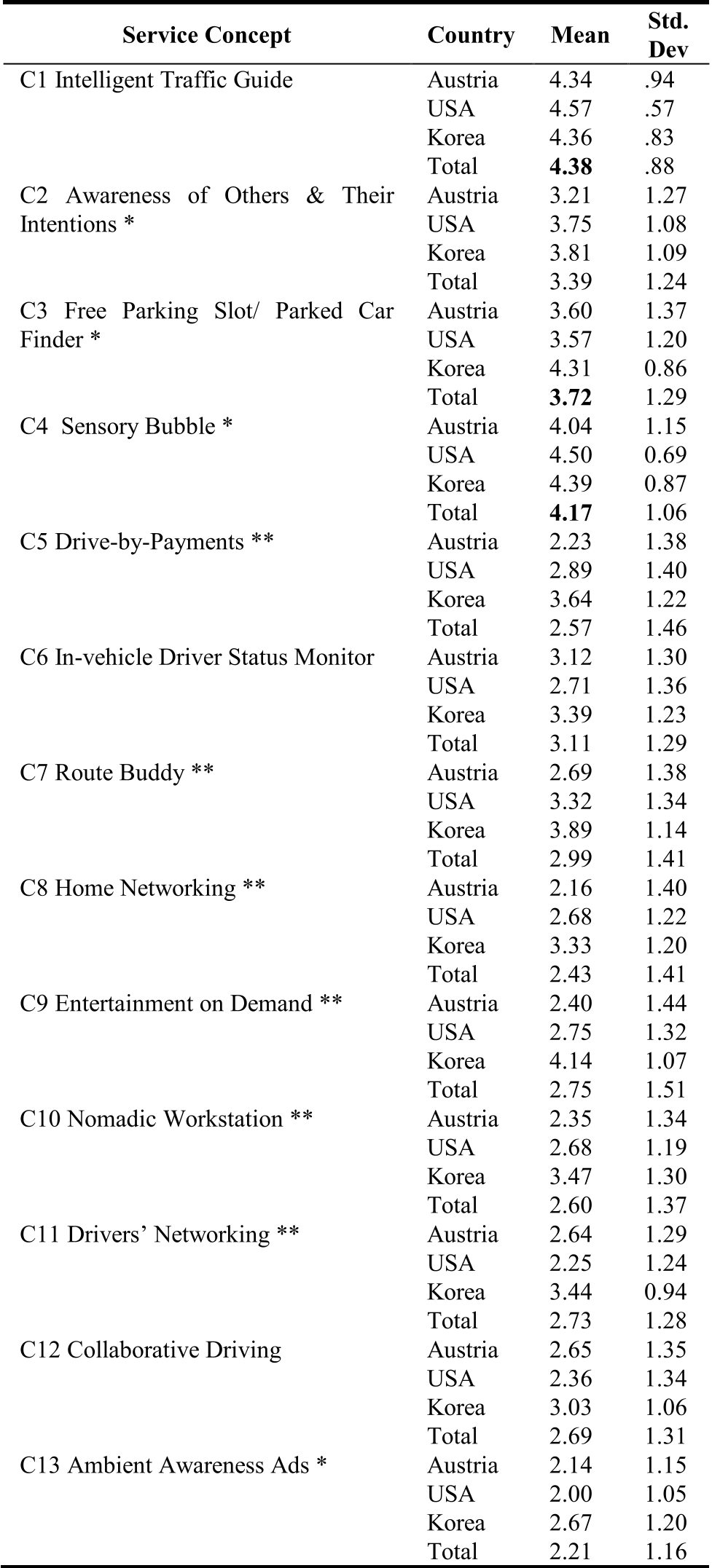
- The Safety Universal: Concepts like the Intelligent Traffic Guide (C1) and Sensory Bubble (C4) were top-rated across all countries. When it comes to survival, everyone wants the tech.
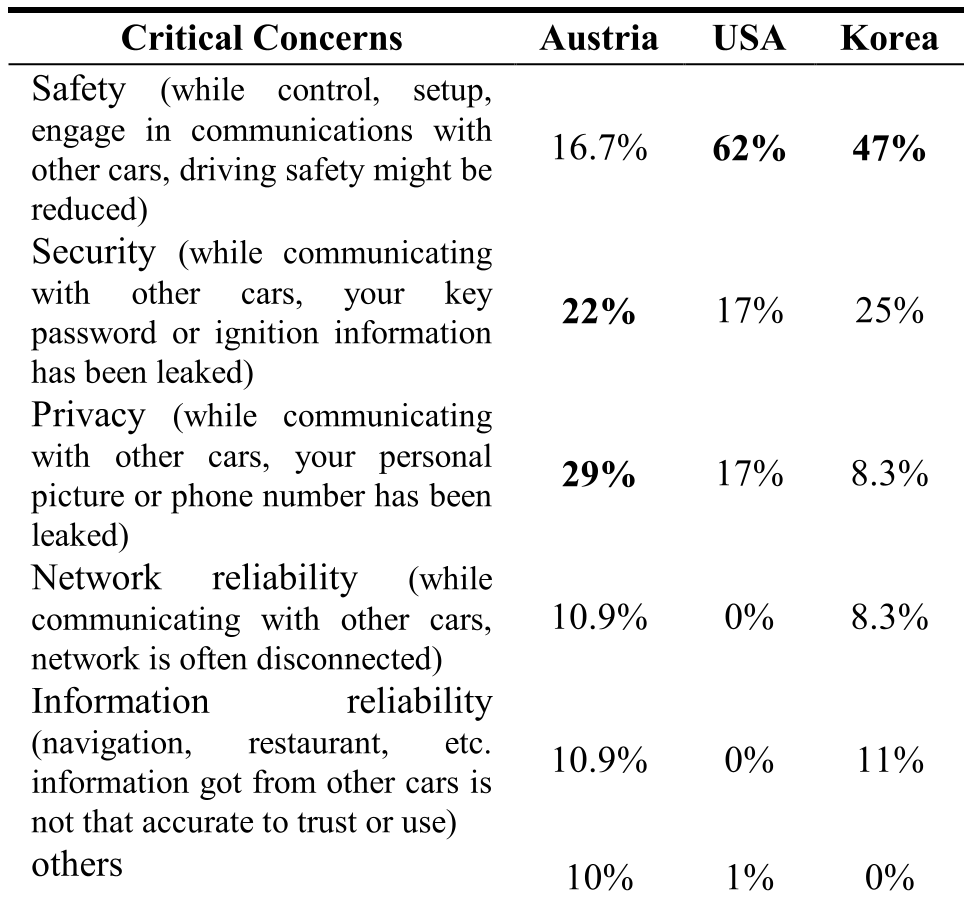
- The Privacy Barrier: 29% of Austrians cited Privacy as their biggest concern for V2V communication. In contrast, Americans and Koreans prioritized Safety (potential distraction) over data leakage.
- Local vs. Global Brands: Interestingly, while Koreans use global smartphones (iPhone), they strictly prefer local navigation brands (iNavi, Gini). This suggests that some in-vehicle services must be deeply localized to win market share.
Collaborative Driving & AI Agents
A fascinating segment of the study surveyed opinions on In-vehicle Agents. Drivers generally preferred humanoid, female-voiced agents (especially in Korea and the US), viewing the driving task as a collaboration rather than an independent chore. Korea led the charge here, with a 4.0/5.0 positivity rating for intelligent agents.
Critical Analysis: The Road Ahead
The paper's takeaway is clear: Context is King.
- In Korea, the car is an extension of the digital lifestyle—DMB (TV) and SNS integration are highly desired.
- In Austria, the car is a private sanctuary—high manual transmission use (96%) suggests a desire for control and a suspicion of proactive "black box" systems.
- In the USA, the focus is on utility—solving the "locked key" problem or receiving traffic updates via V2V.
Limitations: The study primarily focused on university-affiliated populations. Future research must expand to older generations to see if these cultural templates hold as the "digital native" cohort ages.
Conclusion
This work serves as a foundational "test bed" for Automotive UI. It reminds us that before we can achieve fully autonomous, interconnected roads, we must first master the cultural nuances of the humans sitting behind the wheel.