
Decoding the Global Psyche: How Deep Learning Maps Cross-Cultural Reactions to COVID-19
Cross-Cultural Polarity and Emotion Detection Using Sentiment Analysis and Deep Learning on COVID-19 Related Tweets
This study presents a cross-cultural sentiment and emotion analysis of COVID-19 related tweets using a two-staged deep learning architecture. By employing LSTM-based models with FastText and GloVe embeddings, it achieves state-of-the-art accuracy on the Sentiment140 dataset to track public reactions across six countries during the initial pandemic outbreak.
TL;DR
Researchers have developed a multi-stage LSTM framework to analyze nearly half a million tweets, revealing how different nations truly felt during the COVID-19 lockdowns. By breaking down "Positive/Negative" labels into six "Plutchik-inspired" emotions, the study highlights a profound truth: geographical proximity does not guarantee emotional alignment.
Background: A Planet Divided by a Pandemic
When COVID-19 struck, the world didn't just split by borders, but by psychological responses. While Pakistan and India shared high emotional correlations, the Nordic neighbors—Norway and Sweden—stood "poles apart" due to their drastically different governmental strategies. This paper investigates whether AI can accurately capture these cultural nuances through Natural Language Processing (NLP).
The "Why": Beyond Binary Sentiment
Most sentiment analysis tools tell you if someone is unhappy. But in a crisis, the type of unhappiness matters. Is the public afraid (leading to compliance) or angry (leading to social unrest)? The authors argue that understanding this distinction is crucial for policy-making.
Methodology: The Hierarchical LSTM Model
The researchers didn't settle for a simple classifier. They built a two-stage architecture:
- Stage 1 (Classifier A): Determined the Polarity (Positive vs. Negative) using an LSTM model enhanced by FastText embeddings.
- Stage 2 (Classifiers B & C): If positive, the model branched to detect "Joy" or "Surprise." If negative, it dove into "Sadness," "Fear," or "Anger."
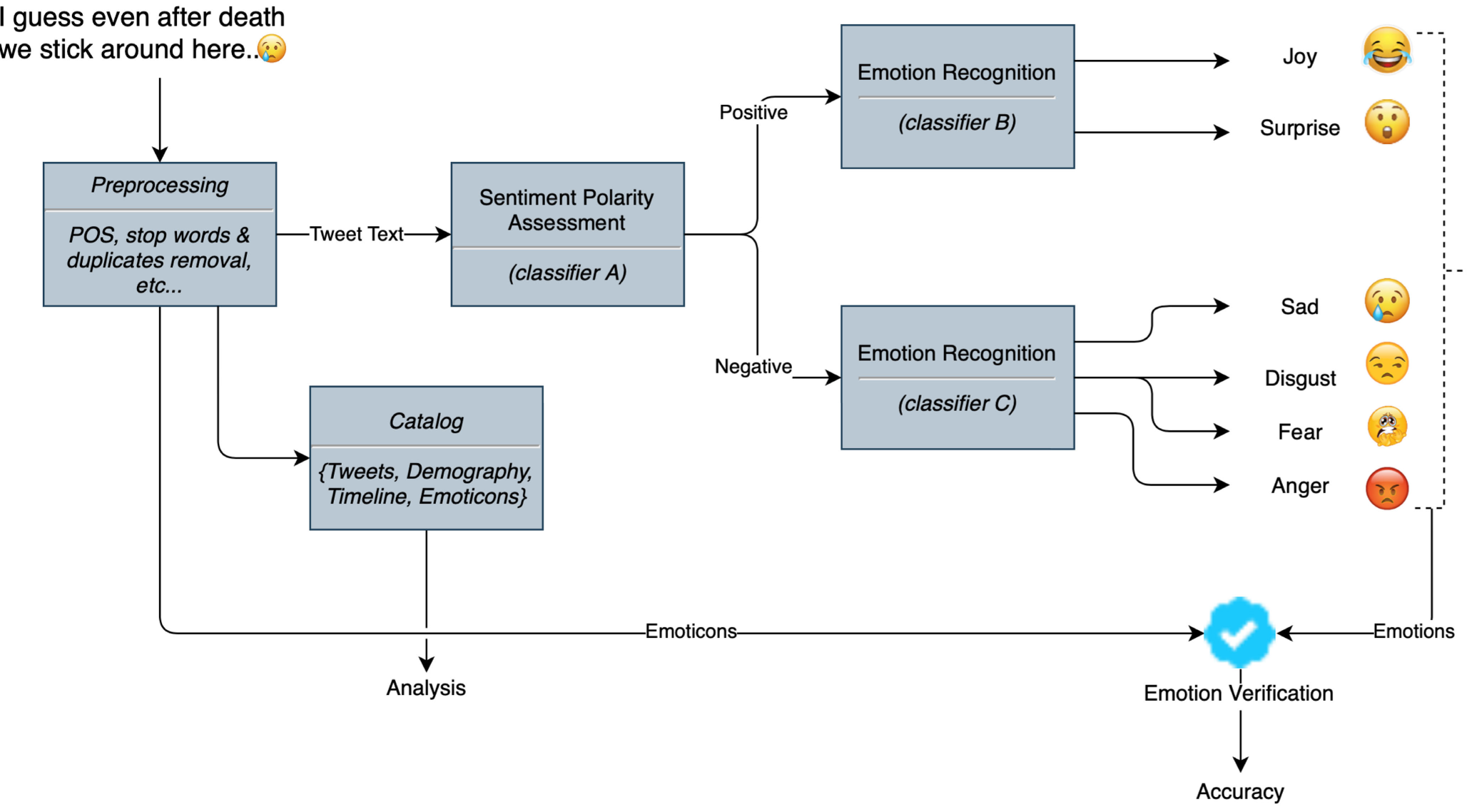
Interestingly, the study tested BERT and GRUs, but found that LSTM with specific pre-trained embeddings (FastText/GloVe) actually yielded superior results for this specific short-text Twitter task, highlighting that "newer" isn't always "better" for niche NLP applications.
Key Findings: The "Nordic Divergence"
The most striking result came from the comparison of Sweden and Norway. Despite sharing similar languages and histories:
- Sweden: Opted for "herd immunity." Public sentiment remained surprisingly positive and trusting for longer.
- Norway: Imposed a strict lockdown. Sentiment correlated much more closely with the rising/falling curves of positive cases.
- Correlation: The Pearson correlation for positive sentiment between them was a low 0.402, compared to a staggering 0.967 between the US and Canada.
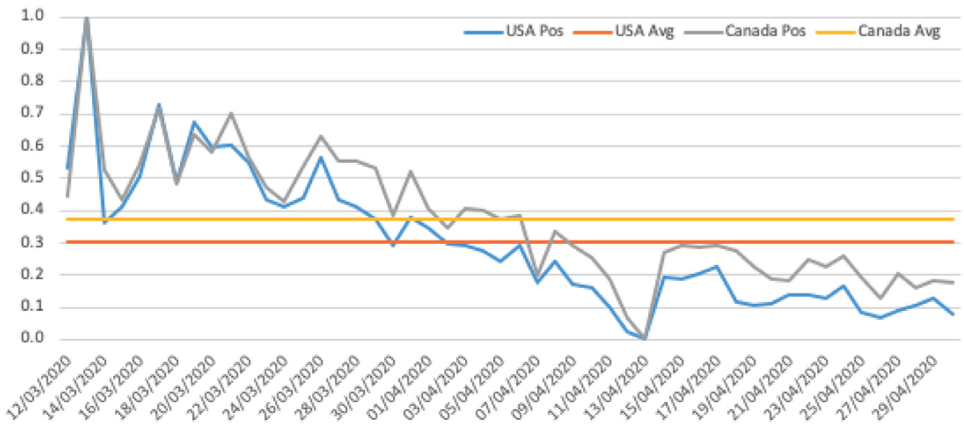
Innovative Validation: The Emoji as Truth
One of the paper's cleverest moves was using emoticons as a validation set. Since they lacked a "ground truth" for millions of COVID tweets, they used the presence of specific emojis (e.g., 😠 for anger, 😭 for sadness) to verify the model’s text-based predictions. The model achieved 76% accuracy in this "weakly supervised" test, proving it wasn't just guessing.
Critical Insight & Future Outlook
While the study is robust, it touches on a significant limitation: context and sarcasm. Cultural nuances like "Roman Urdu" or localized sarcasm remain "dark matter" for current embeddings.
Takeaway: This research proves that AI can act as a real-time thermometer for societal health. For future crises, governments might use such models to adjust their communication strategies—moving from "broadcasting" facts to "responding" to the specific emotional pulse of the people.
Theoretical Limitations to Note:
- Language Bias: The study focused only on English tweets, potentially missing the sentiment of non-English speaking populations in South Asia and the Nordics.
- Platform Specificity: Twitter users are not always representative of a whole nation's demographic.
Conclusion
By blending deep learning with cross-cultural psychology, this work elevates sentiment analysis from a simple marketing tool to a vital instrument for social science and crisis management.