
Digital Footprints of Nations: Measuring Cultural Distance via Twitter
Cross-Cultural Studies Using Social Networks Data
This paper introduces an automated framework for cross-cultural studies using Twitter data to quantify cultural distances between 22 countries. By analyzing the distribution of 17 million tweets across six news categories (Politics, Economics, Art, Sports, Science, and Tech), the authors successfully replicated and extended findings from traditional cultural dimension theories like Hofstede’s.
TL;DR
Researchers have moved beyond slow, biased questionnaires to map the "cultural distance" between 22 nations using 17 million tweets. By analyzing what news topics different countries talk about—from Politics to K-Pop—this study proves that social media data correlates strongly with decades of sociological theory (Hofstede’s Dimensions) while providing 100x more data points.
The "Self-Enhancement" Problem in Sociology
For decades, cross-cultural psychology has been stuck in a "survey trap." When you ask someone, "How much do you value social hierarchy?" they often suffer from the positive self-enhancement illusion—they answer based on who they want to be, not who they are. Furthermore, traditional studies are small (rarely exceeding 1,200 participants per country) and plagued by translation errors that can decouple the meaning of a question across languages.
The authors of this paper argue that social networks offer a "normal state" environment. People tweet about what genuinely interests them, providing a raw, unfiltered look at a nation's collective psyche.
Methodology: From Tweets to Cultural Vectors
The framework operates as a sophisticated pipeline that turns "noise" into "distance."
1. Classification & Translation
Because the data is multilingual, the authors translated all tweets into English (the most stable target for NMT). They used a Multinomial Naïve Bayes classifier—a robust choice for "short text" where word relationships are sparse—to categorize tweets into six pillars: Politics, Economics, Art & Entertainment, Sports, Science & Health, and Technology.
2. The 7D Cultural Space
Each country is represented by a distribution vector. If 27% of a country's tweets are about Art (like the USA) and only 12% in others, they move further apart in this multi-dimensional space.
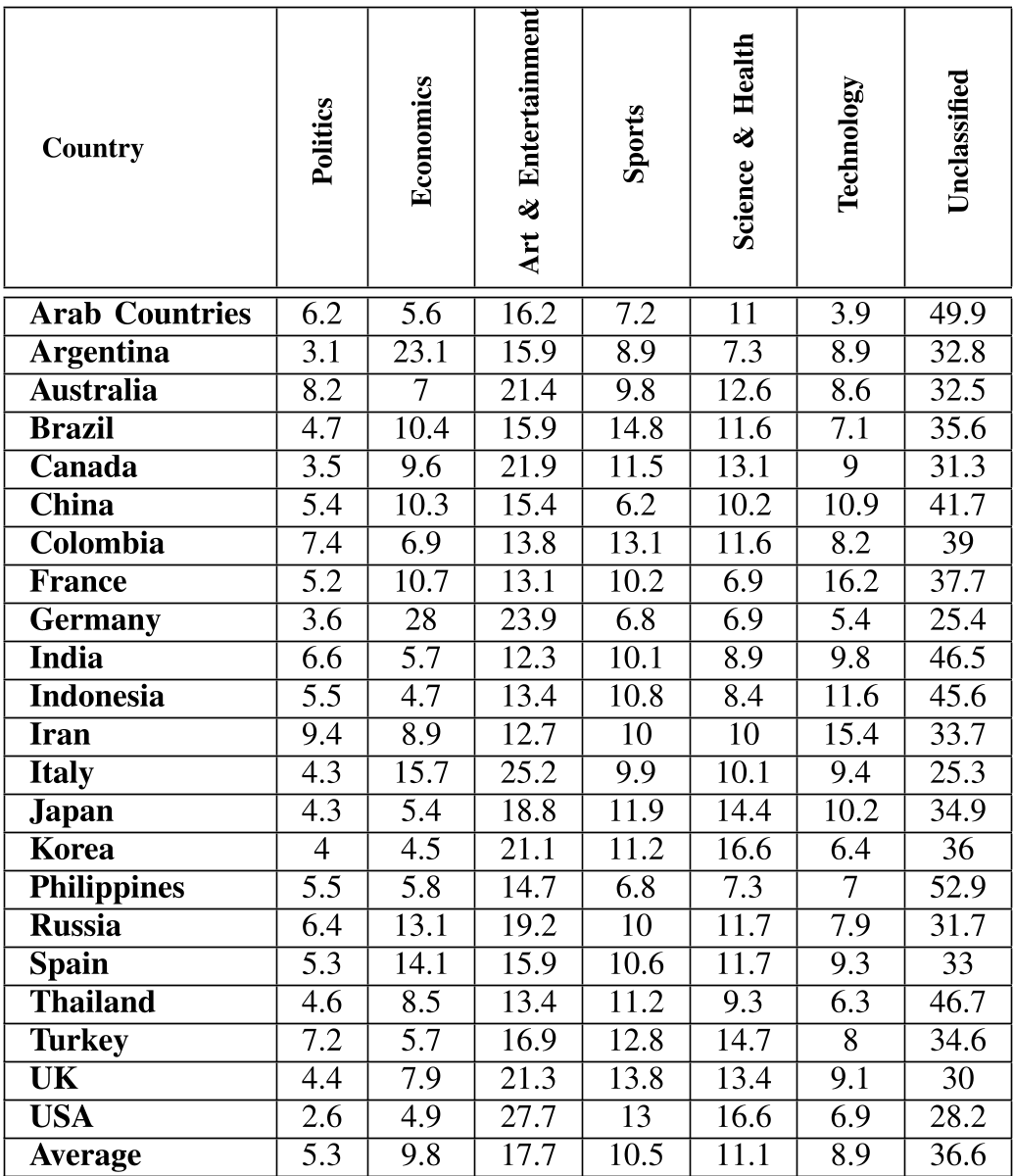 Table: The distribution of news-oriented tweets across 22 countries, forming the basis for cultural vectorization.
3. Calculating Distance
The "Cultural Distance" (CulD) is derived using the Euclidean distance between these vectors:
Experiments: Validating the Digital Mirror
The authors validated their digital metrics against the "Gold Standard" of sociology: Hofstede’s Cultural Dimensions.
Key Discoveries:
- The Art-Individualism Link: There is a massive 0.72 correlation between Hofstede’s Individualism index and interest in Art & Entertainment. Individualistic societies tend to use social media as a platform for creative self-expression.
- Power Distance vs. Art: Countries with high Power Distance (stronger social hierarchies) showed significantly less interest in tweeting about Art (correlation of -0.62).
- The Science-Sports Tradeoff: Interestingly, a high interest in Science & Health was negatively correlated with Sports interest (-0.66).
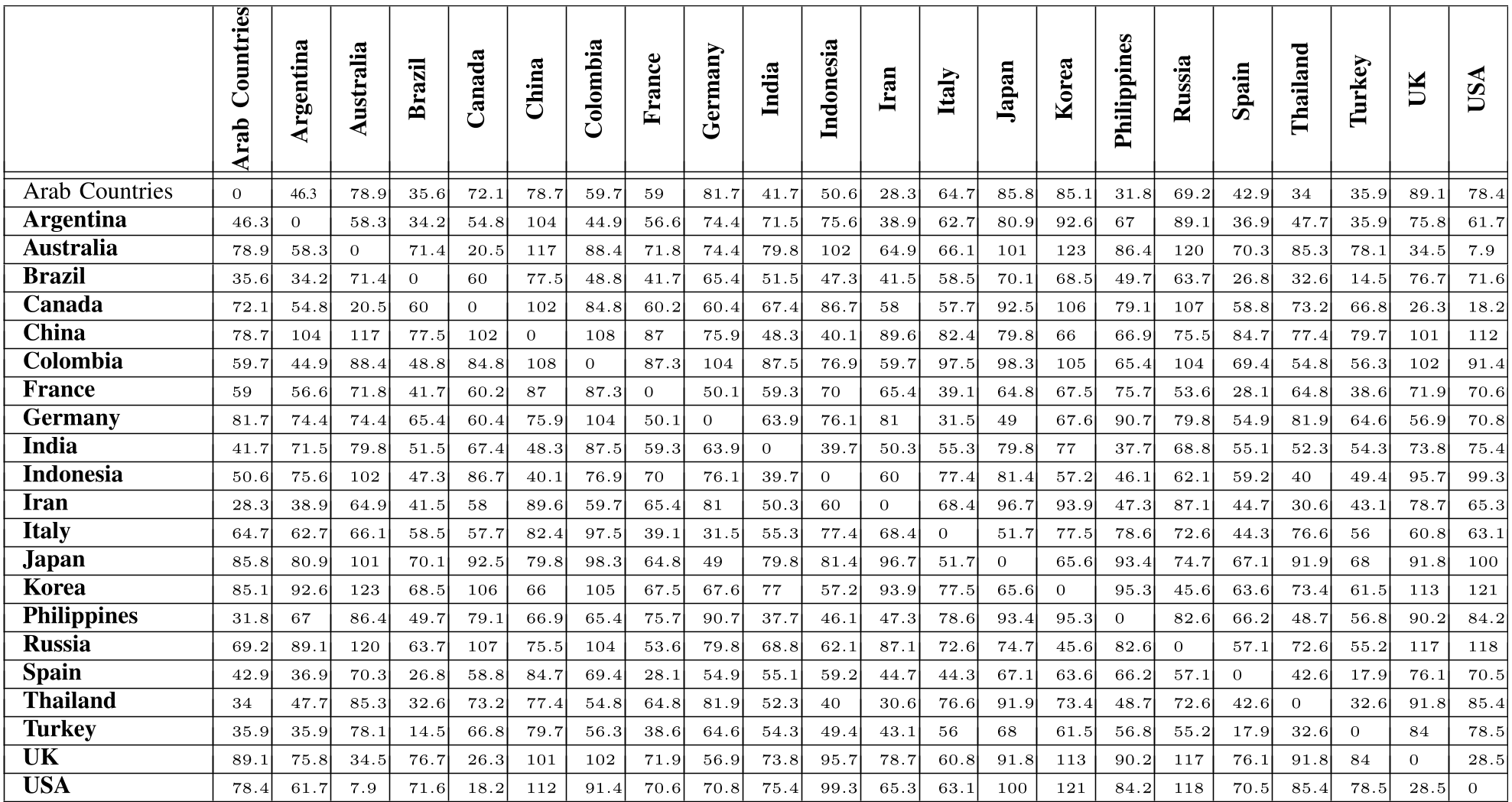 Table: The finalized Cultural Distance matrix between 22 nations, generated entirely from social media behavior.
Critical Insight: Why This Matters
The most profound takeaway is the proof of legitimacy. Despite the informality and "noise" of Twitter, the results showed a positive correlation with traditional scores across all 22 countries studied. This suggests that "Digital Proxies"—using automated scrapers to replace human surveys—are no longer a fantasy but a valid statistical tool.
Limitations & Future Work
While powerful, the study hit a "geolocation wall": only 5% of tweets have GPS tags. Identifying a user's country remains the bottleneck. Future iterations could leverage LLMs to better understand the sentiment behind the news topics, rather than just the frequency of the topics themselves.
Conclusion
This paper bridges the gap between Big Data and Social Science. It proves that our online behaviors are not just random "likes" and "retweets" but are deeply anchored in the cultural dimensions established by decades of prior academic research.