
Cross-Domain Semantic Transfer: Bridging the Gap in Social Media Multimedia
Cross-domain semantic transfer from large-scale social media
The paper introduces a cross-domain semantic modeling framework for automatic image annotation in Location-Based Social Networks (LBSNs). It leverages large-scale, heterogeneous User-Generated Content (UGC) from platforms like Foursquare and Flickr to bridge the gap between visual information and uncorrelated textual tips using an Adaptive SVM-based semantic transfer mechanism.
TL;DR
In the landscape of Location-Based Social Networks (LBSNs), images and text are often ships passing in the night—uncorrelated and independent. This paper proposes a robust framework that extracts "hot topics" from textual tips, filters out irrelevant "noisy" photos using part-based detection, and employs a sophisticated social-to-social semantic transfer method using Adaptive SVMs to automatically annotate images, turning raw pixels into actionable insights for personalized recommendations.
The Motivation: The "Silence" of Social Images
When you check into a restaurant on Foursquare, you might upload a photo of your steak and leave a separate tip about the "spicy beef soup." The problem? The system doesn't inherently know that your photo is a steak.
Existing challenges include:
- Data Asynchrony: Visual and textual data are uploaded independently.
- Label Scarcity: Manual annotation for millions of user-generated photos is impossible.
- Domain Noise: Many social photos are high-noise (e.g., selfies blocking the venue) which degrades semantic discovery.
Methodology: The Three-Pillar Architecture
The authors break the problem into a logical pipeline that moves from noisy text to refined semantic concepts.
1. Textual Insight & Hot Topic Extraction
By collecting tips from Foursquare, TripAdvisor, and Wikipedia, the system uses TF-IDF and a Random Walk-based graph to identify the most relevant keywords for a venue. This ensures that the "semantic vocabulary" is grounded in real-world user interests.
2. Intelligent Noise Filtering
Instead of treating all photos as equals, the authors argue that "selfie-heavy" photos are noise for venue semantic discovery. They utilize a Part-Based Detection Model to calculate the area occupied by humans. If a person covers >25% of the frame, the image is discarded as "low-relevance."
 Figure 1: The holistic framework of the automatic image annotation system.
3. Cross-Domain Semantic Transfer
This is the "secret sauce." The authors leverage Flickr as an auxiliary domain because it already contains tagged images. They use an Adaptive SVM (A-SVM) approach:
- Train auxiliary classifiers on large-scale Flickr data.
- Learn a "delta function" () using a small labeled set from the target domain (Foursquare).
- Construct an Ensemble Classifier that combines the broad knowledge of the auxiliary domain with the specific nuances of the target domain.
Experimental Results: Proving the Power of Transfer
The researchers tested their method on a dataset involving 81,165 venues in Singapore. The results clearly show that the "Collaborative" approach (combining local Foursquare data with Flickr ensembles) yields the best results across almost all food-related categories.
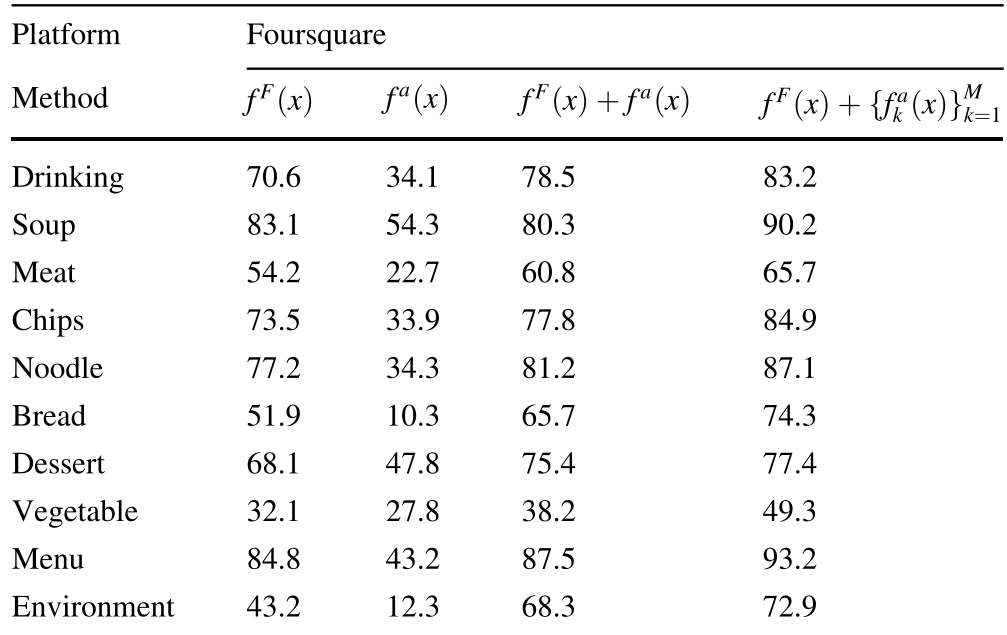 Table: Comparison of different modeling methods on Foursquare.
Key Findings:
- Precision Boost: For the "Menu" concept, the proposed ensemble method achieved a staggering 93.2% precision.
- Filtering Efficiency: The Part-based model achieved a 98.2% precision in human detection, significantly higher than the standard HOG (Histogram of Oriented Gradients) baseline.
Critical Analysis & Future Outlook
While this paper was pioneering in its approach to "Social Media Transfer," its reliance on Bag-of-Words (BoW) and LBP features dates it slightly compared to today's Deep Learning models. However, the logic of transfer—using one rich social domain to fix a sparse one—remains highly relevant.
Future Research Directions:
- Integrating deep feature extractors (like ResNet or Vision Transformers) into the Adaptive SVM framework.
- Applying these cross-domain transfers to real-time mobile augmented reality (AR) where venue information must be served instantly based on a camera feed.
In conclusion, this work demonstrates that social media isn't just a collection of silos; by cleverly transferring semantic knowledge across platforms, we can build a much more intelligent and personalized user experience.